
Introduction
Having already tested the newer Phantom 5 OC and Phantom 5.5, I spotted this 2022 Phantom 5S in the Auchterlonies second-hand store and wondered if it might sit somewhere between the two.
The 5 OC exceeded my pre-test expectations. The 5.5 disappointed. But was that down to the head shape, the shaft position, or some combination of both?
That was the question that made this older 5S interesting.
First Impressions
When I first picked this up, I immediately liked the way it sat behind the ball. It felt comfortable straight away.
That doesn’t always happen.
As we will come on to later, I think that has a lot to do with how the shaft attaches to the head. The shaft enters directly into the thicker blade section, with the alignment line sitting just above it. That gives a very clear relationship between the shaft, the face and the sightline.
It immediately reminded me of my SeeMore putters, which was a big positive.


This is an older Scotty Cameron model from two releases back, around 2022 to 2023. It has the solid alignment line that I like, and it also has a fully milled face rather than the insert used on the new models. It’s not completely face-balanced either, with around 10 to 15 degrees of toe hang.
The fangs are subtly different from the latest model, as shown in the alignment section below. I actually found them less distracting on this older version.
That was a surprise.
Specification (as tested)
Total weight: 584g (on the heavy side)
Head weight: undeclared, 2x15g head weights
Swing weight: D9
Length: 34”
Loft: 3.5° (+/-1°)
Lie: 70° (+/-2°)
Toe Hang: Minimal 10-15°
Grip: Scotty Pistolero Plus
As this was a second-hand buy, it could be adjusted for length and lie in the store, but changing the length would likely require a new grip.
Protocol Snapshot (How I Tested It)
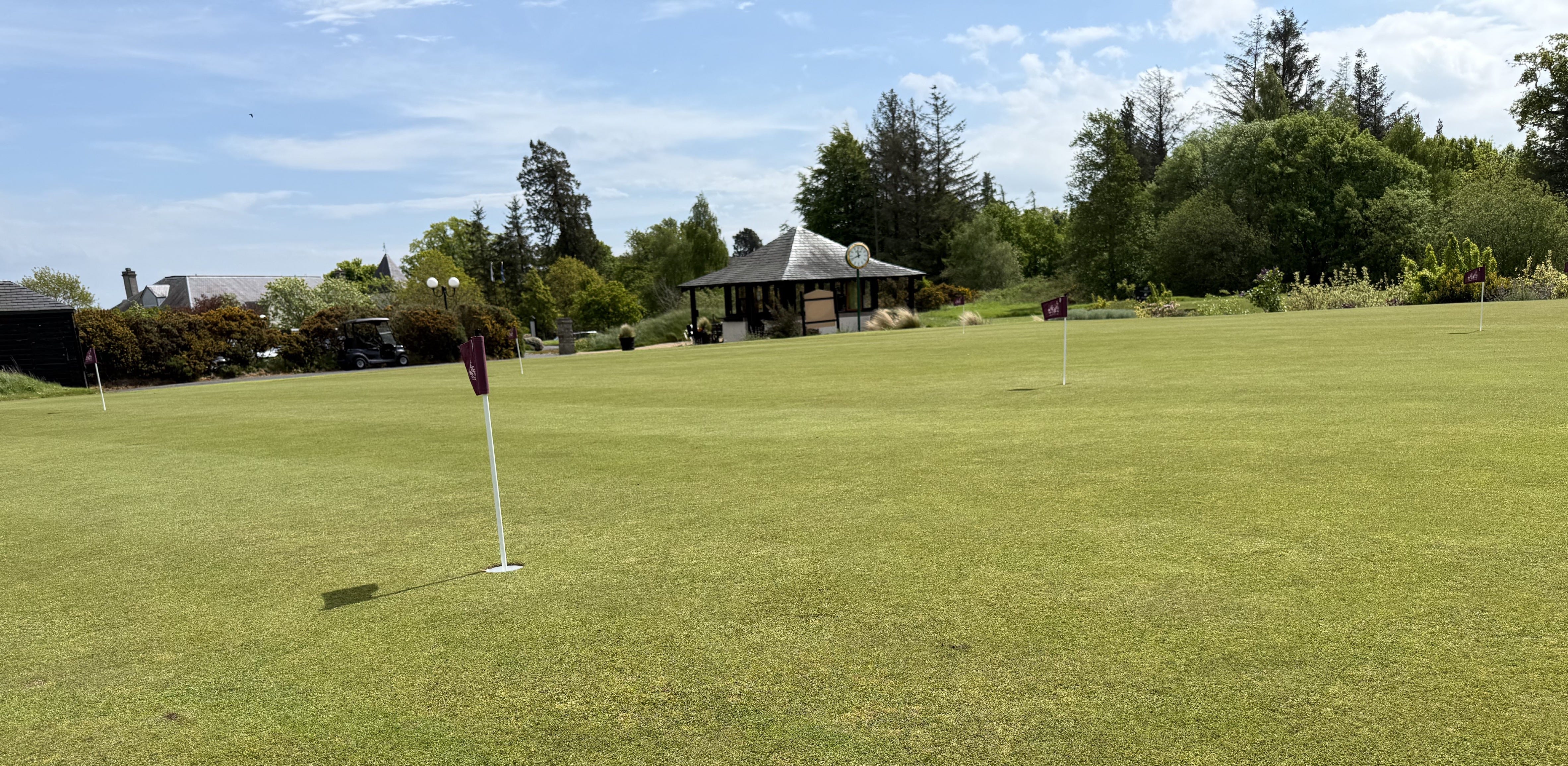
Surface: Practice green at Craigtoun Course
Conditions: A lovely May day with warm sunshine but a stiff breeze. The wind was strong enough to need factoring in to putts.
Make Test: 6 putts x 3 reps from 3, 6, 9, 12, 15 ft
Lag Test: 40 ft to 3 ft - uphill and downhill - run once
Start Line: Gate drill (two tees at 18 inches ahead, gate only just wider than a ball)
Benchmark: SeeMore Nashville mFGP
Full testing framework: HERE
How Did It Perform?
Notes
The practice green at Craigtoun Course was in great condition and rolling nicely. It was a lovely day for testing, although the breeze was stiff enough to need taking into consideration.
After my other centre-shafted testing, I was intrigued to see how the 5S would perform. It is at the heavier end of my comfort zone, which took a bit of getting used to, but once I settled into it, I found it a very enjoyable putter to use.
The caveat is obvious: this was a single practice-green session in breezy conditions. I would want to repeat the test and get it onto the course before drawing firmer conclusions.
Pros and Cons
Looks (+ve): I much prefer this older model to the current version. I find the fangs visually less noisy, and I was immediately more comfortable with this head.
It is a second-hand putter, but it has been well looked after and is in great condition. At £300, I wouldn’t expect anything less, though.
Grip (+ve): The Pistolero Plus grip sits very nicely in my lead hand and feels comfortable. I like a lot of the Scotty Cameron grips, and this one suited the putter well.
Headcover (-ve): A familiar complaint in my Scotty Cameron reviews.
As this is second-hand, I can’t complain too much, but Scotty Cameron really could do better with headcovers. I recently saw someone selling magnetic conversion kits, but they are only going to work if the Velcro is still in good condition.


Aim/Alignment (+ve): This is the main point of the review.
The similarity to my SeeMore putters made me very comfortable. The shaft enters directly into the thicker blade section, with the sightline sitting just above it. That combination gives me a very clear visual relationship between shaft, face and alignment.


The start-line result was solid, although just behind the SeeMore. That feels about right. The 5S gave me a very comfortable visual picture, but the SeeMore remains the benchmark for alignment and start line.
If there is one thing to come from this review, it’s that when it comes to centre-shafted putters, I seem to prefer this style of shaft attachment.
The BB-28 and Pippi 12 helped me clarify that centre-shafted putters can suit me, but this was different. The Phantom 5S felt more natural because the shaft, blade section and alignment line all worked together in a way my eyes understood quickly.
I don’t think I just like centre-shafted putters.
I think I like centre-shafted putters where the shaft enters the front section of the head directly, and where the alignment help sits close to the face.
That’s an important distinction.
Feel and Sound (+ve): It was really nice to go back to an older, fully milled Cameron head and get that familiar sound and feel.
Interestingly, I’ve always preferred the feel of Scotty Cameron mallets rather than their blades. It must be something to do with the extra mass. There is a solidity to the strike that I really enjoy, without it feeling too hard or clicky.
Pace Control (+ve): It’s a heavy putter, but my pace control was good.
It took a little while to adjust to the weight, but once I did, the 5S performed well. Uphill lag putting matched my SeeMore, and downhill it was only slightly behind. If anything, I felt more comfortable with the 5S than my SeeMore on the lag test.
That was similar to my experience with the 5 OC, where I also found pace control to be strong.
Performance Overall (+ve): The performance was strong enough to make the test feel meaningful rather than just interesting.
The Phantom 5S was very steady through the make test. From 3ft, 6ft and 9ft, the results were exactly where I would want them to be. The 12ft test was the only slightly odd one, with a poor middle set followed by a recovery, but that feels more like normal putting variance than a major concern.
It didn’t beat the SeeMore overall, and the start-line test still slightly favoured my gamer, but the 5S was close enough to make me want more time with it. That’s probably the fairest conclusion from one practice-green session.
It combined some of what I liked about the 5 OC with some of what I hoped to like about the 5.5. It had stability, a little more natural flow than I expected, and a visual setup that felt much more familiar.
Unfortunately, this one had to be returned to the shop because another customer was interested, so I didn’t get the chance to try it on the course under scoring pressure.
Price (neutral): At £300, this is still pretty expensive for a three to four-year-old putter.
That said, it’s also a good example of how well Scotty Cameron putters tend to hold their value. If you buy carefully, there is usually a decent resale market, which makes experimenting with second-hand models slightly less painful.
What does Vertex say?
Vertex testing was done indoors on my putting mat.
Face at impact: With an average of 0.9° open with 83% consistency, this was pretty much in line with my normal results.
Tempo: 1.8 with 97% consistency. Despite my comments about getting used the the weight, this was a very positive result.
Acceleration: 1.7 meters per second squared with lower consistency at 70%. That may well be down to getting comfortable with the heavier feel.
Lie angle at impact, shaft lean at impact, and loft angle at impact were all within the Vertex target ranges, suggesting a good physical fit.
Conclusion
The Scotty Cameron Phantom 5S was another positive surprise.
It didn’t replace my SeeMore, and I didn’t get the chance to take it on the course under scoring pressure, so I need to be careful not to overstate the result. But as a test, it was genuinely useful.
The 5S helped me understand why some centre-shafted putters suit my eye better than others. It isn’t just about the shaft being in the middle. It is about how the shaft enters the head, where the alignment line sits, and whether my eyes are encouraged to aim from the face rather than from the back of the putter.
That’s where this older Phantom 5S worked so well.
It gave me some of the stability I liked in the 5 OC, a little of the natural flow I wanted from the 5.5, and a visual setup that felt much closer to my SeeMore putters.
Fit verdict (for me)
Would I game it tomorrow? Not quite, but only because I didn’t get enough time with it. I would definitely be interested in finding another one for more comprehensive testing.
What would I change? The fangs. Even though I found them less distracting on this older model, I still think they would be an easy target on bad putting days.
What have I learned? I like centre-shafted putters, but the way the shaft attaches to the head and the way alignment lines are used really matters. The Phantom 5S helped clarify that I prefer a direct shaft-to-face relationship, with the sightline close to the front section of the putter.
You can find all my other putter reviews, including my other Phantom reviews, by clicking the link below.
If you found this review useful, hitting the like button helps more people find it.
If you value independent testing and would like new reviews sent directly to your inbox, then please subscribe. It’s free, and you can cancel at any time.
Links:
Full testing framework: here
All my other putter reviews: here
A really good looking putter Keith!!