

This is the framework I use to keep my testing repeatable, my comparisons fair, and my conclusions grounded in real-world putting. I try to go beyond first impressions and put each putter through the same routine, so comparisons stay honest, and the conclusions stay earned.
The goal is a consistent format you can trust. You should be able to compare reviews, understand why something worked (for me) or did not, and decide whether it fits your eye and your stroke.
This post is pinned to the top of On The Green so you can find it again easily.
What this framework is, and isn’t
It is
A repeatable routine used across my putter reviews
A blend of performance data and transparent subjectivity: looks, feel, confidence
A way to compare each putter against my current gamer, in the same session, on the same greens, rather than reviewing it in isolation
It isn’t
A promise that my best putter is your best putter
A lab-style test that ignores how putting works in practice, because comfort matters and performance shifts under pressure
The core idea
My reviews follow the same structure, so you can skim or go deep.
Context and first impressions (shape, setup, weight, alignment cues)
Standard protocol results (make rate, pace control, start line)
Pros and cons (separating performance from everything else)
Conclusion (fit, trade-offs, who it suits)
The standard protocol
1) The Make Test, plus pace control
This is the backbone.
Six putts
Repeated three times
From five distances, typically 3, 6, 9, 12 and 15 feet (my makeable range)
I also include a 30-foot lag test, focused on pace control and leave quality.
EDIT: Feb ’26: The lag test has changed to a 40-foot test and is conducted with both an uphill and a downhill putt. The aim is the same: try to leave within a 3-foot radius.
Expectation management: I include PGA Tour make rates (Mark Broadie, Every Shot Counts) at similar distances to anchor what “good” looks like. One limitation is that Broadie’s published splits jump in five-foot increments from ten feet, so twelve feet is not a perfect match.
2) The Start Line Test, face control
This is a classic Dave Pelz drill. If a putter cannot start the ball where you are aiming, nothing else matters.
Simple setup
Find a short, straight putt
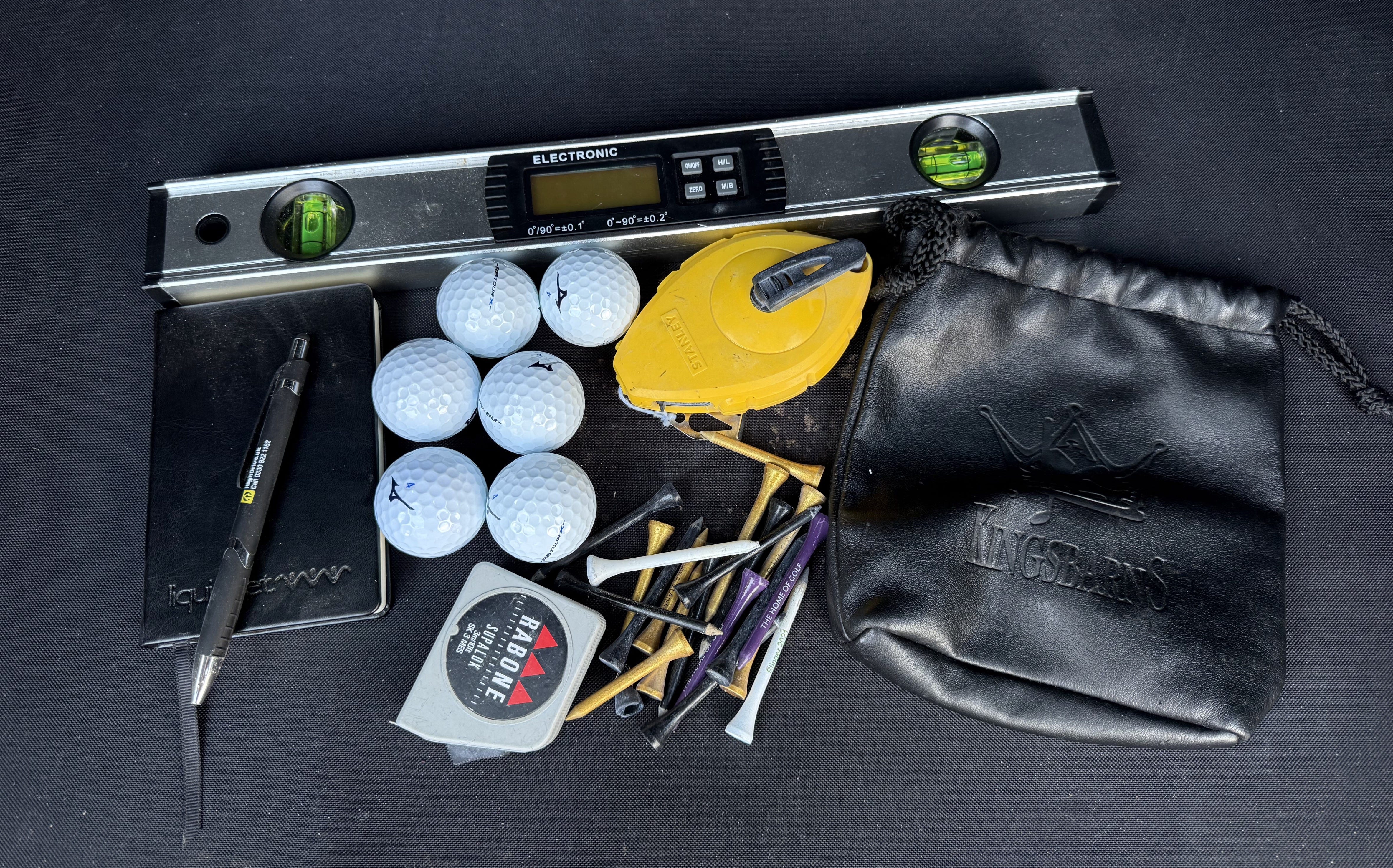
Around 18 inches in front of the ball, insert two tees into the ground to create a gate that is only just wider than a ball
Putt through the gate
It is a simple test that quickly shows whether the ball is starting where you think you aimed it. If the ball hits the right-hand tee, the face is open. If the ball hits the left-hand tee, the face is closed.
The benchmark rule
My current gamer is always the benchmark. It is in the bag because, today, I believe it is the best putter for me.
In 2025, the benchmark started as a Toulon Garage Atlanta. Later that year, I put a SeeMore MiniGiant FGP through the protocol, and it did enough to displace the Toulon. It’s a bit like “winner stays on” when playing pool.
The putter under test completes the full protocol, while the benchmark putter (usually) runs the protocol once. Is that biased in favour of the gamer? Possibly. It also reflects reality, where familiarity is an advantage.
Testing environment
Every review is conducted on a real putting green. I describe conditions, including green quality, weather, and anything quirky about the location, because those details shape the results.
Historic testing has taken place on either St Andrews Links practice greens or at The Craigtoun Course (formerly The Duke’s), although a new green may be added.
What I’m evaluating
Performance
Make rate at short and mid-range distances
Pace control on lags
Start line consistency through the gate
Aim and alignment
Whether the head shape, alignment lines, and visual framing help or hinder.
Feel and sound
Subjective, but I try to describe it consistently. Feel matters because it influences pace control and confidence. I often prefer a milled face, but I still want the results to earn the verdict.
Weight and balance
Anything that forces me to change how I putt, or makes me manufacture a stroke to suit the putter. This became clearer when testing some zero-torque models.
Practicalities
Often captured in pros and cons.
Grip comfort
Headcover usability
Adjustability and customisation
Price and resale, especially in the UK second-hand market
How to interpret my conclusions
When I say a putter is good, I usually mean one of two things.
It performs well in the protocol and could replace my gamer
It is a strong product, but it does not match my stroke, preferences, or eye
I also flag when a putter improves as I adapt, and whether that adaptation feels reasonable or like I am forcing a relationship. Traits tend to reassert themselves under pressure. Not ideal on a downhill, left-to-right five-footer for par.
This framework is my way of staying honest. Same routine, same benchmark, and a clear record of what happened. If you have ideas for improving it, I’d like to hear them in the comments. And if you want new reviews when they land, you can subscribe.
All putter reviews can be found within the On The Green section of the website
Very good protocol, Keith. Thanks for sharing. Only suggestions I have would be do uphill and downhill 30 foot putts and maybe also 40 foot uphill and downhill putt. 👍👍😀😀