

Introduction
Over the last few years, I’ve become increasingly interested in golf biomechanics as I attempt to understand how my body moves during the golf swing. I’ve already written about my experiences with SportsBox AI, and more recently my speed training with James Tait has made me think carefully about how my body produces speed and how efficiently I use it.
Over the last couple of years, I’ve experienced a succession of physical problems, including ankle injuries, tendinosis in both elbows and issues with my right hip. Getting older doesn’t come alone, and at 57 I’m increasingly aware of my physical limitations. While I want to keep improving my golf, I also want to continue playing for another twenty or thirty years. That requires listening to my body while understanding and accepting what it is telling me!
Am I moving in ways that place unnecessary stress on my body? Am I unconsciously compensating for certain physical limitations? How do I get the most out of the body I’ve got without risking further injuries?
Recently, I listened to an interview with Michael Neff, the founder of GEARS, on the Don’t Get Me Started podcast (an excellent podcast). One thing that struck me was his discussion about experienced coaches turning to GEARS when they couldn’t fully understand what was happening in a player’s swing.
It made me wonder what GEARS could tell me about my swing and prompted me to investigate whether anyone in Scotland was using GEARS. That led me to Oli Morton at the excellent Archerfield Performance Centre in East Lothian. Is there something about my swing that I’ve previously missed, or would GEARS simply confirm what I already know? Perhaps more worryingly, would it open Pandora’s Box and give me a whole new collection of swing faults to worry about?
What Is GEARS?
GEARS stands for Golf Evaluation and Research System, and it was developed by Michael Neff, an American PGA professional and golf coach. The system was launched in 2014, following several years of development, with the intention of bringing 3D motion-capture technology, previously largely confined to research environments, into golf coaching and club fitting.
The system uses multiple cameras and motion-capture sensors to create detailed 3D representations of both the golfer and the club throughout the swing. The technology is similar to that used by filmmakers to animate characters, although its application in golf goes considerably beyond creating an animated representation of the swing. GEARS measures how the body and club move and interact, providing information that can be used for both swing analysis and equipment fitting. Billy Horschel is a fan of the system and credits working with Neff for identifying equipment issues that were impacting his iron play.
The Archerfield Experience
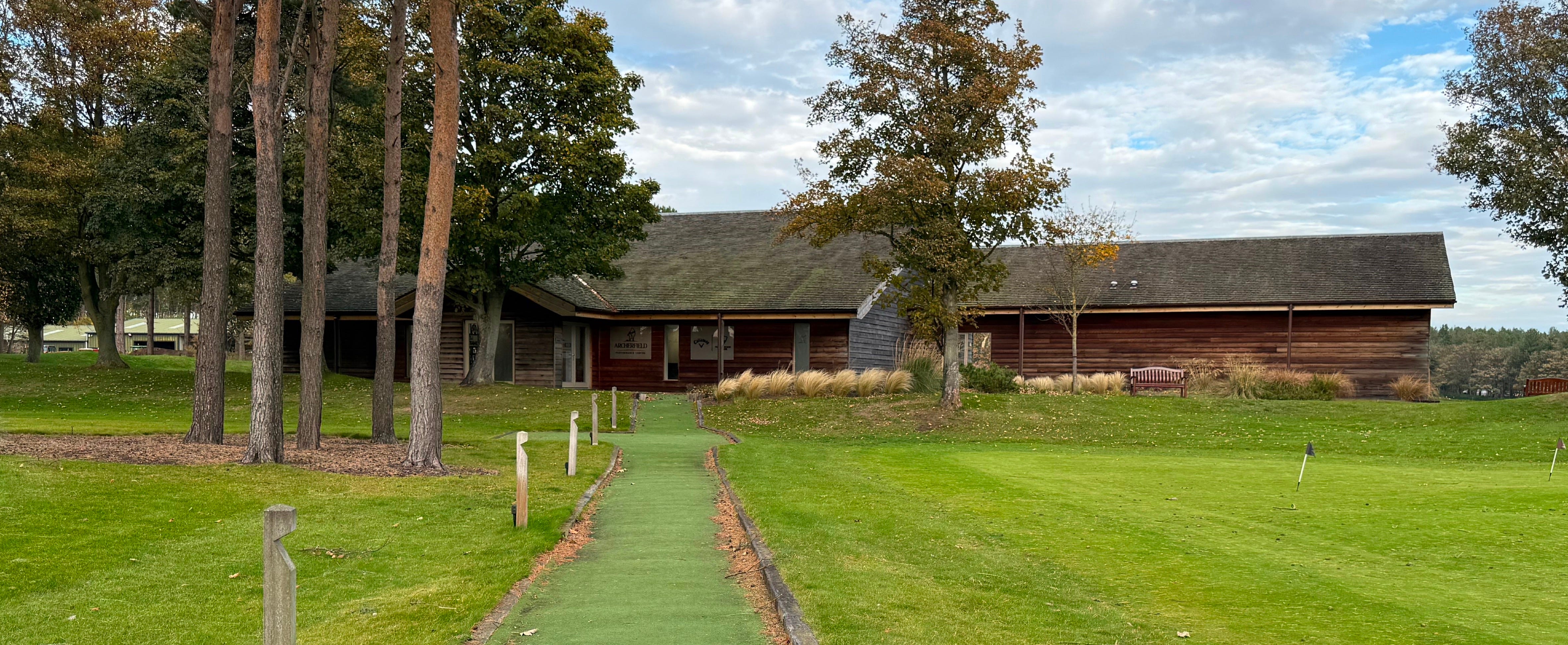
Before travelling to Archerfield, I had a thirty-minute video call with Oli to discuss the process, my objectives and how we might work together beyond the initial assessment. Oli offers several coaching packages, including in-person, remote and hybrid options, and we talked through the different approaches and their costs. For this session, though, I wasn’t really looking for a conventional golf lesson; I wanted to understand my biomechanics and how my body was functioning during the swing. We would make a decision on further coaching afterwards.
Oli has an impressive coaching background, including experience working with Gary Nicol and Pia Nilsson, but what appealed to me most was his approach to the whole golfer rather than simply the technical aspects of the swing. That became apparent when we met at Archerfield and spent time discussing our thoughts around golf improvement, coaching and how people learn.
The session was scheduled to last up to three hours, and started with a TPI physical screening. For anyone unfamiliar with TPI, the Titleist Performance Institute has developed a series of assessments designed to identify physical characteristics and limitations that may influence how a golfer moves. Given my recent injuries, this was an important part of the experience.
I scored 28, which Oli described as a very good result, particularly as he is a very strict assessor! My general mobility was good, and there was nothing particularly alarming. The tests did point to some issues that would become more apparent later. In particular, my single-leg balance, lower-quarter rotation, seated trunk rotation and wrist hinge. Given my recent injury problems, this was actually an encouraging start to the session.
Getting Wired Up
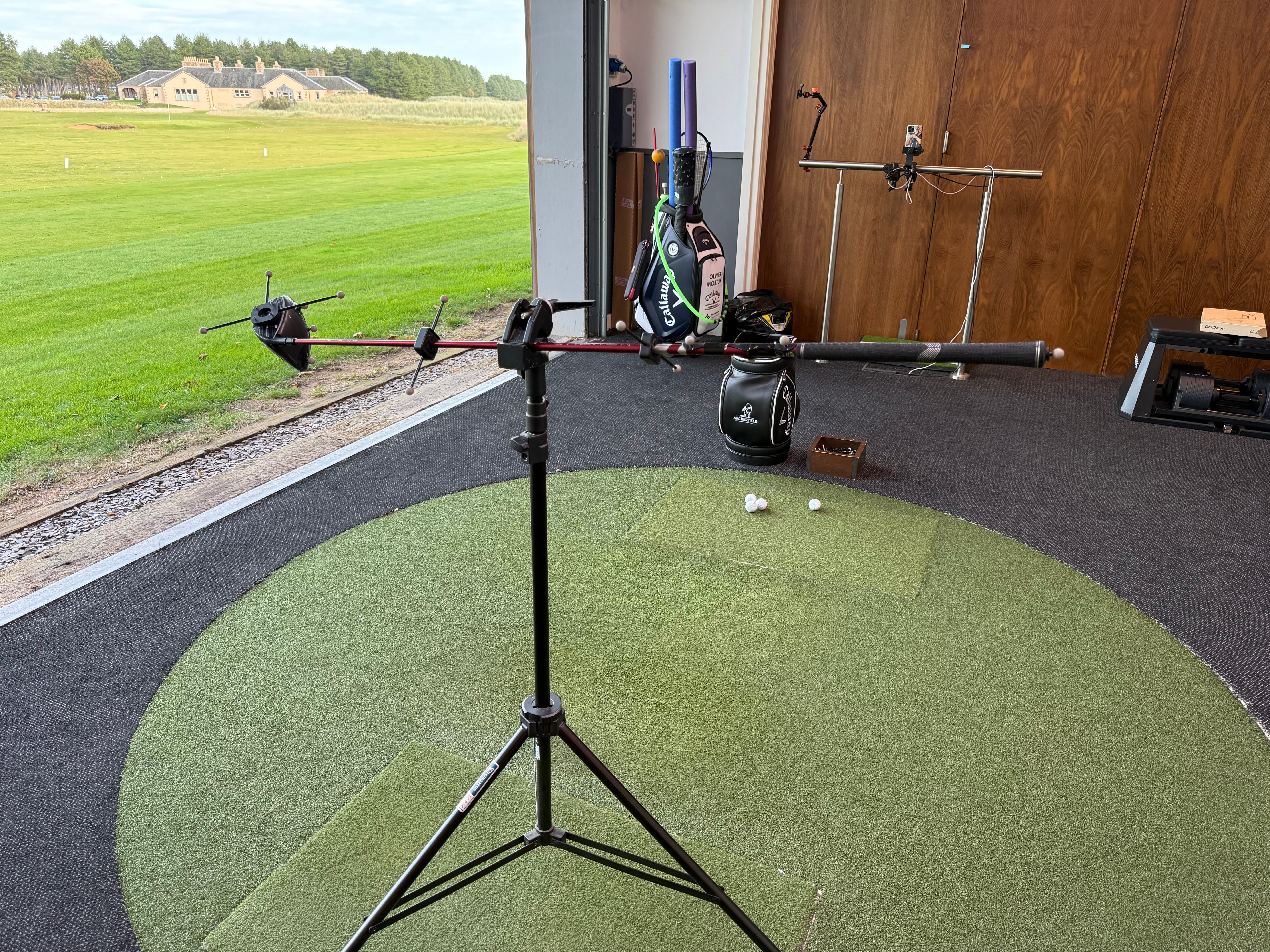
With the physical screening complete, it was time to start hitting some golf balls. While I warmed up, Oli fitted the GEARS tracking markers to my driver and 7-iron, then calibrated the clubs before fitting me into the motion-capture suit.
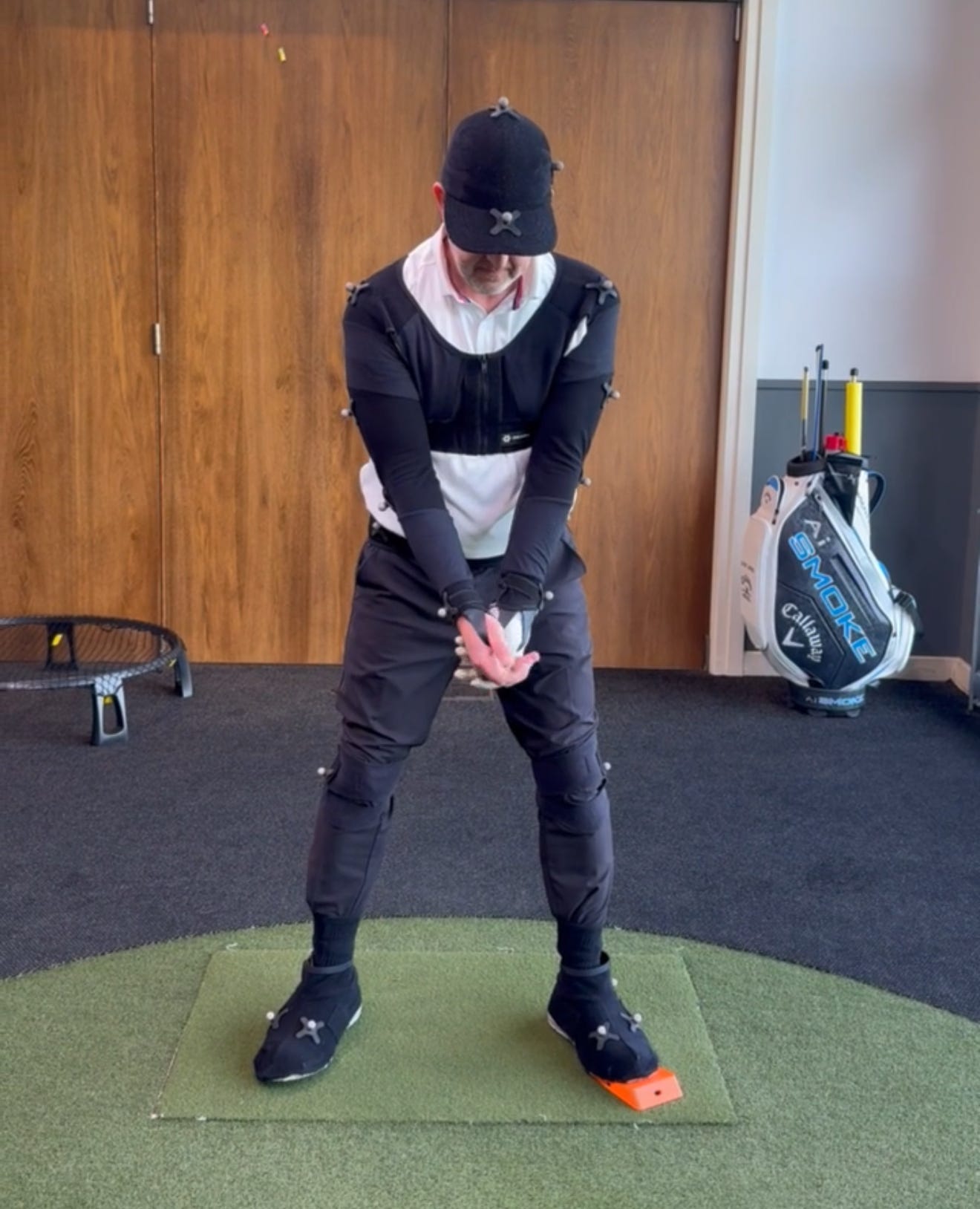
This was a rather strange experience. The suit has numerous sensors positioned around the body, allowing the cameras to track the movement of different body segments throughout the swing. Given the technology’s connection with filmmaking, I was slightly concerned that I might appear on screen looking like Shrek! Fortunately, once everything was calibrated, the 3D representation looked rather more like me, although I’m not sure it was any more flattering.
One thing worth mentioning is that the tracking markers attached to the clubs are extremely light. Unlike the rather substantial attachment used with SAM PuttLab, they have very little effect on the swing weight or feel of the club. They initially look a bit off-putting, but I really didn’t notice any issues when swinging.
Once everything was ready, we started with a series of 7-iron shots before moving on to driver. Oli then took me through the recordings. He explained how different parts of my body were moving and how that related to the movement of the club.
Two Very Different Swings
Recently, my speed training has produced some encouraging results, but perhaps not quite in the way I originally expected. The biggest improvement has actually been in my iron play. My strike has become more consistent and my ball flight more neutral, and I’ve developed considerably more confidence in that part of my game. Hopefully that will improve my approach play and greens in regulation.
However, driver has been a different story. Historically, driving has been one of the stronger parts of my game, but I’ve struggled with consistency in recent years and haven’t really developed the same level of trust in my increased speed as I have with my irons. Regular blog readers will know that I’ve also spent quite a bit of time experimenting with different drivers, looking for something that might help me regain my consistency. I’ve increasingly wondered whether chasing speed has encouraged some less desirable movements, or perhaps simply exaggerated an existing weakness in my swing. New clubs are great, but sometimes it’s the golfer rather than the equipment that needs attention!
I have two particular bad habits that can cause problems with the driver. The first is allowing myself to drift too far away from the ball at address. This tends to flatten my swing, which can lead to both a hook and an over-the-top swing that can produce a high slice. The second is standing with my feet too far apart, restricting my ability to rotate and encouraging excessive lateral movement during the backswing. They’re areas I’ve worked on previously, but they have a tendency to creep back into my game.
GEARS made the difference between my iron and driver swings very obvious. With the 7-iron, my narrower stance produced less lateral movement and better rotation. With driver, the sway motion was considerably more pronounced. I was actually moving 5.5 inches laterally away from the ball during my backswing.
Knowing I’m prone to swaying is one thing; seeing the movement on screen is quite another. What felt like a normal backswing involved a substantial shift away from the ball, and I had very little awareness of it while swinging. Oli suspected that my wider stance was contributing to the problem, potentially compounded by compensations for the rotational issues identified in the initial TPI screening.
The encouraging news was that my upper-body movement was generally good, and Oli couldn’t identify anything in my swing that particularly concerned him from an injury perspective. It doesn’t necessarily mean that my golf swing has nothing to do with my injuries, but it was reassuring to know that there were no obvious biomechanical warning signs. Of course, it also means I need to look elsewhere to explain my persistent elbow problems!
From Analysis to Coaching
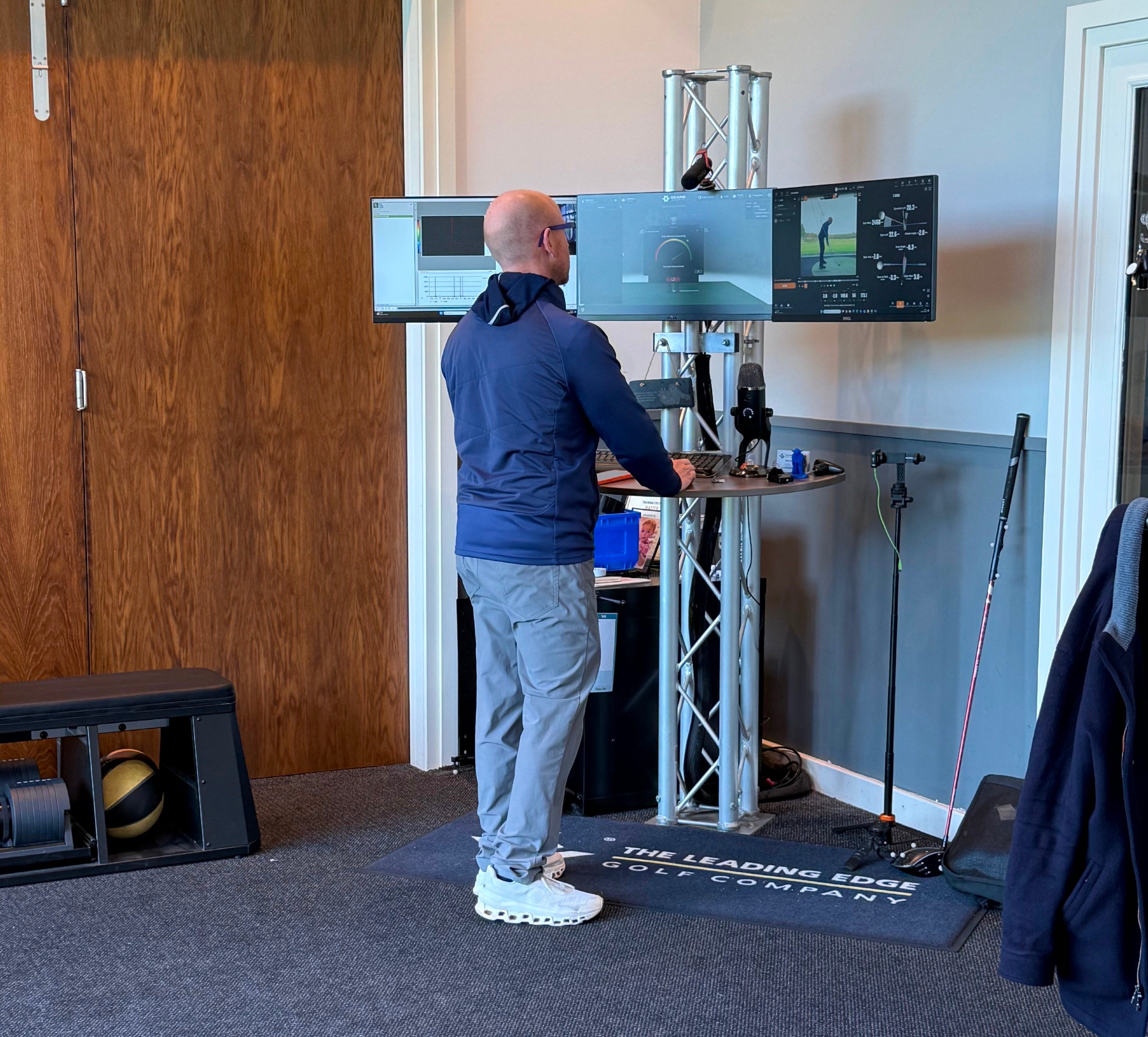
Having identified the excessive sway, the next step was to work out what to do about it. This is also where the rotational limitations identified during the TPI screening came back into focus and gave us some indication of why I might be compensating with lateral movement.
Rather than simply telling me to stop moving laterally or prescribing a series of technical swing positions, Oli worked on helping me experience what better rotation should feel like. That very much appealed to the way I learn, where I respond better to visual and feel-based instruction.
We started by adjusting my stance, particularly splaying my right foot outwards to make rotation easier. Oli then introduced three progressive drills, which he called Gears 1, 2 and 3. The first involved making gentle swings with my feet together and toes splayed outwards. We then gradually widened the stance and increased the speed, eventually working towards a normal stance and full swing.
The principle was quite simple. With my feet close together, excessive lateral movement will make it difficult to maintain balance, so the drill encourages rotation rather than sway. By progressively widening the stance, the idea is to retain that rotational feeling as the swing becomes more normal.
We also worked with a wedge under my left foot and a feeling of my right side almost corkscrewing into the ground during the backswing. Oli then introduced a resistance band running from my foot around my shoulder to exaggerate the sensation further. The rotational limitations identified during the TPI screening also gave us some indication of why I might be compensating with lateral movement, and helped inform the exercises Oli prescribed for me.
What I particularly liked was that Oli wasn’t simply giving me instructions. We discussed how I learn and which feelings were most effective for me, adapting the drills accordingly. It felt like a collaborative process rather than a conventional lesson where the professional tells you what to do, and you attempt to reproduce it.
Seeing Is Believing
After working through the drills, we returned to GEARS to examine my driver swing again. With my feet more splayed and rotation improved, my lateral movement reduced from 5.5 inches to just 2 inches. That’s a substantial change. Perhaps more importantly, my strike became noticeably more consistent too.
The new movement also felt better. I wasn’t having to force myself into an uncomfortable position or consciously restrict my backswing. By making it easier for my body to rotate, I could reduce the unwanted lateral movement without feeling that I was fighting my natural swing.
Of course, I haven’t suddenly fixed my driver swing. The improved foot position is really just a temporary solution while I work on developing better rotation and movement patterns. Also, being able to reproduce something in a controlled coaching environment is very different from doing it consistently on the golf course. However, I now have a much clearer understanding of what I’m trying to achieve.
This is where GEARS demonstrated its value. Seeing the movement, making an adjustment and then seeing the measurable difference was particularly powerful. Sometimes, seeing really is believing.
What Happens Afterwards?
One of the benefits of the GEARS experience is that the session doesn’t simply finish when you leave Archerfield. I have access to the GEARS Locker, where my recorded swings and analysis are stored, allowing me to revisit the movements we examined during the lesson. Not every comparison Oli demonstrated during the session is available there, but it’s a useful resource for reviewing my swing.
I also received a session summary through the Skillest platform, including a video of the resistance-band exercise and Oli’s notes. In addition, I have the detailed results of my TPI assessment along with a personalised exercise programme through TPI Client, focusing particularly on thoracic mobility and stretching. Between these resources, I have plenty to work on, both at the range and in the gym.
Technology Versus Coaching
Having previously experienced SportsBox AI, I’m not convinced I learned dramatically more about my biomechanics from GEARS. SportsBox provided an excellent representation of my movements at considerably lower cost. The differentiation, though, is that GEARS is capable of much more, particularly in measuring the interaction between the golfer and the club.
During my session, Oli noticed that my driver shaft appeared to be deflecting and drooping excessively, possibly because it was no longer ideally suited to my increased swing speed. This was interesting because I have a tendency to strike my driver low and towards the toe of the face, something I’d always assumed was primarily down to my swing delivery. Could the shaft profile also be contributing? Oli suggested looking for a shaft with a stiffer tip and midsection but a softer handle. However, I wonder whether improving my rotation and reducing my lateral sway might also change the way I load and deliver the shaft. Until I’ve made progress with those movements, it’s difficult to know whether I really need a different shaft or simply a better swing!
When experimenting with golf technology, I’ve become increasingly conscious of the fact that not everything we can measure is necessarily important. In fact, I sometimes wonder whether the act of measuring something actually encourages us to place more emphasis on it than it deserves. Just because a golfer’s movement differs from some idealised model, does that necessarily mean it needs correcting? After all, the golf swing is a complex sequence of interconnected movements, and through trying to fix one problem, it’s all too easy to create another.
For me, this is where the quality of coaching becomes particularly important. Oli wasn’t trying to make my swing conform to a predetermined model, but was looking at how I moved, what I wanted to achieve and which changes might genuinely help me. Ultimately, it’s about choosing the right tool for the job, and having someone who knows how to use it. GEARS offers extraordinary capabilities, but that doesn’t necessarily mean every golfer needs them.
Is GEARS Worth the Investment?
A comprehensive GEARS assessment isn’t inexpensive, but at considerably less than the cost of a new driver, I think it’s worth putting the investment into perspective. I spent almost three hours working individually with a highly experienced coach, using some extraordinarily sophisticated technology. The experience also included a comprehensive physical screening, a thirty-minute consultation beforehand and access to the GEARS Locker, Skillest and TPI Client resources afterwards.
Importantly, I came away with both swing drills to work on at the range and a programme of physical exercises to do at home and in the gym. Had I sought that combination of swing instruction and physical performance advice separately, I could easily have ended up paying for additional sessions with different professionals.
For me, the whole experience was definitely worth the money. I gained a better understanding of my biomechanics, practical ways to improve my swing and, perhaps most importantly, reassurance that there was nothing obviously concerning about the way my body was moving.
What Next?
As much as I enjoyed working with Oli, the practicalities of travelling from St Andrews to Archerfield make regular in-person lessons difficult. He offers remote and hybrid coaching options, but my preference is to work face-to-face, particularly when trying to develop new movement patterns and sensations.
Fortunately, Mike Lander has recently returned to coaching at St Andrews Golf Academy following a period of illness, and I’ve decided to resume working with him. We’ve already had our first lesson, during which we discussed the GEARS findings and started working on my driver swing. It was encouraging to be able to bring that information into a lesson with someone who already knows my game, rather than starting again with a new coach.
Verdict
I went to Archerfield primarily because I was fascinated by GEARS and wanted to discover what such a sophisticated system might reveal about my golf swing. The technology was everything I hoped it would be, but what I hadn’t anticipated was just how impressed I would be with Oli’s approach to coaching. His ability to interpret the information, understand my objectives and help me find practical ways of improving was ultimately what made the experience so worthwhile.
Would I recommend the experience? Yes, particularly to golfers who enjoy understanding their swings in detail or who are looking for a comprehensive assessment to help them improve. For someone dealing with ongoing injuries or significant physical limitations, however, I’d also consider working with a suitably qualified physiotherapist alongside the golf biomechanics assessment.
Much of what GEARS revealed was confirmatory rather than revelatory, but that doesn’t diminish the value of the experience. My physical screening was reassuring, and I now have a better understanding of my historic tendency to sway, particularly with my driver. Although the problem is less pronounced with my irons, it’s still there, so improving my rotation should benefit my whole game. As I’ve discovered with my speed training, improvements in one area can have benefits elsewhere in the bag. Whether I can turn this new understanding into lasting changes remains to be seen, but at least I now know what I’m working on and why.
The hard work starts now.
Have you experienced GEARS or another form of golf biomechanics analysis? I’d be interested to hear whether it changed your understanding of your swing and, more importantly, whether it helped you improve.
If you’ve enjoyed this review, please consider subscribing to The Club House for more independent equipment reviews, testing and thoughts on the game.