

Introduction
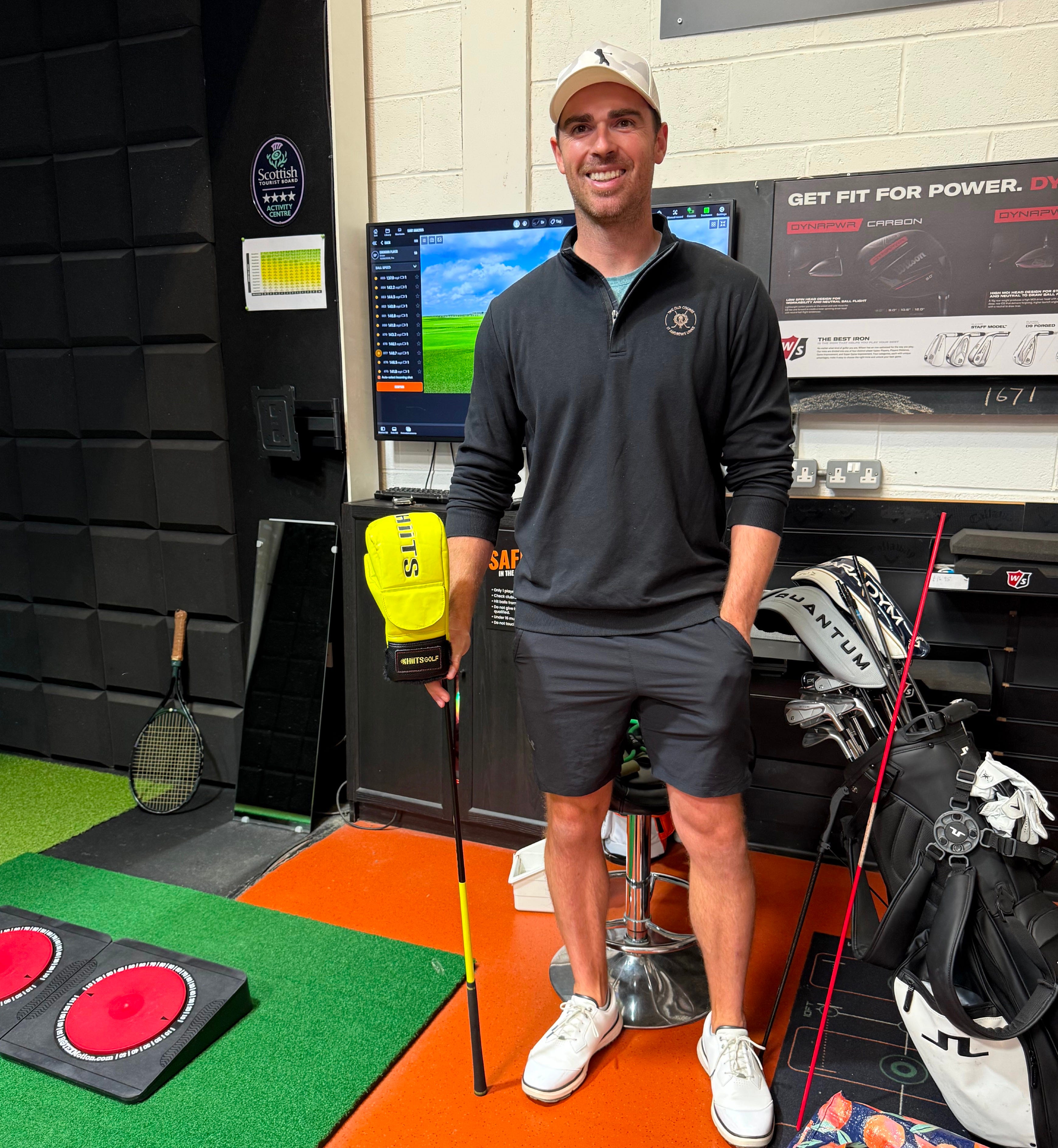
When I started working with James Tait, I wanted to find out whether I could increase my swing speed and, more importantly, whether I could make that additional speed useful on the golf course. At 57, I was also conscious that there was little point in chasing a few extra yards if I ended up injuring myself in the process and made the promise to stop if it did.
In my original article, I explained how we established a baseline driver speed of around 94mph. During that first session, I managed to reach 100.2mph with my own driver and 103.5mph with the HiiTS training driver. I’d never broken 100mph in a session before, so that was an encouraging start. But finding some additional speed during a lesson is one thing; developing it, retaining it and learning to use it on the course is quite another.
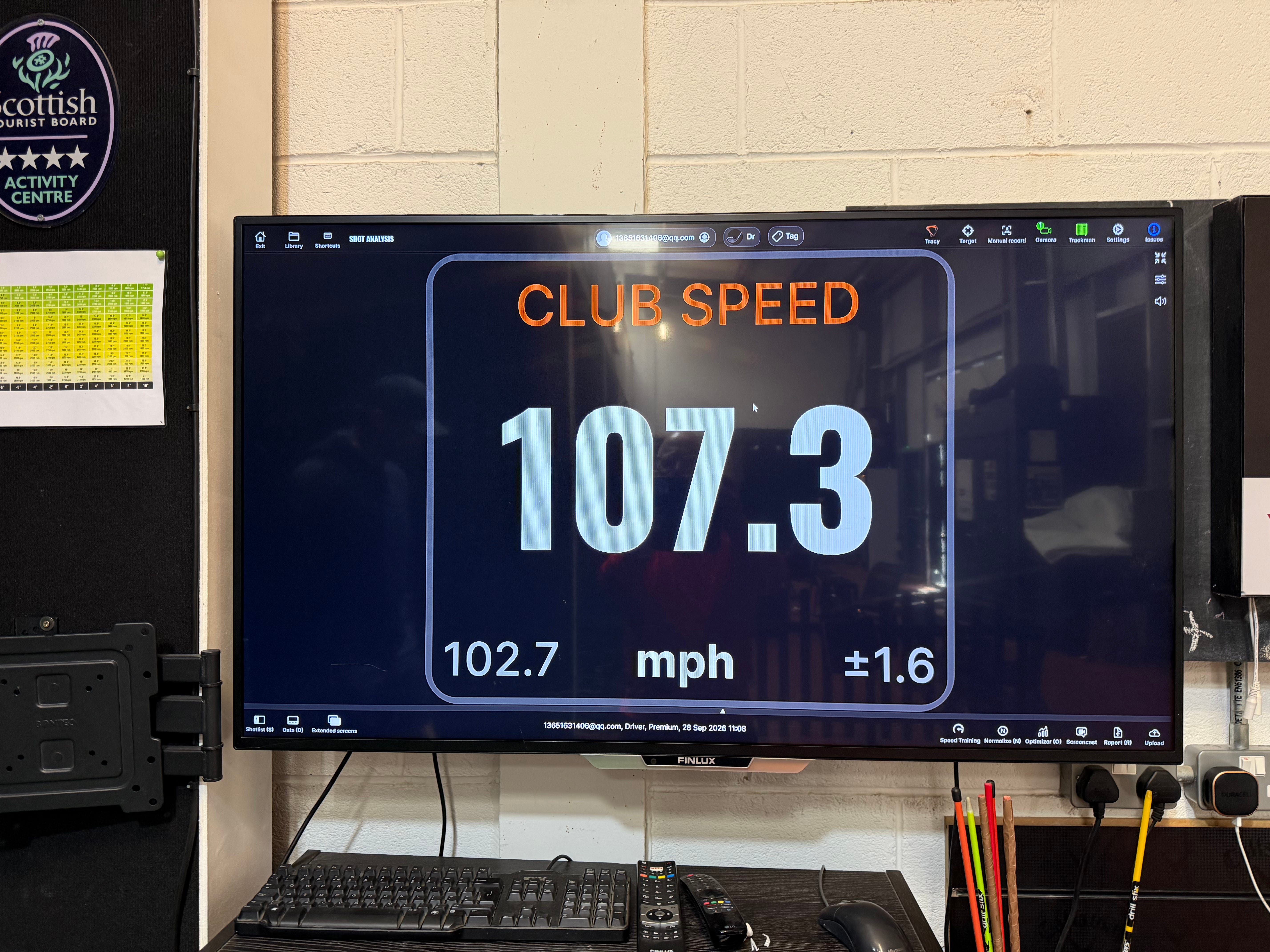
Now, three further sessions later, I’ve recorded a maximum driver speed of 107.3mph, and my normal swing speed has increased to around 100mph and appears quite stable there. However, the experience has also highlighted some of the limitations of my swing and the difficulty of confidently taking new movements onto the course.
So, was it worthwhile?
The Training Sessions
Every session began with a comprehensive stretching and warm-up routine. We used Rotex Motion plates and exercise bands to work on mobility and loosen everything up before swinging a club. When I was previously using speed sticks at home, this was the area I spent the least time on, which is how injuries happen! During these sessions, and while practicing, I was consistently finding that my lats were tight, so we gave them additional attention. I also introduced new stretches to my gym sessions to help.

Once we’d finished stretching, we moved on to hitting balls, starting with wedges to get the body moving before progressing to the 7-iron and gradually increasing the speed. From there, we’d hit some drivers before moving into the speed training itself, using either the Speed Toad or HiiTS driver.
The objective with these training aids was simple: swing as fast as possible without worrying about hitting a ball and where it might finish. With the Speed Toad, I eventually recorded a swing speed of 113mph. Of course, that’s not directly comparable with swinging a normal driver, but it was encouraging to see what my body was capable of producing when swinging with full intent.


Finally, we’d return to hitting drivers and try to translate some of that speed into a proper golf swing. Put a ball in front of me, and things changed. Suddenly I’m thinking about making a good strike, controlling the clubface and where the ball might finish. Rather than simply swinging freely, I start trying to manage the outcome. And, somewhat ironically, that can make me swing less efficiently. The more I did it, the more comfortable I got though, and it was during this final stage of the programme that I recorded my fastest driver swing of 107.3mph.
The Physical Demands
I’ll make no bones about it, these were physically demanding sessions. By the time we’d worked through the warm-up, the various clubs, the speed training aids and the final driver swings, I’d often hit 150 or more shots. And, unlike a normal practice session, most of that work involved swinging at or close to maximum effort. I certainly felt it by the end.
One of my original concerns was how my body would cope with the demands of speed training. I’m pleased to say that, although I was tired at the end of each session, I didn’t experience much discomfort afterwards.
It’s also worth pointing out that for most of this year I’ve been following a comprehensive gym programme, guided by my physiotherapist and using TPI exercises. By working on my physical conditioning alongside the speed training, I’m hoping the two complement each other. I certainly wouldn’t want to overlook the contribution of the work I’m doing away from the golf course.
The Results
The headline number is 107.3mph. That’s an improvement of 13.3mph over my original baseline of 94mph, or just over 14%. When I started this programme, I really didn’t know what to expect, but I’m delighted with that result. When I tried speed training before, I never consistently got above 100mph.
But while the maximum speed is impressive, I’m actually more pleased with what has happened to my normal driver swing.
Before starting the programme, I was swinging at around 94mph. That’s now increased to around 100mph, and it seems to be becoming my new cruising speed. During my recent TaylorMade Qi4D driver fitting with Adam Legg, I was swinging at 101mph, and I was also crusing over 100mph during the warm-up for my final session with James.
That’s encouraging because I wasn’t trying to break any records on either occasion. Additional speed is starting to become part of my normal swing rather than something I can only produce when making a maximum effort.
Interestingly, though, I suspect there’s still more to come.
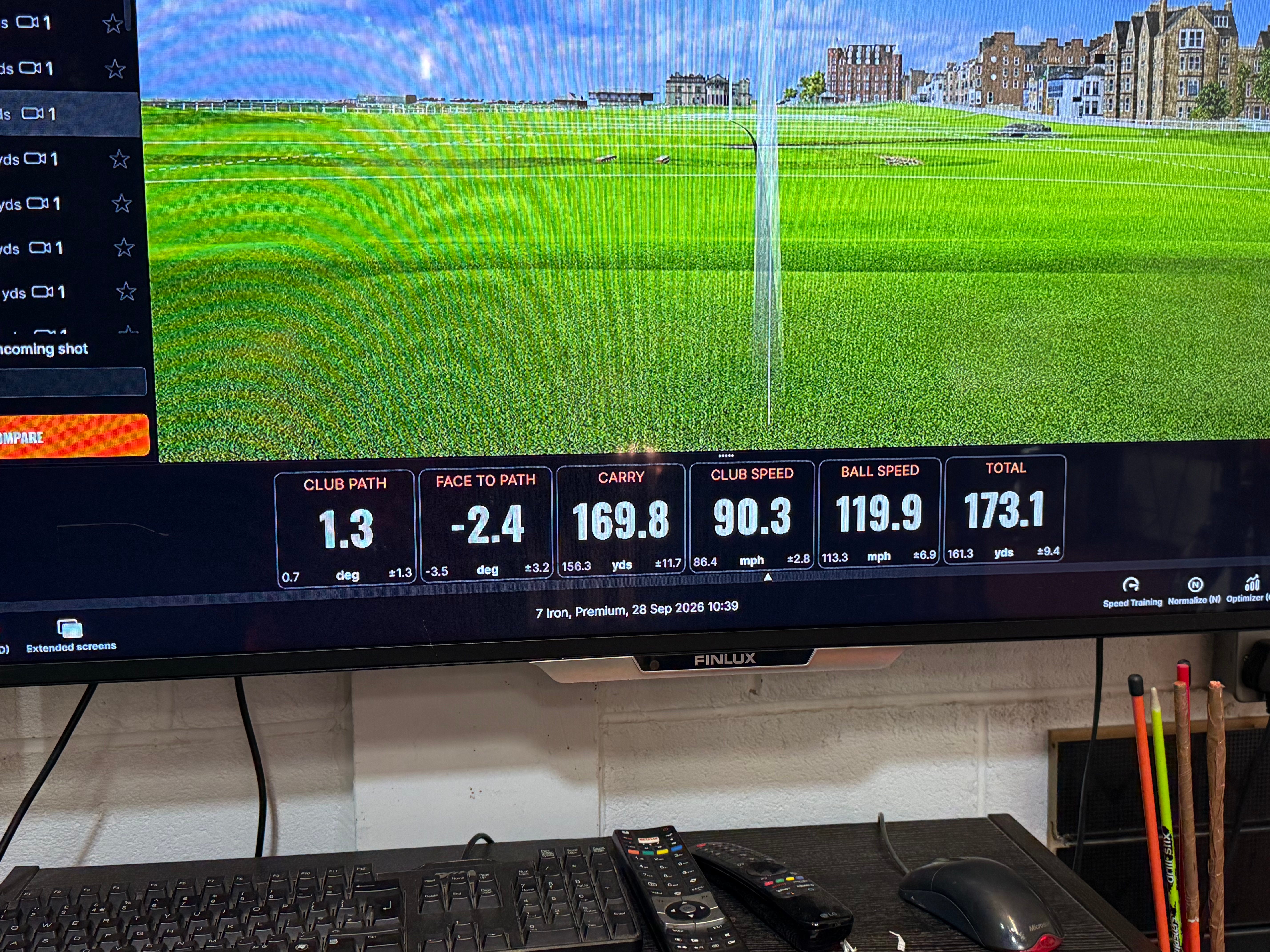
During the final session, I was swinging my 7-iron at around 89 to 90mph, producing carry distances of between 165 and 170 yards. When you consider that the PGA Tour average is 92mph, that’s a pretty good result for this 57yr old! However, given the relationship between iron and driver speeds, it seems reasonable to think that I might not yet be making the most of my potential with driver.
There are still some inefficiencies in my swing, particularly with my weight transfer and transition. I still have a tendency to become impatient at the top of the backswing, then spending some of my speed too early rather than allowing it to build naturally through impact. I have a habit of trying to muscle the ball despite knowing that a smooth, fluid swing generally produces better results. Knowing something and actually doing it are two different things. For whatever reason, I currently find it much easier to trust that feeling with my shorter clubs than I do with driver.
Perhaps the next gains won’t come from learning to swing faster, but from learning to use the speed I’ve already developed more efectively.
Taking It Onto the Course
Of course, generating additional speed on a launch monitor is one thing. Taking it onto the golf course, where there are consequences for a poor shot, is quite another.
I’ve found it considerably easier to transfer the changes into my iron play. One of the main things I’ve been working on is making a fuller shoulder turn and getting my hands higher in the backswing. For some reason, I just find that more natural with an iron in my hands than I do with driver.
The results have been encouraging. My ball flight has become much more neutral, and I’m hitting my irons at least one club further than I was before starting the programme. That’s a substantial improvement, and one I’m very happy with.
I’ve subsequently completed a gapping session to establish my new carry distances, although learning to trust those numbers on the course is another challenge. With winter approaching, that might have to wait until next season before I can properly assess the benefits.
With driver, however, things have been rather more complicated and I’ve played some of my best and worst golf of the year since starting the training.
When I trust the swing, make a full turn and allow everything to flow naturally, the results can be excellent. But when I become concerned about where the ball might finish, or start trying to force some additional speed, my old habits return. I get impatient in transition, come over the top and cast the club, with occasionally disastrous consequences off the tee. Stay out of trouble from the tee and I’ve been able to score well. But there have been too many tee shot penalties.
I’ve touched on this before in Living with the Wave. Trusting the swing is easy to talk about, but considerably harder to do when you’re standing on a tee with trouble waiting for anything that goes offline. I know what a good swing feels like, and I’ve seen what it can produce. But that doesn’t mean I can summon it whenever I want.
Was It Worthwhile?
Absolutely. I wouldn’t hesitate to recommend working with James. As the world’s No. 5 long-drive competitor, he certainly knows how to generate speed, but more importantly, he’s helped me make significant improvements to my own game. The gains in my iron play alone have made the experience worthwhile.
The driver is still a work in progress, but I don’t regard that as a failure of the training. I’ve increased both my maximum speed and my normal cruising speed, and I’ve seen what I can produce when I allow the swing to flow. What I haven’t yet developed is the confidence and consistency to access that speed as often as I’d like.
My objective remains to increase my normal, comfortable swing speed while knowing that I have more available when I need it. That, for me, is the real value of speed training. It’s not simply about discovering how fast you can swing a club, but making some of that additional speed part of your normal golf game.
What Comes Next?
I could continue working with James over the winter, and there’s certainly more to learn. However, there’s also a financial consideration. For roughly the same cost as another four sessions, I could buy The Stack System and follow a structured speed training programme myself.
Much like going to the gym, I suspect that consistency will be important if I’m going to maintain and develop the gains I’ve made. Realistically, I should be doing some dedicated speed work at least once or twice a week throughout the winter, rather than relying on occasional sessions. Which also points to something like The Stack.
There’s also the possibility of joining a group training programme at Drumoig, which I’ve expressed an interest in. They also use Smart2Move force plates, and I’d be fascinated to see what they reveal about how I’m using the ground to generate speed. I’ve also booked a GEARS session at Archerfield to gain a better understanding of my body movements and swing mechanics. I’m hoping GEARS might also shed some light on how my swing is contributing to my ongoing elbow tendonitis and other physical issues.
When I started this experiment, I wanted to discover whether I could increase my swing speed. James has helped me answer that question rather emphatically. I also finish the sessions convinced that I have more speed available if I can learn to tap into it. More patience in transition appears to be one of the key components and something to work on over winter.
The final challenge is learning to take my higher speed onto the course and trusting it.
If you’ve enjoyed following my speed training experiment, I’d love to hear whether you’ve tried anything similar and how well the results transferred onto the course.
And if you’re interested in more independent equipment reviews, golfing experiments and the occasional reflection on the game, please consider subscribing to The Club House. It’s free, and you’ll receive new articles directly in your inbox.
Further Reading