
Introduction
Having been surprised by the success of the Bettinardi BB-28 in my previous review, I was keen to see if I could find a similar putter that addressed some of the size and weight concerns I had noted.
That was the question behind this test.
I’ve found that I like the design language of centre-shafted blades, especially when the putter gives me a clear relationship between the shaft, the face and the leading edge. But I also remain sensitive to weight, grip feel and alignment lines.
So the theory was simple enough: could I find something with the centre-shafted appeal of the BB-28, but in a slightly smaller and lighter package?
Enter the Yes! Pippi 12.
This is a classic Anser-style head with the C-Groove face that I liked so much on the Yes! Tracy II. Back in 2012, this was one of the first Yes! releases under the ownership of Adams Golf.
This one came from eBay. It is in excellent condition, given its age, and it cost the princely sum of £60 plus postage.
There really are some excellent putter bargains out there for the sharp-eyed.
First Impressions
There is a subtle change to the design language in this Adams Golf era of Yes! putters. The older two-tone look had been replaced by an all-black PVD finish, and they added a polymer-filled sound slot.
The C-Groove face is still there, which was one of the main reasons I wanted to try it. I liked the roll and feel of the Tracy II, so I was curious to see whether that same face technology would work in a centre-shafted blade.


In terms of looks and quality, I would say this putter reminds me a little of the Odyssey DFX line. The original price point of £149 would also place it in a similar bracket.
It’s a good-looking putter, but the Bettinardi is clearly the more premium object. That’s not really a criticism of the Yes!, because the pricing reflects that difference. It just doesn’t have the same quality of materials or finish.
The only small issue is the grip. This one has been fitted with a Ping Pingman grip. I like the texture, but it’s just a touch too thin for my liking.
In theory, I’d prefer something slightly thicker. A Lamkin Deep Etched Sink Fit would be the obvious candidate, as that has worked well for me on the BB-28. But as I’ll come to later, I’m not sure the grip is the main problem.
Specification (as tested)
Total weight: 542g
Head weight: 350g
Swing weight: D9
Length: 34”
Loft: 3°
Lie: 70°
Toe Hang: Around 30°
Grip: Ping Pingman, thin.
Protocol Snapshot (How I Tested It)
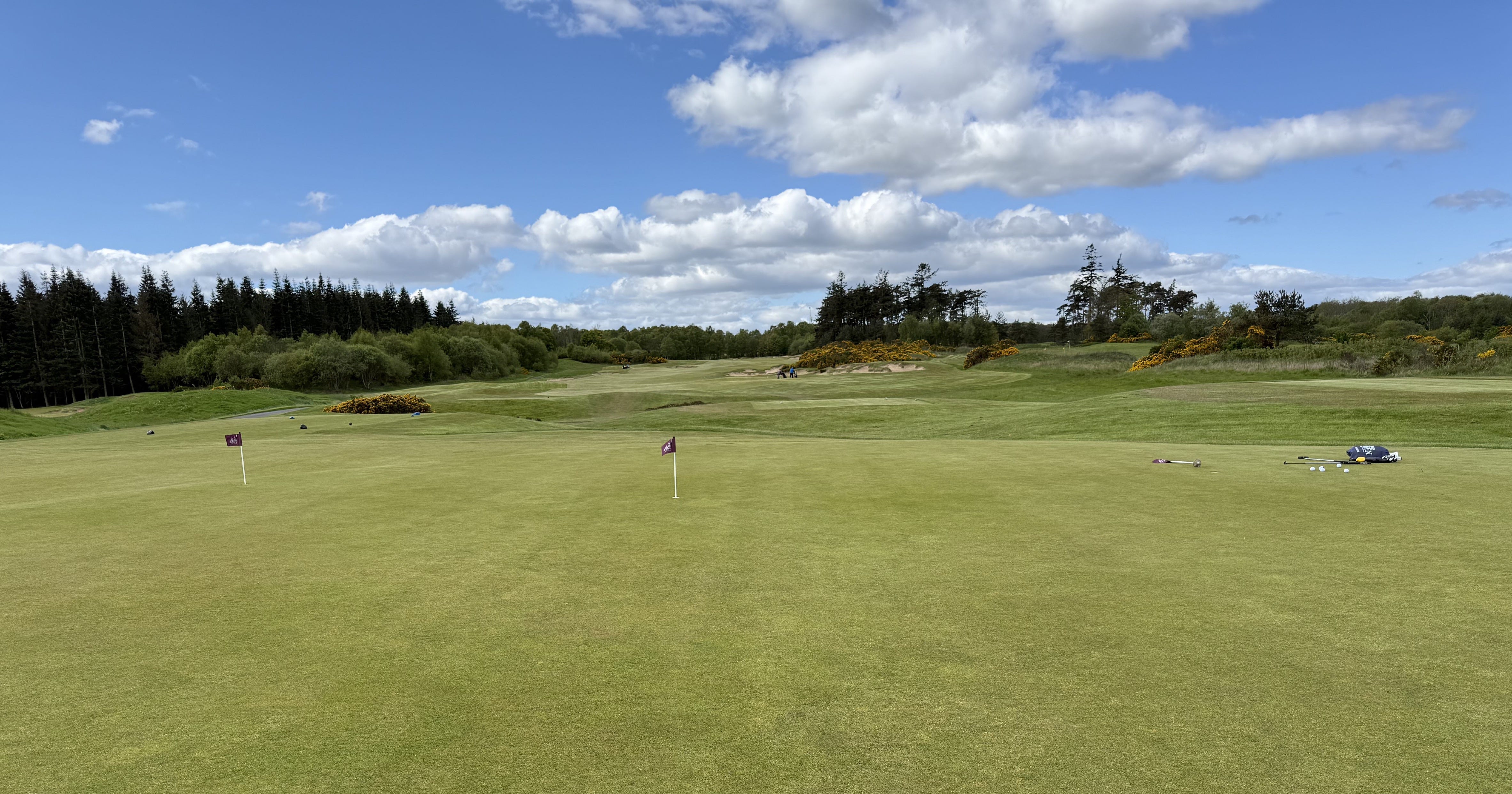
Surface: The practice green at the St Andrews Golf Academy is a bit patchy at the moment, so testing moved to the excellent green at Craigtoun, which is now running very nicely. It is a great place to practice and is more challenging than it looks in the photo.
Conditions: A nice May afternoon with warm sunshine and a strong breeze. Strong enough to make me factor it in to my putting.
Make Test: 6 putts x 3 reps from 3, 6, 9, 12, 15 ft
Lag Test: 40 ft to 3 ft - uphill and downhill - run once
Start Line: Gate drill (two tees at 18 inches ahead, gate only just wider than a ball)
Benchmark: SeeMore Nashville mFGP
Full testing framework: HERE
How Did It Perform?
Notes
It’s lovely to be back up practising at the Craigtoun Course again.
The green was in good condition and running well, but it was a breezy afternoon. Strong enough that I had to factor the wind into some of the longer putts, especially during the lag testing.
This was one formal test session, supported by a few more casual practice sessions. That distinction is relevant here because the Pippi 12 felt more comfortable when I was putting around than it did under structured pressure testing.
The results were decent overall, matching rather than exceeding my benchmark putter. But is that enough to earn a place in the bag?
Pros and Cons
Looks (+ve): I like the smaller shape. It is compact, tidy and sits nicely behind the ball. The black finish works well and had no negative impact on alignment. If anything, I generally prefer black putters, so that part suited my eye.
The putter is also in excellent condition, especially given its age.
Grip (neutral): The Ping Pingman grip is a classic shape and the texture is good, but it felt too thin for me. I found myself becoming a little jerky with it, especially on longer putts.
In theory, I’d prefer something slightly thicker. However, I’m not going to change it, because the grip wouldn’t solve my bigger concerns with the feel, sound and flange line.
Headcover (-ve): Another Velcro fastener, and this one is really showing its age. The Velcro has failed, and the fabric is deteriorating. But it is 14 years old!


This obviously doesn’t affect performance, but it is one of those small second-hand putter realities. Sometimes you get a bargain. Sometimes you also get a headcover that has lived a full life, and you need to factor a replacement into the true cost.
Aim and Alignment (neutral): The actual aim performance was good. In the gate drill, the Pippi 12 matched my benchmark putter, with both going 6 from 6.
The more important point is how it looked and felt behind the ball. The Pippi 12 confirmed that I like centre-shafted, straight-shafted putters. When the shaft sits close to the ball, the whole picture feels simpler to me. I don’t feel as though I’m aiming from the heel, the hosel or the back of the putter. I feel as though the shaft, face and ball are all part of the same visual system.
It’s almost like I’m trying to hit the ball with the shaft.
That might not sound technically correct, but as a feel, it makes sense to me. It gives me confidence in my aim, and it helps my eyes settle on the strike area rather than wandering around the rest of the head.
The flange line was less convincing. It felt more prominent than expected and more “in your face” than the line on the BB-28, even though it is shorter. That’s a good reminder that alignment is not just about length. Placement, contrast and how your eye reacts to it all matter.
Feel and Sound (-ve): This was the biggest disappointment. I had high expectations here because I liked the Yes! Tracy II so much, but the Pippi 12 didn’t give me the same experience.
I think the sound slot is the problem, at least for my taste. It makes the putter sound clicky and harsh compared with the Tracy II. The C-Groove face still puts a nice roll on the ball, but the overall sound and feel were not what I hoped for.
Weight (+ve): I do prefer the lighter overall weight compared with the BB-28 and my SeeMore Nashville mFGP. At 542g, it is the same as my Mini Giant FGP, and that feels like a sensible range for me.
It is heavy enough to provide stability, but not so heavy that I feel the head is doing too much of the work.
Stability and feedback (neutral): The Pippi 12 was definitely not as stable as the BB-28 or my SeeMore putters. It gave a lot of feedback on strike quality, and I could clearly feel when contact was not quite centred, but I can’t say that I liked it. Could that be down to the shaft? It certainly doesn’t feel as stiff as my other putters.
Pace Control (neutral): This was the weakest part of the test, and I think it is related to the points above. The results were still decent overall, but I could get a little jerky with it, especially on longer putts when I felt like I had to hit it harder. The miss was more two-way than anything definite to the right or left.
It was never extreme, but it did make the putter feel slightly less predictable than my benchmark. In casual practice, pace control was better. Under structured testing, it became more fragile.
Compared with the BB-28 and SeeMore (neutral): The more I used the Pippi 12, the closer it got to the BB-28, but the Bettinardi still felt more comfortable behind the ball and better through the stroke. Pace control, feel, sound and confidence were all stronger with the BB-28 and the SeeMore.
That doesn’t mean the BB-28 has won the job. It has gone in the bag for course testing, but I still come back to the SeeMore heads for visual comfort and trust. I prefer their top alignment line and boxy, rectangular design. Both of my SeeMore putters give me more confidence at address than either the BB-28 or the Pippi 12.
That probably tells me where things stand. The Pippi 12 supports the centre-shafted idea, but it reinforces my preference for the SeeMore design.
Performance Overall (+ve): The performance was good enough to be taken seriously. But it only matched, rather than exceeded, the benchmark putter.
That makes this a useful test rather than a failed one. The issue is that performance is not the only thing that matters with a putter. Sound, feel, stability and visual confidence all feed into trust, and the Pippi 12 didn’t quite give me enough of that.
Price (+ve): At £60 plus postage, this is very good value. It is an older second-hand putter, but it is in excellent condition and offers something quite distinctive.
If you are curious about centre-shafted putters with toe hang, this is exactly the sort of model that makes sense as an experiment.
What does Vertex say?
So far, I’ve only done the Vertex testing indoors on my putting mat, as it’s easier to control the environment. The beauty of the Vertex sensor is its size and portability, though, so I do intend to start using it more on the putting green.
Face change: The Pippi 12 averaged 1.05° open at impact, but consistency was good at 87%. That fits with the outdoor testing, where aim and start line were not the main concern. The putter performed well in the gate drill, and the Vertex data seems to support that.
Rhythm: Rhythm was a little faster at 1.71, but very consistent at 96%. That probably reflects one of the things I liked about the putter. It is lighter than the BB-28 and my SeeMore Nashville mFGP, and I do like that. The lighter overall weight made it easier to move, even if it didn’t always feel as stable.
Acceleration: Acceleration was 1.8m per second squared, but consistency was much lower at 58%. That was the most interesting part of the Vertex data for me. It seems to reflect what I felt during testing and practice, where I could become a little jerky with the stroke and occasionally push putts.
Overall, the Vertex data supports the outdoor test pretty well. Face control and rhythm were decent, but acceleration consistency was the weakness, as it just didn’t always move through the ball as calmly as I wanted.
Conclusion
I’m slightly disappointed overall.
Not because the Yes! Pippi 12 performed badly. It didn’t. The results were decent, and the Vertex data broadly supported what I felt during testing.
The putter aimed well and confirmed that I like the centre-shafted space. There is something about the shaft sitting close to the ball that makes sense to my eye. But there are different ways of achieving that.
Fit verdict (for me)
Would I game it tomorrow? I could, but I’m not going to.
What would I change? The headcover. In theory, the grip too. But I’m not going to make that change, because it wouldn’t solve the sound, feel or alignment line issues.
What have I learned? The Pippi 12 has helped me clarify my preferences around centre-shafted designs, toe hang, face-led alignment and alignment line placement.
However, for now, the SeeMore remains the putter in the bag.
Final thought
Have you tried a centre-shafted putter? Was it face-balanced, or did it have toe hang?
Let me know in the comments. I’d be interested to hear what you thought, especially if you’ve found a centre-shafted model that suited your eye.
If you found this review useful, hitting the like button helps more people find it.
If you value independent testing and would like new reviews sent directly to your inbox, please subscribe. It’s free, and you can cancel at any time.
Links:
Full testing framework: here
All my other putter reviews: here
Nice review Keith - definitely looks like center shafted putters match you will well. Also great to hear you are using Vertex data to help with your evaluations.