
Introduction
Watching The Open recently, the Scotty Cameron Phantom 3.2 was getting plenty of attention. Cameron Smith, known for his excellent putting with a Scotty Cameron 009 blade, had switched to a black version of it. Ludvig Åberg was also using one, as was Ryan Gerard, and I suspect there may also have been others.
Their putters featured different neck and alignment options from those Scotty Cameron offers at retail, but I’ll come back to that later.
If the Phantom 3.2 was good enough to tempt some excellent blade players into making a change, would it have the same impact on me?
First Impressions
When is a mallet not a mallet?
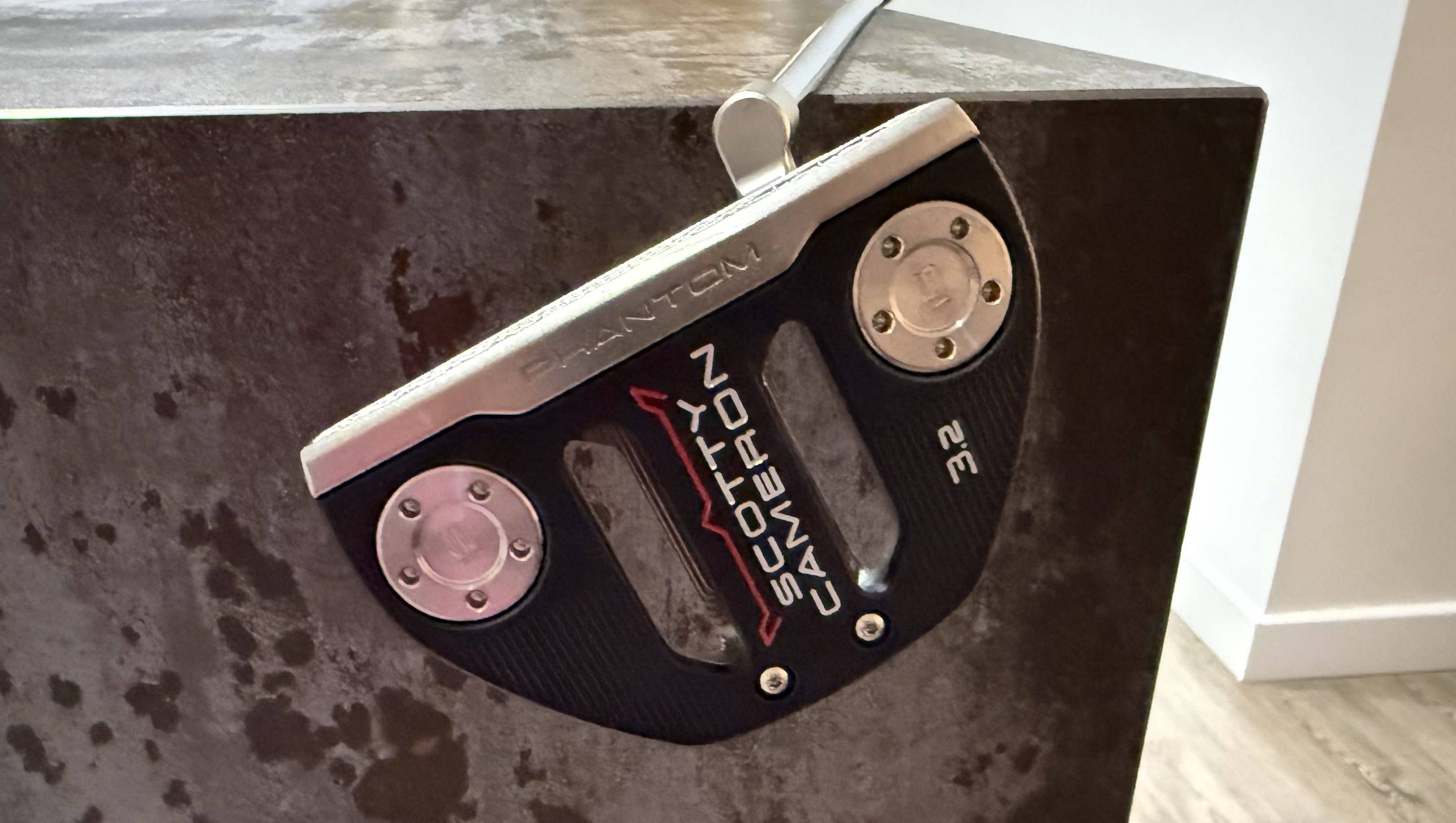
I would describe the Phantom 3.2 as a compact or mid-mallet rather than a full mallet. The design should give it a higher MOI than a traditional blade, adding a little more stability, but the centre of gravity remains relatively close to the face. In theory, that should help it feel and move more like a blade through the stroke.
The TaylorMade Spider Tour V follows a similar design concept and is positioned as the Spider model most likely to appeal to blade players.
You get more stability than a standard blade and the enhanced alignment options of a mallet, but within a relatively compact head shape.


While I like the shape and size of the Phantom 3.2, I really don’t like the three alignment lines. It looks a little like a special collaboration with Adidas, although my first thought was the old Zebra mallet.
Picking it up for the first time, I was also struck by how heavy it felt. I expected something around the 560g mark, but this weighed in at a hefty 580g. That extra weight caused me some problems during testing.
Specification (as tested)
Total weight: 580g (on the heavy side)
Head weight: undeclared, 2x15g head weights
Swing weight: D8
Length: 34”
Loft: 3.5° (+/-1°)
Lie: 70° (+/-2°)
Toe Hang: Minimal 33°
Grip: Scotty Full Contact Grey
Definitely get fitted correctly and take advantage of the custom length, lie and loft.
Protocol Snapshot (How I Tested It)
Surface: Practice green at Craigtoun Course
Conditions: A lovely July day with a firm green that was running well.
Make Test: 6 putts x 3 reps from 3, 6, 9, 12, 15 ft
Lag Test: 40 ft to 3 ft - uphill and downhill - run once
Start Line: Gate drill (two tees at 18 inches ahead, gate only just wider than a ball)
Benchmark: Lajosi custom blade
Full testing framework: HERE
How Did It Perform?

Notes
The practice green at Craigtoun Course was in excellent condition and rolling nicely after a period of very good weather.
Following my recent testing and review of the AimPutt training system, I have been using my custom Lajosi blade as my gamer. It felt more comfortable at address with the AimPutt than my SeeMore putters did, so it provided the benchmark for this test.
Pros and Cons
Looks (neutral): I like the shape of the head, but I really dislike the alignment lines Scotty Cameron has chosen for the retail version.
I wish they had used the simple single line seen on Ludvig Åberg’s putter. Better still, I would choose the Cameron Smith version, which I think looks excellent.


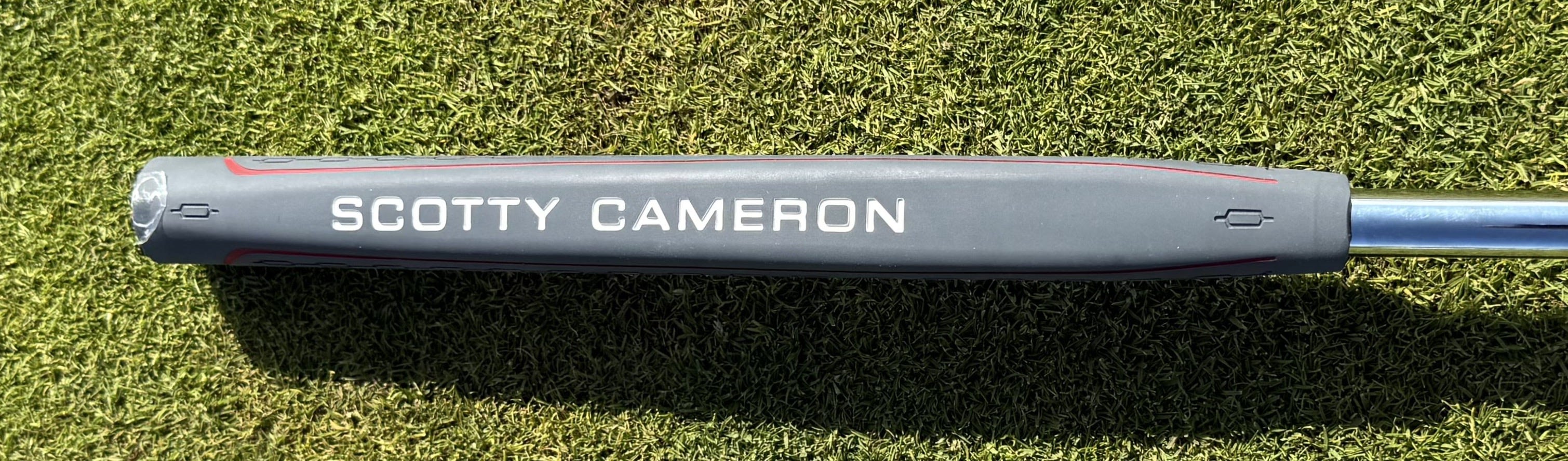
Grip (+ve): The Grey Full Contact grip has a classic Scotty Cameron shape and feels very good in the hands. It is thinner than the SuperStroke Pistol 1.0 fitted to my Lajosi, but Scotty Cameron offers plenty of alternative grip options, so most golfers should be able to find something they like.
Headcover (-ve): This is a familiar complaint from my Scotty Cameron reviews.
Forcing a mid-mallet head into a blade headcover with a Velcro fastening is not ideal. I find the covers increasingly frustrating whenever I test a Scotty Cameron putter.
A magnetic fastening would be an obvious improvement. A more conventional mallet cover, or even a slightly wider blade cover, would also make the Phantom 3.2 much easier to live with.


Aim/Alignment (neutral): This was almost very good.
With one solid line, or perhaps the shorter line seen on Ludvig Åberg’s putter, the Phantom 3.2 would look close to perfect for me. The three lines make the retail version feel unnecessarily busy and slightly confusing.
That said, the head shape still allowed me to focus most of my attention on the face, and I found it relatively easy to aim. I just didn’t like the way it looked behind the ball.
Feel and Sound (-ve): Some of my reaction may be connected to the weight, but I also don’t like the full-face insert Scotty Cameron is using in the Phantom range.
As with my other recent Phantom reviews, I found the impact sound unpleasant. It is difficult to describe, and it certainly sounds different outdoors than it does indoors, but I preferred the TaylorMade Spider putters I was testing at the same time.
Scotty Cameron can do better than this.
How about a Teryllium option?
Pace Control (-ve): For me, pace control was the weakest part of the Phantom 3.2’s performance, and I think the weight was the main reason.
Some golfers really like heavy putters, but I find that my rhythm and tempo begin to struggle with them. I’m also not convinced the extra weight suits a head that is designed to move and release more like a blade.
Someone with greater technical insight may be able to explain that relationship better, but the result for me was clear: I found it difficult to control distance consistently.
Performance Overall (-ve): As the distance increased, the performance deteriorated quickly.
I struggled to control the head and produced a two-way miss, alongside the pace-control problems. It took a lot of concentration to get the best from the putter, and even then the results were inconsistent.
There were some good streaks, but not enough to give me confidence in the overall performance.
Price (neutral): At £449, this is an expensive putter.
The build quality is in line with what you would expect from Scotty Cameron, and the available adjustments to length, lie and loft add value. Even so, it remains expensive compared with many competing options.
What does Vertex say?
I completed the Vertex testing indoors on my putting mat, and the results were considerably more encouraging than those from the practice green.
In theory, the Vertex data appears to show a putter that should work. In reality, it didn’t perform that way outdoors.
The average face change was just 0.02° open, which was an astonishingly good number. I certainly don’t have a “straight back, straight through” stroke, and nor do I try to. However, that average concealed a relatively wide range, and the consistency was not particularly strong. The phrase about there being three types of lies, “lies, damned lies and statistics”, came to mind.
Vertex measured my tempo at 1.8, with 97% consistency.
Considering how much I felt the weight affected my rhythm on the practice green, that was a very positive result.


The weaker Vertex numbers came from lie angle, shaft lean and loft at impact. All three suggested that the putter did not fit me particularly well and that I was manipulating it during the stroke.
Given the available adjustments to length, lie and loft, there should be scope to improve those results through a proper fitting. I would also be interested to know how much of a role the overall head weight played.
Conclusion
I found the Scotty Cameron Phantom 3.2 disappointing, although there is clearly an interesting putter somewhere within the design.
I like the compact mid-mallet shape, and the Vertex results suggest that the basic concept may suit my stroke. However, the retail alignment lines are too busy for my eye, the overall weight made pace control difficult, and the outdoor performance became increasingly inconsistent as the putts got longer.
The contrast between the Vertex data and the practice-green results is perhaps the most interesting part of the review. The numbers suggest potential, but I never felt comfortable enough to turn that potential into reliable performance.
With a simpler alignment option, a lighter build and a fitting to adjust the lie and loft, I would be interested in trying the Phantom 3.2 again.
In this specification, though, it wasn’t for me.
Fit verdict (for me)
Would I game it tomorrow? No
What would I change? The alignment lines and the weight.
What have I learned? I still like the idea of a compact mid-mallet. Despite the aspects of the Phantom 3.2 that didn’t work for me, the Vertex results suggest that this type of head may suit my stroke. I may simply need to find the right version of it.
You can find all my other putter reviews, including my other Phantom reviews, by clicking the link below.
If you found this review useful, hitting the like button helps more people find it.
If you value independent testing and would like new reviews sent directly to your inbox, then please subscribe. It’s free, and you can cancel at any time.
Special thanks to Adam Legg and Auchterlonies for lending me the review putter.
Links:
Full testing framework: here
All my other putter reviews: here