
Introduction
When I saw that L.A.B. were introducing the Link 2.1 and Link 2.2, more traditionally shaped heel-shafted zero-torque putters, I knew I had to get my hands on them for testing. Fortunately, I was able to borrow both models from Adam Legg at Auchterlonies, which gave me the chance to put them through my usual review process rather than simply forming an opinion from photographs or launch material.
With the degree of customisation available with L.A.B. putters, I do think it is especially important to find a good fitter and get properly dialled in. If you believe in the lie-angle balance theory, then you really do need to make sure the lie angle is right for you. These are not putters I would want to buy blindly, particularly given how much the look, lie, shaft position and alignment options can affect how they sit behind the ball.
First Impressions
The Link 2.1 is the longer of the two new heads and, to my eye, it looks a similar size to the original Link.1 that I tested last year. It would have been interesting to compare the dimensions side by side, but unfortunately I wasn’t able to do that. My immediate reaction was that it was still a little too long from heel to toe for my eye, and I found myself preferring the slightly smaller Link 2.2 model, which I will review next.


That said, there are some clear improvements here over the original Link.1. The 303 stainless steel construction and milled face make this feel like a more premium, more complete putter. This particular model had the standard steel shaft and the L.A.B. pistol rubber grip.
Specification (as tested)
Total weight: 548g
Head weight: “standard”
Swing weight: E2
Length: 34”
Loft: 2° effective loft
Lie: 69° with custom range of 65°-74°
Toe Hang: Zero-Torque
Grip: L.A.B. Pistol Rubber Black
Protocol Snapshot (How I Tested It)
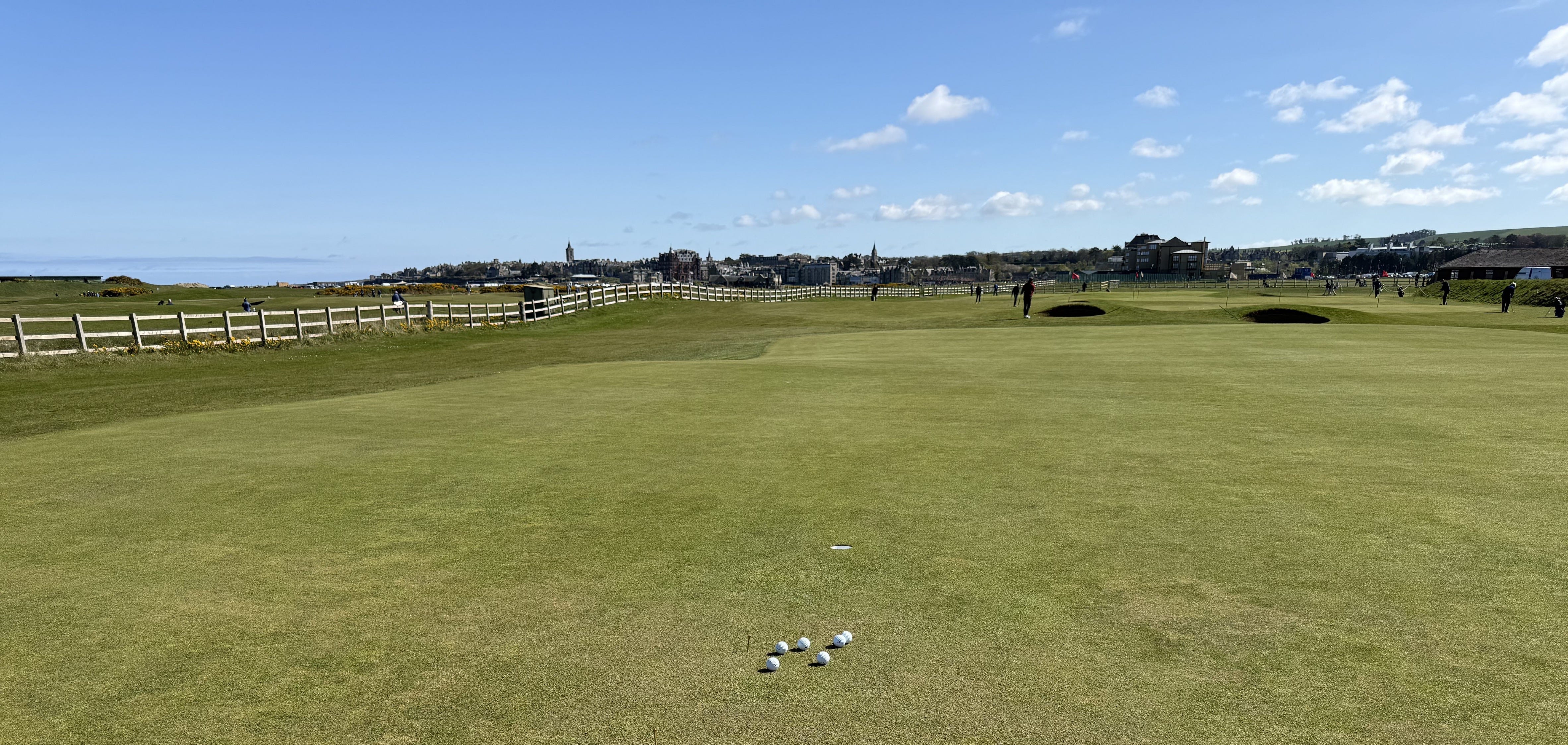
Surface: Eden practice green at St Andrews Golf Academy
Conditions: A lovely early June day with warm sunshine.
Make Test: 6 putts x 3 reps from 3, 6, 9, 12, 15 ft
Lag Test: 40 ft to 3 ft - uphill and downhill - run once
Start Line: Gate drill (two tees at 18 inches ahead, gate only just wider than a ball)
Benchmark: SeeMore Nashville mFGP
Full testing framework: HERE
How Did It Perform?
Notes
The Eden practice green at the St Andrews Link Academy is a super place to test putters. It is an original Harry Colt green from before the Eden course was altered to make way for the academy. There is plenty of space for my standard testing, and if it’s quiet enough, it also makes for a really challenging par-2 course.
I was genuinely intrigued to see how these new L.A.B. putters would perform. Combining more traditional blade looks with modern zero-torque technology sounded like a potentially winning combination, and I went into the test really wanting to like them.
Pros and Cons
Looks (neutral): Hats off to L.A.B. for trying to produce a putter that will appeal to a more traditional market. That is no easy task when the whole design is still being built around the lie-angle balance concept. Unfortunately, to make the zero-torque design work in this shape, there has to be a compromise around the neck so that the shaft axis still matches the centre of gravity of the head. I understand why it is there, but visually, I just don’t like it.
As mentioned above, I also found the 2.1 head slightly too long for comfort. I had the same issue with the original Link.1 model. For some golfers, that extra length may create a sense of stability, but for me, it starts to look a little stretched, and that affects my confidence at address.
Grip (neutral): I have never been a big fan of the standard L.A.B. grip, although at least this one is black and should not show dirt as badly as the one I had on my old DF3. Personally, I find it a bit chunky and I don’t particularly like the feel of the material either.
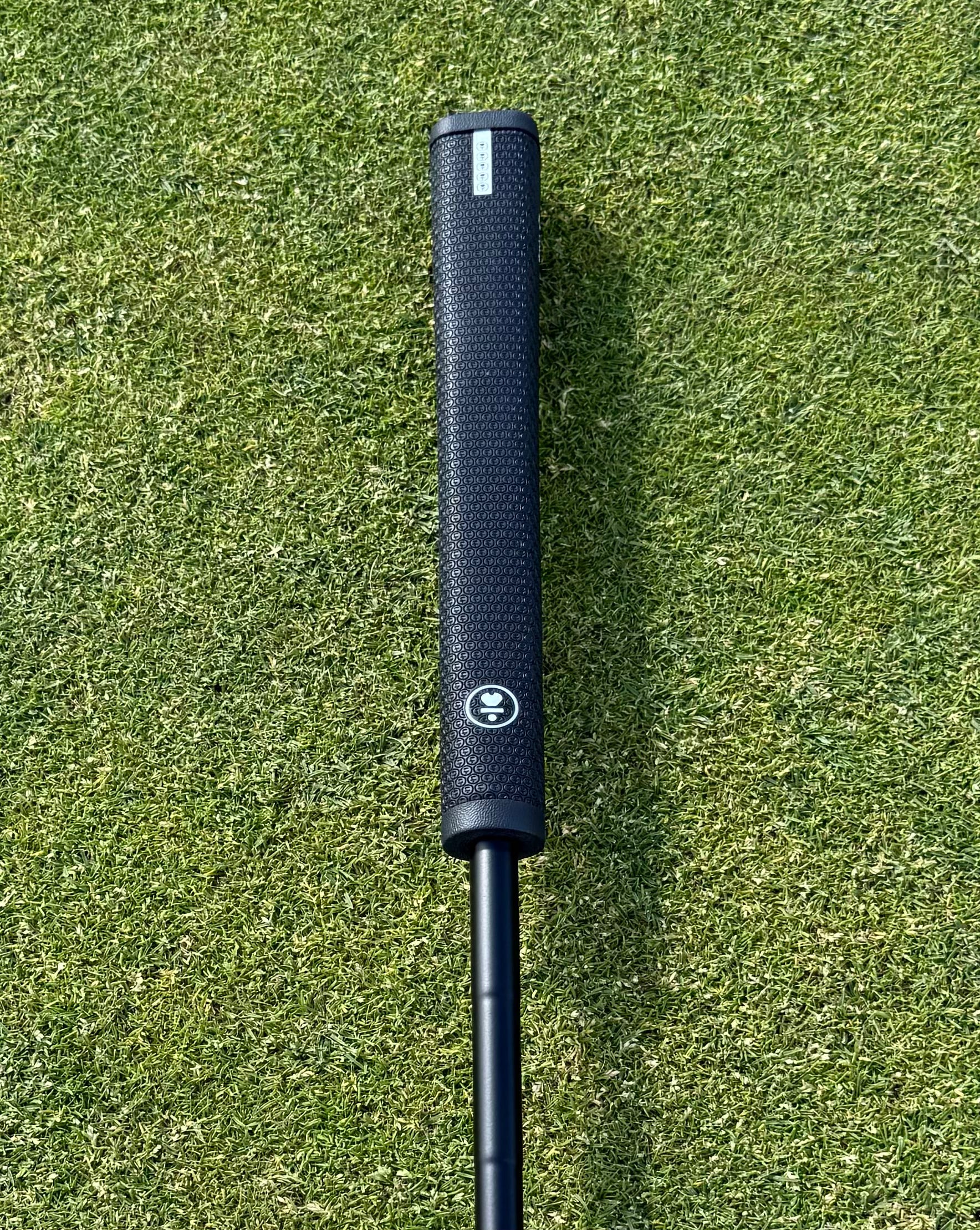
The good news is that L.A.B. offer several different standard grip options, so this is easy enough to change at the time of purchase. As with most things L.A.B., the fitting and ordering process gives you plenty of ways to build something closer to your own preference.
Headcover (neutral): L.A.B. headcovers are generally very good, and this one is no exception. However, for a putter at this price, I was disappointed to see that the white cover supplied with this test model was a $20 upcharge item. That may be a small thing in the context of a premium putter, but it still slightly jars when the base price is already high.


Aim/Alignment (-ve): This was my biggest issue. I just couldn’t get on with the way this putter sat behind the ball. The heel attachment made the blade look as though it was aiming left at address, and once I saw that, I found it very hard to unsee it.
Interestingly, there was a DF3 player on the green while I was doing the testing, and he asked to try the two new models. His reaction was very similar to mine, and he didn’t particularly like them either. That doesn’t prove anything, of course, but it did suggest that I wasn’t alone in finding the look slightly awkward.
I had a similar issue when I tested the OZ.1i HS and the Axis1 Rose. There is just something about the way these heel-shafted, torque-managed putters look that doesn’t appeal to me. It will be interesting to compare them with the new heel-shafted offerings from Odyssey, because this appears to be an area that more manufacturers are exploring.
Feel and Sound (neutral): The new milled face is a big improvement over some of the other L.A.B. models I have tried. There is a cleaner, more premium feel here, and it gives the putter a quality that the older Link.1 didn’t quite have for me.
However, with the 2.1 head, I found that if I didn’t catch the ball out of the sweet spot, there was a significant change in both sound and feel. In one sense, that is good feedback. In another, it highlighted how poorly I was swinging this particular putter. The feedback was honest, but in my hands it wasn’t especially flattering.
Pace Control (+ve): Pace control was generally good and definitely better than I have experienced with some other L.A.B. putters. I don’t know whether that is down to the new milled face, the stainless steel construction, the head shape, or simply the way this model presents behind the ball, but it was one of the stronger parts of the test.
Even though I never felt fully comfortable aiming the putter, I did feel reasonably connected to distance. That is worth noting, because with some zero-torque putters, I have struggled more with pace than direction. Here, the bigger problem was not distance control but confidence and alignment.
Performance Overall (-ve): Overall, this putter simply didn’t work for me. The test results were poor, and more importantly, I never felt as though I had much confidence standing over the ball. I found it difficult to align, and although the pace control was decent, the rest of the performance did not come together.
The issues with feel and sound on slightly off-centre strikes gave me immediate feedback, but that feedback mostly confirmed that I was not delivering the putter well. That is not necessarily the putter’s fault, but it does matter in a review like this. A putter either gives you confidence and helps you organise yourself, or it doesn’t. For me, the Link 2.1 didn’t.
Price (-ve): This was a base model putter with no shaft or grip upgrades, and it comes in at $599 on the L.A.B. website. The white headcover is a $20 upcharge over the standard cover, which you will see in the 2.2 review, and which I actually prefer.
The one positive I can add is that it appears L.A.B. no longer charge extra for length and lie adjustments, although it also looks as though some of that has simply been built into a higher base price. In terms of custom alignment options, nobody really matches L.A.B. unless you are going to a bespoke putter maker, but this is still an expensive putter.
What does Vertex say?
Vertex testing was done indoors on my putting mat.
Face at impact was 0.9° open and very consistent, which is pretty much my usual stroke. Tempo was also very consistent at 1.83. Acceleration, however, was 1.4 m/s² and very inconsistent.
Lie angle at impact was unchanged from address, which was a positive. However, shaft lean and loft angle showed that I was reducing the lean through the stroke and adding loft. Both are poor for accuracy and helped confirm what I saw during the outdoor testing. I simply wasn’t delivering this putter as well as I would want to.
Conclusion
I genuinely wanted to like this new blade-style putter from L.A.B., but unfortunately I just couldn’t get on with it. Hopefully, the smaller 2.2 model will restore a bit of positivity, because there are definitely things here that I like in principle.
The 303 stainless steel construction and milled face are clear improvements, and I admire what L.A.B. are trying to do by bringing their technology into a more traditional-looking head shape. But looks and feel still have to work for the person holding the putter, and for me they didn’t. I can’t sugarcoat the fact that performance, in my hands, was poor.
That doesn’t mean it won’t work for you. In fact, if you like the look of heel-shafted putters and already get on well with L.A.B.’s design philosophy, this may be exactly the kind of model you have been waiting for. But standing over this putter gave me no confidence at all, and once that happens, it is very difficult for any putter to survive a proper test.
Fit verdict (for me)
Would I game it tomorrow? No.
What would I change? The neck. I understand why it is designed this way, but it just doesn’t work for my eyes and makes the head look as though it is aiming left. With more time, I could probably adapt to that, but I would rather use something that gives me confidence straight away.
What have I learned? I wish L.A.B. had brought out a slightly smaller version of the original Link.1 rather than going in this new direction. There are things I like here, particularly the milled face and 303 stainless steel construction, but performance is what matters most, and this one didn’t deliver for me.
I’d love to know if you have tried the new Link 2.1 from L.A.B. and what you thought of it. Please leave a comment below.
If you found this review useful, hitting the like button helps more people find it.
If you value independent testing and would like new reviews sent directly to your inbox, then please subscribe. It’s free, and you can cancel at any time.
Links:
Full testing framework: here
All my other putter reviews: here
Guess it just doesn’t match your stroke Keith!!