
Introduction
I don’t know quite what possessed Scotty Cameron when they released the original Detour line back in 2006. The Detour 1 was a sight to behold, although I’ve never actually seen one in the flesh. I’m sure that adapting the original design into the more conventional Newport 2 head improved its popularity, but as the old saying goes, “it’s a face only a mother could love”. I understand the logic behind the design, but not everything that makes sense should be made!
However, the Detour turned out to be an excellent candidate for conversion back into a more conventional Newport 2. But not just any Newport 2. The Detour head has a 2-degree high toe, which gives it a subtly different appearance to the standard Newport 2. Personally, I like that slightly higher toe, as it’s similar to my Lajosi gamer, with which I’m very comfortable.

I’ve been looking for a good example of one of these conversions for quite some time, and was delighted when this one became available. The work was completed by Chris Finch, from Preston, who was possibly the first person to complete a conversion. He worked with Putter Parts to develop the insert and the machining required to transform the original head.
The challenge was to create an insert heavy enough to replace Scotty Cameron’s distinctive alignment aid while retaining a pleasing feel at impact. The finished head weighs approximately 340g, a little lighter than the 350-360g of many modern blades. I’m interested to see how I get on with that given previous success with lighter putters.
So, had Chris managed to turn one of Scotty Cameron’s strangest creations into something rather special? And, perhaps more importantly, would it perform as well as it looked?
First Impressions
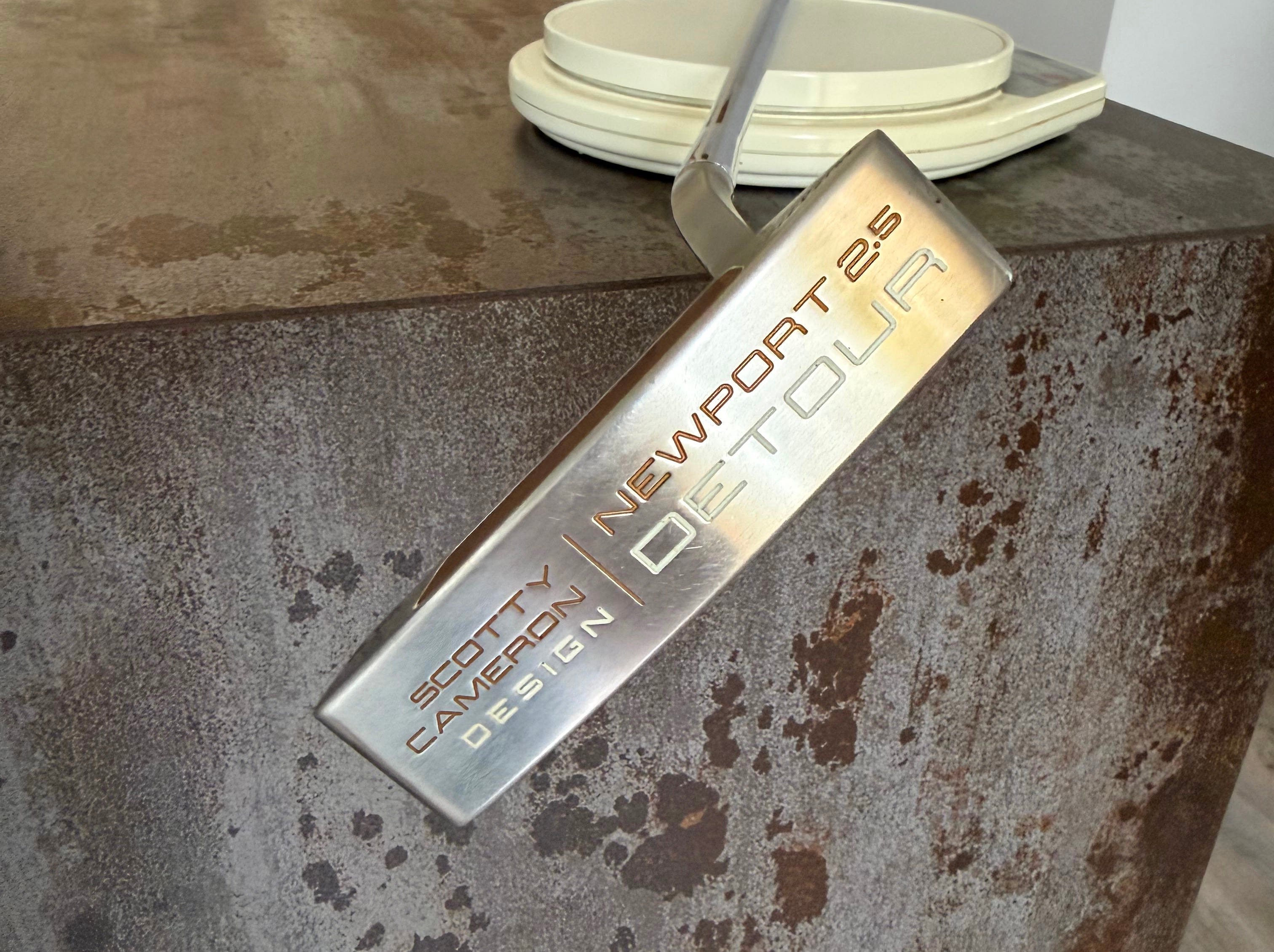
Wow. Chris Finch has done a fantastic job with this putter, and the photographs really don’t do it justice.
Behind the ball, I immediately felt comfortable. I’ve always preferred the straighter lines of the Newport 2 over the curvier Newport 1, and the slightly higher toe makes this particular example even more appealing. Finding one with a completely naked head is a real bonus too. Most standard Newport 2 putters have a flange line, and the Detour conversion is one of the few ways of getting this head shape without one.


The plain stainless steel head and copper insert complement each other beautifully, while the paintfill colours provide a little contrast without being overdone. It’s a very clean, understated design, which is quite remarkable when you consider what it started life as.
The original owner specified a flat face on the copper insert, and I’m glad they did. I’ve used deeply milled putters that have felt a little too soft for my liking, and I suspect milling this particular insert might have taken things too far. Copper is already a relatively soft material, and I was interested to see how it would feel.
Of course, there’s a danger in falling in love with a putter before you’ve even hit a ball with it. I may have done that here as it went straight into the bag before I’d completed my usual testing.
But looking good and performing well aren’t necessarily the same thing. The testing would still have to justify my enthusiasm.
Specification (as tested)
Total weight: 574g (surprisingly heavy)
Head weight: 340g
Swing weight: C0 (light head and shorter length)
Length: 33.5”
Loft: 4°
Lie: 71°
Toe Hang: 60°
Grip: Scotty Cameron midsize Matador (86g - quite heavy)
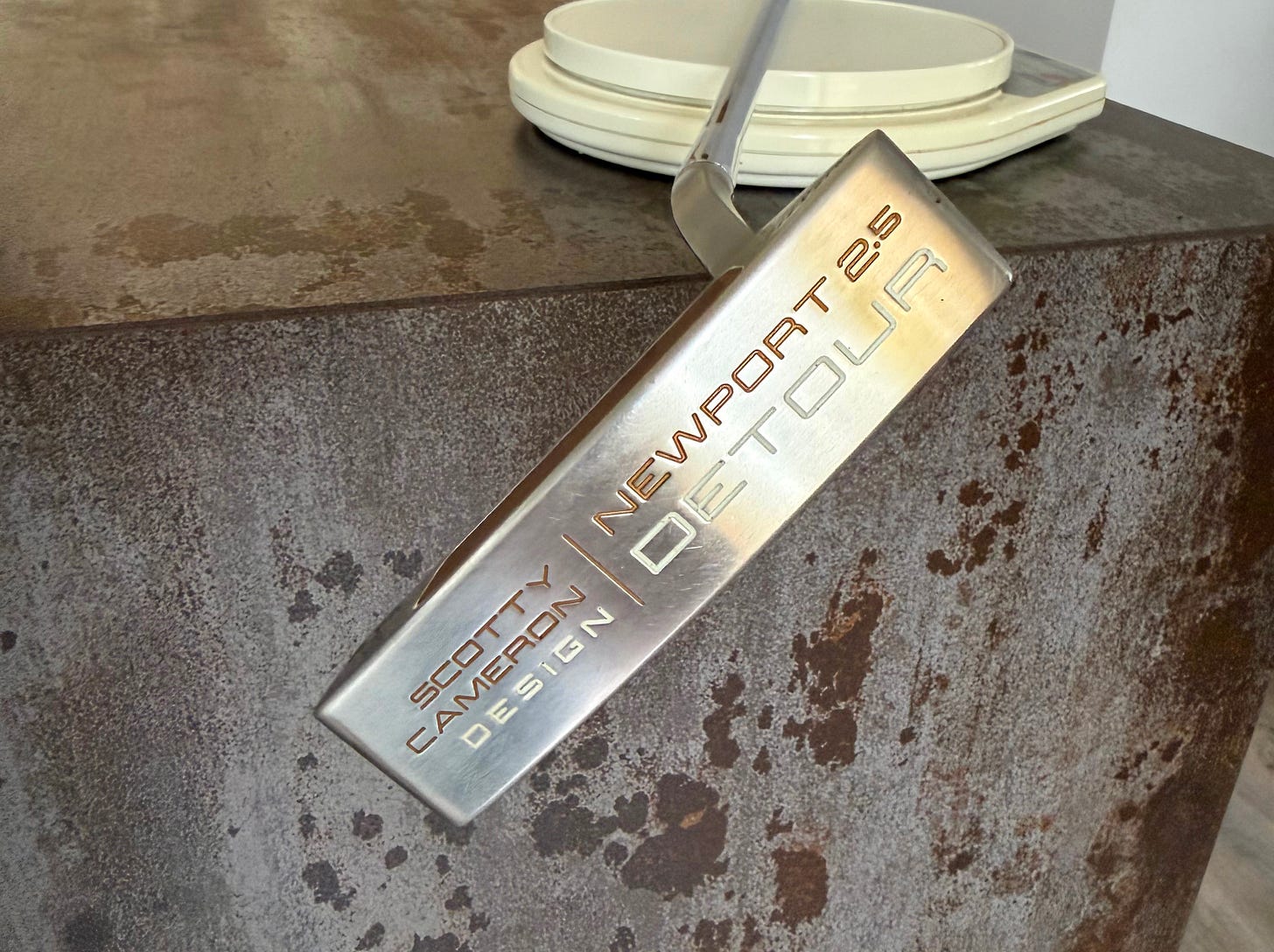
Interesting to see less toe hang than with the previous Newport 2.6 review
Protocol Snapshot (How I Tested It)
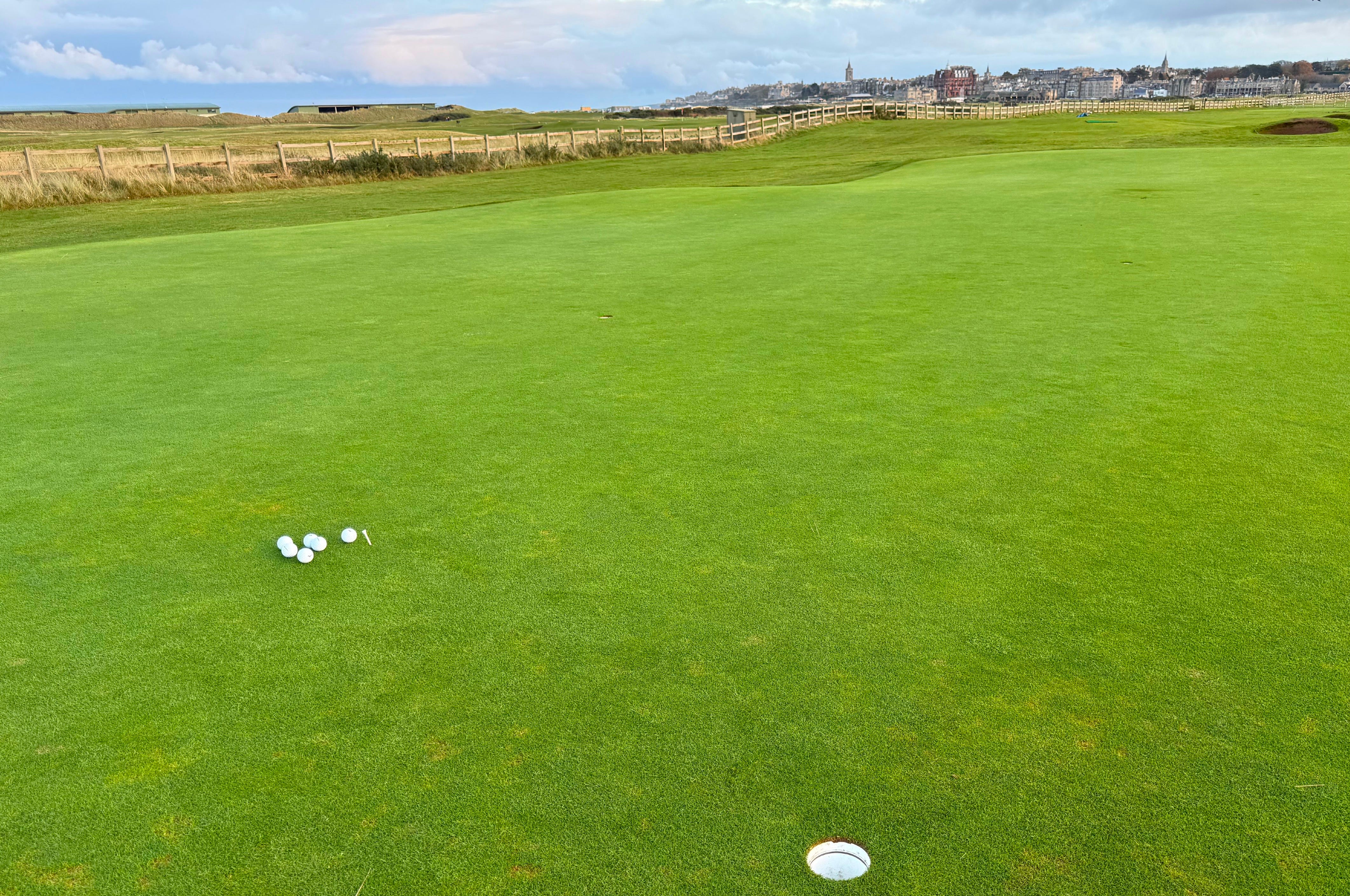
Surface: The St Andrews Golf Academy Eden green
Conditions: A cold, damp Sunday afternoon in early November.
Make Test: 6 putts x 3 reps from 3, 6, 9, 12, 15 ft
Lag Test: 40 ft to 3 ft - uphill and downhill - run once
Start Line: Gate drill using Aim Putt
Benchmark: Lajosi custom blade
Full testing framework: HERE
How Did It Perform?
Notes
It was a cold and damp afternoon, with plenty of moisture on the green. It hadn’t been cut for a couple of days either, so the grass was longer than usual and the green was running quite slowly. Nevertheless, it’s still my favourite place to test putters, and you can see from the results that I was putting well with both of them today.
As with my other recent tests, my Lajosi LP7JS was the benchmark. I also hit a few putts with a very old and rusty Circa 62 No. 3 to decide whether it might be worth restoring. More on that another time!
Pros and Cons
Looks (+ve): I’ve already made my feelings about the appearance fairly clear, but it’s worth mentioning how well the head sits behind the ball. There’s slightly more offset than with my Lajosi, but that doesn’t bother me at all. The higher toe, clean lines and complete absence of alignment markings all contribute to a shape that really suits my eye. It’s one of the nicest-looking putters I’ve owned.
Grip (neutral): The Scotty Cameron midsize Matador currently fitted is a very nice grip, but it’s just a little thicker than I normally prefer. I’d also rather have a black grip, as white tends to get dirty too easily.
I may remove and save the Matador, replacing it with another Ping PP58, which is my current grip of choice. That’s 6g lighter and would increase the swing weight slightly, possibly bringing it up towards C2. Alternatively, if I want to retain a Scotty Cameron grip, the smaller Matador weighs 77g, some 9g less than the current one.


Headcover (+ve): An unusual positive for me in a Scotty Cameron review, but this one comes with a Chris Finch headcover rather than the original Scotty. It has my preferred magnetic closure, the material feels excellent quality and the fit is very secure. There’s little danger of this one falling off!


Aim/Alignment (+ve): I know I’m a little unusual in preferring completely naked putters, but they seem to work well for me. This Newport 2.5 is no exception.
Without a sight line or dot, I find myself concentrating more on the leading edge of the putter. That feels more natural than trying to match a line on the head with my intended target line. I’m also comfortable with a simple dot marking the sweet spot, but I tend to use that to centre the ball at address rather than as an aiming aid.
There’s something rather ironic about taking a putter originally designed around an elaborate alignment system, removing it entirely, and discovering that the result works better for me!
Feel and Sound (+ve): I really wasn’t sure what to expect from the copper insert. I’ve used other flat-faced stainless steel Scotty Cameron putters before, and they have sometimes felt a little harsh, with a pronounced click at impact.
That’s not the case here. The copper insert produces a pleasingly solid sensation, accompanied by a slightly muted sound. There’s still enough feedback to know where you’ve struck the ball, but without the harshness I’ve occasionally experienced with other stainless steel blades.
I recently reviewed a Studio Select Newport 2.6, which has a stainless steel face with fine milling. Both putters produce a similarly solid click at impact, but the copper insert is a touch more muted.
I like both, but the Detour conversion probably has the edge for me.
Pace Control (+ve): This was perhaps the most interesting finding from the test, and an area where the Newport offered a noticeable improvement over my Lajosi.
Pace control has always been the weakest aspect of my Lajosi. When I commissioned it, I specified deep face milling, and I’ve often wondered whether that contributes to my tendency to leave putts short. It’s certainly a recurring pattern, although I can occasionally overcompensate and send the ball well past the hole too.
That tendency was evident again during this test, with most of the Lajosi’s misses finishing short.
The Newport was different. I found it easier to get the ball to the hole without feeling I needed to make an exaggerated stroke, and I wasn’t sending as many putts racing past either. My distance control felt more natural, and that gave me increasing confidence as the session progressed.
I wouldn’t necessarily attribute that improvement entirely to the copper insert. The two putters differ in head weight, swing weight, face construction and several other respects, so it’s difficult to isolate one particular factor. Nevertheless, the difference was noticeable, especially on a slow green where getting the ball to the hole can be a challenge.
For me, that’s a significant positive.
Performance Overall (+ve): The results were close, and I putted well with both putters. However, the more I used the Newport, the more confident I became, particularly with my pace control.
That was interesting because my Lajosi is a putter I know extremely well. I’ve spent a lot of time with it, understand how it behaves and have always been comfortable standing over the ball. Yet here was a relatively unfamiliar putter giving me at least as much confidence, and arguably more.
The Newport has now been in the bag for three rounds and has performed well on the course too. I haven’t been keeping my usual putting statistics recently, largely because it’s fiddly to operate my watch beneath several layers of autumn clothing, but I’ve been pleased with what I’ve seen.
It’s still early days, of course, and three rounds aren’t enough to establish anything definitive. But the signs are encouraging.
Price (+ve): This is a rare putter, especially in such good condition, and I paid £230 including delivery. I’m very happy with that.
You can certainly find newer Newport 2.5 models for a similar price, or sometimes less, but almost all will have sight lines, and very few will have a copper insert. Champions Choice and Teryllium models are considerably more expensive.
Original Detour putters are also becoming harder to find, and once you factor in the cost of conversion and restoration, I suspect you’d struggle to replicate this one for £230.
Of course, value is subjective, particularly with something as unusual as this. But given the quality of the work, the condition and how much I enjoy using it, I think I’ve done rather well.
What does Vertex say?
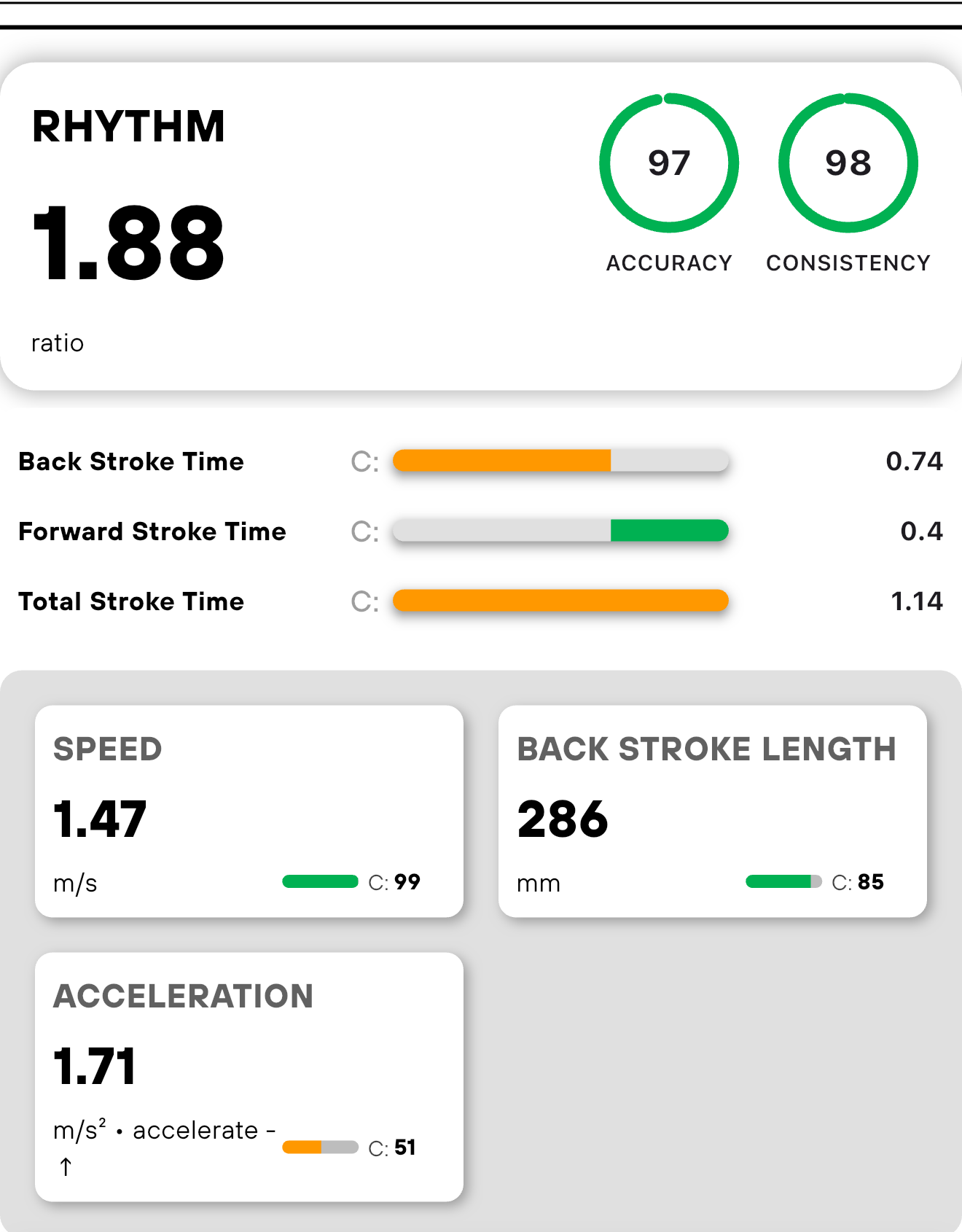
I completed the Vertex testing indoors on my putting mat. The putter that’s performed best for me on Vertex so far has been the TaylorMade Spider Tour V, but this Newport 2.5 has produced some encouraging results too.
The average face change was just 0.45° open, and the results were very consistent. By comparison, the Newport 2.6 I reviewed recently recorded 0.55°. Both are within the ideal limit of 0.6°.
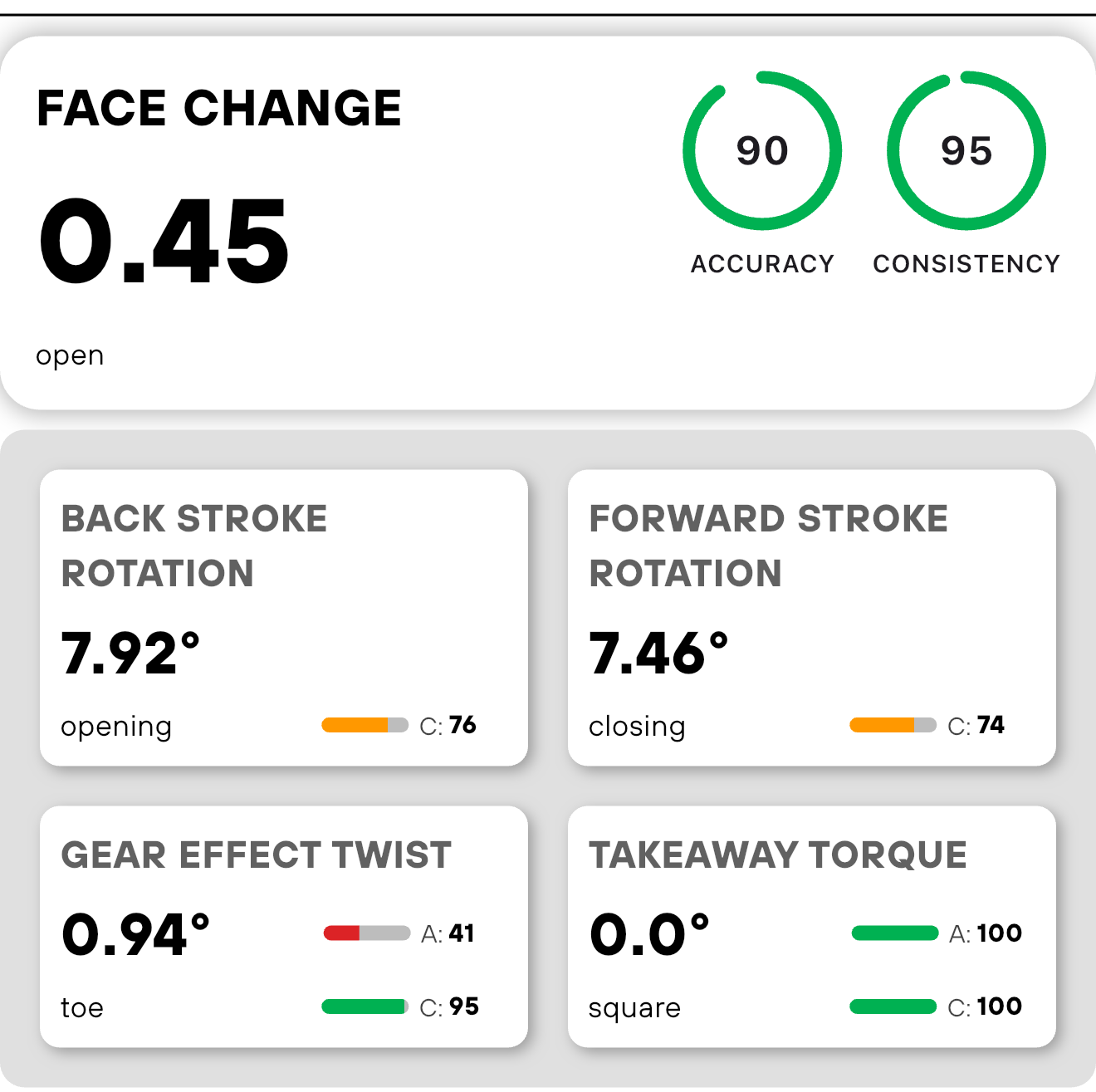
Tempo was also good and, again, remarkably consistent. What’s becoming increasingly interesting is the relationship between swing weight and my ability to deliver a repeatable stroke.
I’m beginning to see a pattern where putters with lighter swing weights seem to suit me particularly well. This Newport measures just C0, yet I had no difficulty controlling it, and the Vertex results suggest that my stroke was very consistent.
That doesn’t necessarily mean lighter swing weights are universally better for me, or that swing weight alone explains the results. There are other variables involved, including length, grip weight and head design. However, it’s another piece of evidence pointing in a similar direction.
There was also almost no manipulation of the lie angle during the stroke, suggesting that the current 71° is a good fit.
The less positive finding concerned shaft lean. I appear to be delivering the putter with more forward lean than ideal, effectively reducing its dynamic loft. The standard 4° loft is higher than my Lajosi, and when I was recently fitted for the Spider Tour V, Bradley Rowntree recommended reducing its loft by 2°.
It’s interesting to see a similar pattern emerging here. Perhaps my natural delivery is better suited to a putter with less static loft than the traditional 4°.
If the Newport remains in the bag, I’ll look at having the loft adjusted. For now, though, I don’t want to change too much when the putter is performing so well.
Conclusion
I’ve been looking for a good example of a Detour conversion for a long time, so finding this one so soon after testing the Newport 2.6 was a pleasant surprise.
It was love at first sight, which isn’t necessarily the best starting point for an objective equipment review. I wanted this putter to be good, and perhaps that influenced my initial impressions. But after completing my usual testing, examining the Vertex data and playing three rounds with it, I’m delighted to say that the performance has justified my enthusiasm.
What I particularly like is the simplicity. The original Detour was designed around an elaborate alignment concept, yet the conversion has removed all of that and produced a clean, traditional-looking blade with a rather special copper insert.
And for me, it works.
The improved pace control compared with my Lajosi was particularly encouraging, while the Vertex results have added to my growing suspicion that lighter swing weights may suit my stroke better than I’d previously appreciated.
It’s still early days, and I may make a couple of small changes to the grip and loft, but I can certainly see this putter staying in the bag for some time.
Chris Finch has done an excellent job with the conversion, and I wouldn’t hesitate to recommend his refurbishment work to anyone looking to restore an older putter.
It’s quite a transformation. From one of Scotty Cameron’s strangest designs to one of the nicest-looking blades I’ve owned.
Fit verdict (for me)
Would I game it tomorrow? Yes. In fact, it went into the bag before I’d even completed testing!
What would I change? Probably the grip, to something a little smaller and lighter. I may also reduce the loft.
What have I learned? Not all blades are created equal. The subtle differences between the Newport and Newport 2 shapes make a surprising difference to my confidence at address. I’m also beginning to appreciate just how much swing weight and face construction may influence my pace control.
You can find all my other putter reviews by following the link below.
If you’ve enjoyed this review, please give it a like. It helps more golfers discover The Club House.
And if you enjoy independent, real-world testing of golf equipment, along with the occasional exploration of the psychology and philosophy of the game, why not subscribe? It’s free, and you’ll get new reviews and articles delivered directly to your inbox.
Links:
Full testing framework: here
All my other putter reviews: here