
Introduction
This is a very interesting putter. It is a centre-shafted, wide-bodied blade/mid-mallet, with about 30° of toe-hang. Made from 303 Stainless Steel with an “aggressive” fly-milled face and a graphite grey PVD finish. It is an attractive putter.
This is the second Bettinardi putter I have tried recently, and some readers may remember the BB-48 that I tested last year. While I liked the look and performance of that putter, I really didn’t like how it felt. Will this one be different?
First Impressions
I was collecting a new bag from Auchterlonies when I spied a couple of Bettinardi putters in the second-hand store. The BB-28 immediately caught my eye simply because of the way it looked. I really liked the graphite grey finish and thought it was a great-looking putter. I’ve been searching for a centre-shafted putter to try for a while, and when I noticed that this one had some toe-hang too, rather than being traditionally face-balanced, I was super intrigued to try it.


My SeeMore putters are similar in that they are very close to being centre-shafted, but both have toe hang. While the Bettinardi is between 20-30°, my Mini-Giant is 60-70°, and the Nashville is almost a full 90°.
Specification (as tested)
Total weight: 564g (on the heavy side of normal)
Head weight: 358g
Swing weight: D9
Length: 34”
Loft: 3°
Lie: 70°
Toe Hang: Bettinardi spec says 1/4 toe-hang, I think it’s around 30°
Grip: Bettinardi branded Lamkin Sink Fit Deep Etched
Protocol Snapshot (How I Tested It)
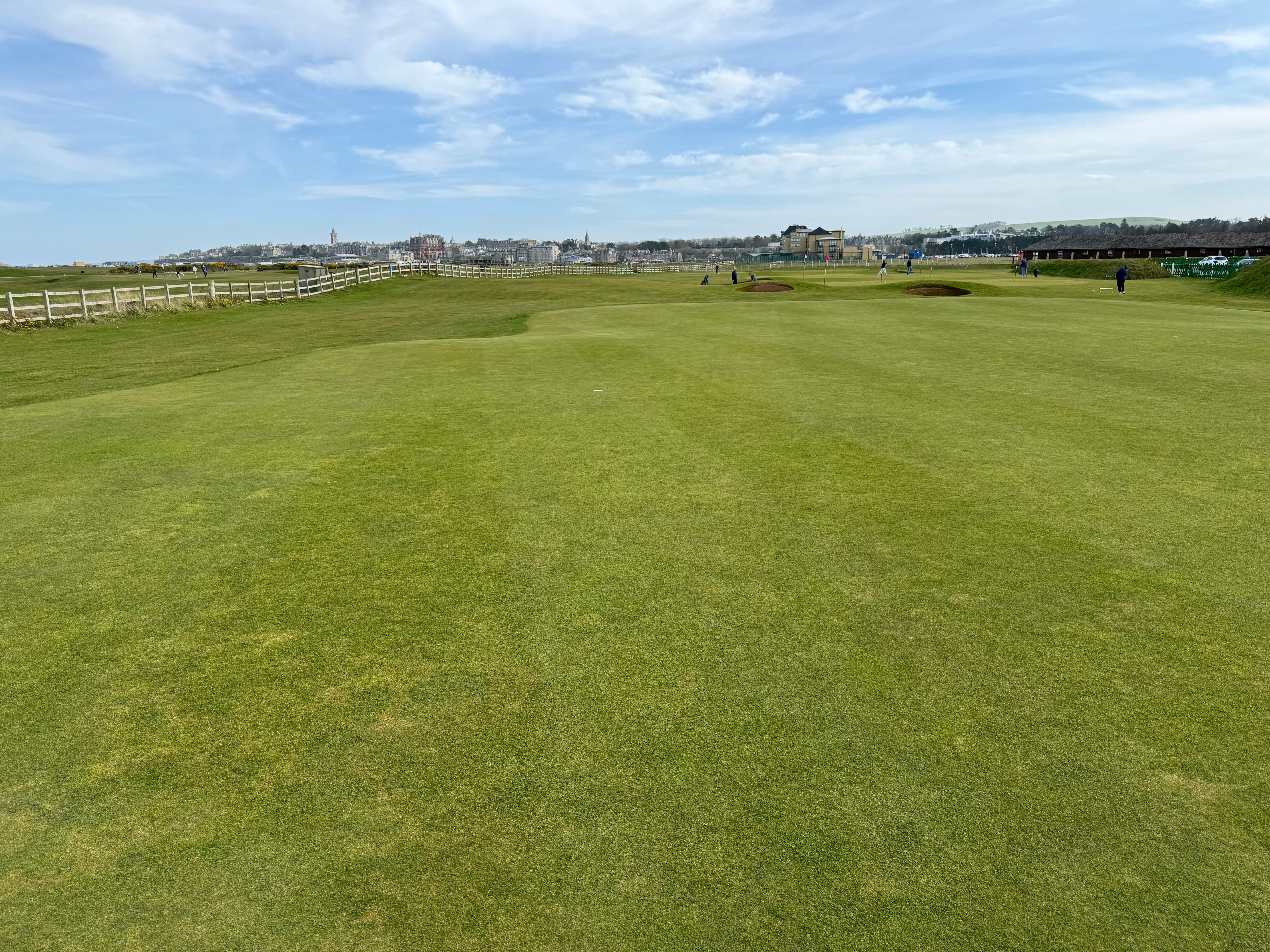
Surface: The very nice practice green at the St Andrews Golf Academy.
Conditions: A lovely April afternoon with warm sunshine and a gentle breeze. Just nice enough for short sleeves.
Make Test: 6 putts x 3 reps from 3, 6, 9, 12, 15 ft
Lag Test: 40 ft to 3 ft - uphill and downhill - run once
Start Line: Gate drill (two tees at 18 inches ahead, gate only just wider than a ball)
Benchmark: SeeMore Nashville mFGP
Full testing framework: HERE
How Did It Perform?
Notes
Oh, I wasn’t expecting that!
My SeeMore putters have seen off all comers, but are under serious threat from the Bettinardi. From the first putt, I felt very comfortable with it, and that only grew through the testing. The colour of the head hides its size and shape, and really helped me focus on the face when setting up.
This feels like a continuation of what I found through testing the zero-torque blades last season and from gaming the two SeeMore models. I like the putter shaft to be visually close to the face, and I like a putter that helps me focus on the strike area.
Pros and Cons
Looks (+ve): I think you’ll have gathered already that I like the way this looks. I’ve definitely got a preference for dark coloured putters, and I particularly like this graphite grey finish. A bit like my SeeMores, it’s a simple shape with few visual distractions (despite being essentially a large Anser shape).
Grip (+ve): I’ve always been a fan of the standard Lamkin Deep Etched grip, but this is the first time I’ve tried the SinkFit model. It has the same familiar shape, but I thought it felt even nicer than the standard model. I liked it.


Headcover (-ve): Another Velcro fastener. This one highlights the issues with that closure mechanism as it ages. One side has become pulled and frayed, making it look untidy, whilst also reducing its effectiveness. Interestingly, the BB-48 I tried last year had a magnetic closure, so maybe they’ve changed with newer models? Otherwise, it is an attractive cover that follows the graphite colour scheme and face milling, and provides good overall protection (for as long as it will stay on).


Aim/Alignment (neutral): I would describe this putter as giving me a three-way confirmation of squareness.
The shaft provides a reference.
The leading edge provides a reference.
The flange line confirms the geometry, rather than competing with it.
That’s unusual for me, as I normally don’t like rear lines, and I’ve struggled with Anser rear shaping. However, I think that’s mainly when they draw attention away from the face. In this case, it seems to be less of an issue, although, being totally honest, I still prefer the top line on the SeeMore.
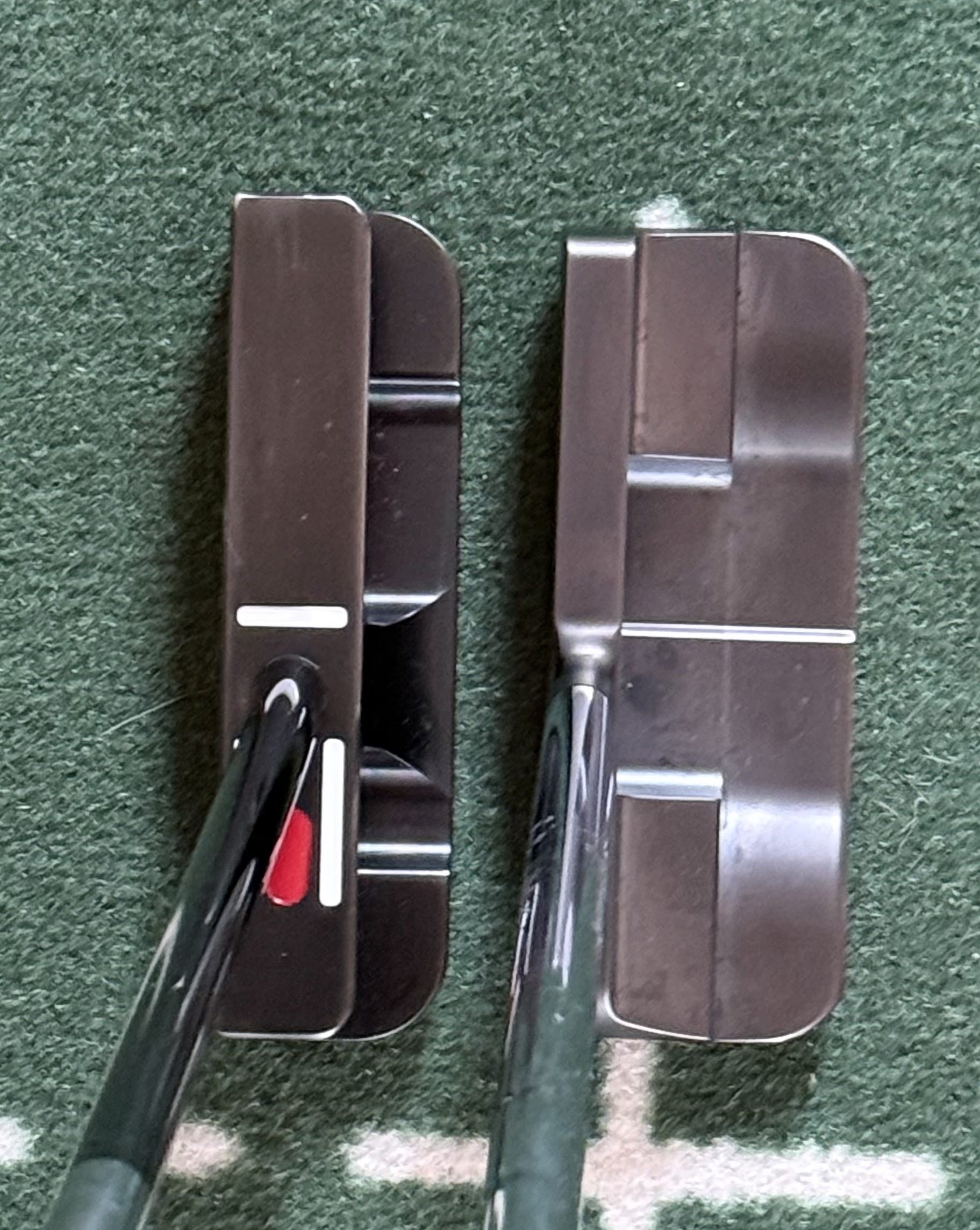
When I use the BB-28, I also imagine the RST aiming system from my SeeMore putters. That bottom part of the putter blade needs to remain hidden by the shaft.
Feel and Sound (+ve): Unlike my previous experience with the BB-48, this model has everything I look for in feel and sound. The BB-48 made me feel like I was putting with a snooker ball, but this BB-28 is considerably softer and exactly the right balance for a milled face. It provided excellent feedback on strike quality.
Weight (neutral): The only slight dislike I have with this putter is its weight, although I’m managing to make it work at the moment. (Head)Weight is something I seem to be quite sensitive to, but unless I go to a bespoke putter manufacturer, I’m limited to what retail manufacturers want to produce. Most heads appear to be in the 350-370g range these days, and only a few offer customisable weights. In an ideal world, I’d like to try this at 20g (or more) lighter.
Pace Control (+ve): The first thing that struck me, hitting a few balls around the practice green, was how immediately good my pace control was (despite the comment above about weight). There is enough toe hang that the putter feels like it flows naturally with my stroke, and I’m not fighting with it. I just needed to look at the hole, let the putt go, and almost inevitably it would finish close to the hole. It quickly built confidence.
On Course Performance (+ve): I was fortunate enough to have this putter for a few days when I had some real golf arranged. I put it in the bag for a round at the Craigtoun Course and a second round at Kingussie in the Scottish Highlands (a great little course with some stunning views). It may just be a honeymoon period, but SGP at Craigtoun was +4.0, and at Kingussie it was +4.6. This putter wants me to buy it! More testing to come.
Performance Overall (+ve): While it’s not the first putter to outperform the SeeMore benchmark in the standard testing, it is the first one I’ve wanted to take to the course and spend more time with. Not many putters have felt this comfortable, this quickly.
Price (neutral): This is a 2022 model putter. When released, it was likely around £399, and this second-hand example is for sale at £160. Bettinardi make excellent putters, but here in the UK, they are not that well known and don’t appear to hold their value particularly well. That makes them good value second-hand.
What does Vertex say?
This is the first putter I’ve tested since I got the Vertex putting sensor. It is a really interesting device, and more information is available here. Vertex provides a lot of data, but for this review, I’m going to focus on face change and rhythm.


Face Change: The target is to keep this under 0.6°. I know from previous SAM Puttlab sessions that I generally leave the putter about 1° open. The BB-28 saw most putts at 0.6° or less, but with a couple of extreme outliers. Interestingly, I never appeared to deliver the face closed, always open.
Rhythm: Optimal rhythm is considered around a ratio of 2, and the BB-28 was right on that average, with a range from 1.9 to 2.1.
As I said above, Vertex provides a lot of data, and I am still experimenting with the sensor. I’ve yet to decide if data helps these reviews or if actual putting performance is all that’s needed. Please let me know your thoughts in the comments section below.
Conclusion
Well, I genuinely didn’t think anything could replace my SeeMore putters. But, they may have met their match in the Bettinardi BB-28. Looks, feel, performance, and confidence make a winning combination.
This test made me think carefully about my putter preferences and challenge my views on rear lines. I am primarily a face aimer. I want the putter to let my eyes organise the picture from the front of the head rather than from the heel, hosel, or back flange. I generally prefer visual quiet and do not like rearward features that feel decorative, over-directive, or disconnected from the actual strike area.
However, this does not mean I dislike all alignment help. The BB-28 suggests that I can like alignment support when it is geometrically coherent. In other words, I seem to respond well when the putter gives confirmation, without adding clutter.
That is an important refinement.
Fit verdict (for me)
Would I game it tomorrow? Yes, it’s in the bag for some real course testing.
What would I change? The head-cover. It needs the Velcro replaced. Ideally, I would like to try a lighter version.
What have I learned? Some centre-shafted putters seem to suit my eye and make me feel very comfortable when putting. This Bettinardi and both my SeeMore putters are great examples. They simplify things for me, and that’s a big positive.
Final thought
So, overall, a bit of a surprise.
The BB-28 performed well in testing and then backed that up over its first two rounds on the course. Since then, I’ve had an enforced absence due to my ankle injury, so the pressure testing has been paused rather than completed.
That probably makes this more interesting, not less.
It is in the bag, but not fully settled.
Have you tried a centre-shafted putter, or any other Bettinardi models? Were they face-balanced, or did they have toe hang?
Let me know in the comments. I’d be really interested to hear what you thought, especially if you’ve found a centre-shafted model that suited your eye.
If you found this review useful, hitting the like button helps more people find it.
If you value independent testing and would like new reviews sent directly to your inbox, please subscribe. It’s free, and you can cancel at any time.
Links:
Full testing framework: here
All my other putter reviews: here
Oh, you find a possible competitor!! Center shafted Putters have a tendency to be a good match for your type of stroke isn’t that right? (à la Bruce). 😊