

Faith has become my golfing mantra.
Early in a round, it’s usually George Michael telling me that I’ve gotta have it. Later, if I’m getting nervous, I’ve had a couple of poor holes, or I’m trying to close out a good score, Bon Jovi takes over and reminds me to keep it. It sounds a bit ridiculous when I write it down, but that’s genuinely how it works. Before a tee shot, an approach or a putt, one of those songs will often drift into my head. Sometimes consciously, sometimes without me even noticing.
But faith in what?
For a long time, I probably thought it meant faith that I would hit a good shot, hole the putt or somehow produce the round I wanted. But I don’t think that is quite right any more. Confidence in a particular outcome comes and goes; it often disappears as quickly as it arrives. Faith feels like something different. Something quieter, something more permanent.
A few years ago, I started reading philosophy because I wanted to become a better man. It began as a way of making sense of life, then gradually became something I wanted to explore more deeply. It wasn’t long before those ideas found their way into my writing and then onto the golf course. Writing helped me understand what I was learning, while golf gave me somewhere to practice it. It is easy to understand patience, acceptance and perspective while reading a book. It is rather harder to embody them after a bad bounce, a missed short putt or three poor holes in a row.
Golf has a habit of revealing the gap between the person you think you are and the alternative person who appears when things become difficult. It doesn’t care how much you have read or how well you understand the theory. Sooner or later, it asks whether you can actually live it.
Fred Shoemaker, Tim Gallwey, Bob Rotella, Moe Norman, Sydney Banks and many others have become companions on my journey. They all approached golf, psychology and life from different directions, but I kept finding myself drawn back to similar ideas. Banks helped me recognise that a thought could be acknowledged without being treated as an instruction. Shoemaker writes about experiencing the game rather than trying to control it, while Rotella continually returns to commitment and trust. Even Moe Norman’s famous “feeling of greatness” seems to point in much the same direction. Different words perhaps, but a remarkably similar message: stop trying to manufacture the perfect outcome and get out of your own way. Stop trying to control what’s not within your control.
All of these ideas sounded wonderfully simple when I encountered them away from the course. But when I’m standing over a five-footer, with another thought arriving just as I’m ready to putt, they are much harder to live. The golf course has a wonderful habit of exposing the difference between what we think we believe and what we actually believe.
That is probably why AimPoint became more important to me than I expected. When I first wrote about learning AimPoint, I thought I was writing about green reading. More recently, I reviewed the AimPutt training aid, which gave me more confidence in my setup. Neither experience was actually really about putting, or at least not only about putting. They were facilitators for something else.
For years, I would stand over a putt having already made my decision, only to question it again. Was it really that much break? Should I move the line another cup? Had I under-read it? Then came my putter setup. Was I aimed correctly? Did I feel comfortable over the ball? Should I start again? The putt had not changed. Only the conversation in my head had.
AimPoint does not give me perfect reads, and AimPutt does not give me a perfect setup. Golf does not work like that. What they have gradually given me is enough clarity to stop searching for one more answer. I made the read, set up to the ball and hit the putt. Sometimes it goes in, and sometimes it does not, but the important change is that I stopped negotiating with myself before I struck it. The conversation in my head became quieter.
Something else happened that I had not expected. The more comfortable I’ve become on the greens, the less pressure I place on every shot that comes before them. For years, I’ve been asking my long game to compensate for a lack of trust with the putter. Every approach seemed to need to finish close because I was not entirely convinced I could deal with what came next. Without realising it, I had made the target much smaller than it needed to be.
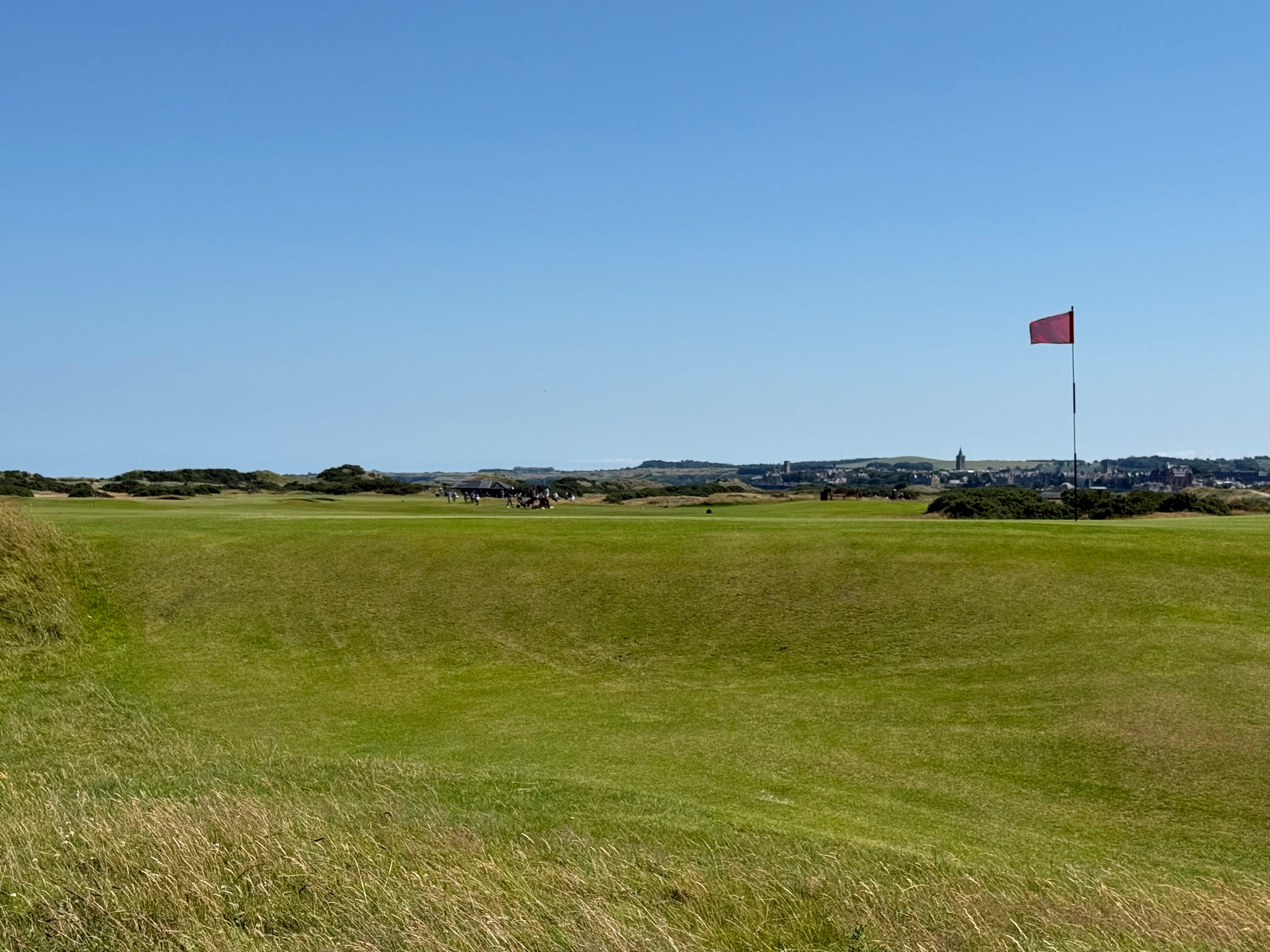
Now the job feels different. Most of the time, I am simply trying to find the green. From there, I trust that I will usually get down in two and, every so often, in one. That changes the way I play. The target becomes bigger, the decisions become simpler, and I stop chasing flags that do not need chasing. Twenty feet no longer feels like failure. It feels like another opportunity. The more I trust the golfer standing over the putt, the less I ask every other shot to be perfect.
That is not really a lesson about putting. It is a lesson about what happens when you finally allow the golfer you have spent years building actually play. Gallwey’s idea now feels much closer to faith than sports psychology. The body knows what to do, if only the conscious mind will let it. The work has already been done through practice, experience, mistakes and reflection. The hardest part is often resisting the urge to add one more instruction just before the club moves.
Neither AimPoint nor AimPutt created that trust. They simply removed enough doubt for it to emerge. They gave me fewer reasons to interfere, and that allowed me to hear something I had perhaps known for a long time: you have done enough. Now let the golfer play.
Nick Faldo gave me another way of thinking about that recently when he asked what you are going to do if your A game does not show up. Do you have a Plan B, a Plan C, or even a Plan D? For years, I think I was waiting for my A game to become my permanent game. Golfers are always talking about having “found it”, usually meaning a swing thought, a feeling or some technical discovery that suddenly makes the game seem easier. Then, inevitably, we lose it again.
But Faldo’s question made me realise that my A, B, C and D games are not different golfers. They are all me. Every one of them has been shaped by the same years of playing, practising, succeeding, failing and learning. Some days my A game arrives on the first tee, and some days it does not. Golf, like life, is different every day. The weather changes, the course changes, the company changes and, whether we like it or not, we change too. Faith cannot depend on which version happens to turn up that morning.
This also changes the way I think about perfection and comparison. Perfection tells me I am not quite ready yet, that there is still something to fix before I can really trust myself. Comparison tempts me to look sideways and wish I had somebody else’s game. Neither is particularly helpful when I am the one who still has to hit the next shot. Faith asks me to accept the golfer who arrived this morning and trust him unequivocally. And perhaps that explains why another song, Have a Little Faith in Me, has joined the others. I used to think it was someone external talking to me. But now I hear one part of me quietly speaking to another and simply asking for trust.
That does not mean the obstacles disappear. I still hit poor shots, miss short putts, make bad decisions and occasionally I allow frustration to get the better of me (I’m still a work in progress, even at 57). Perhaps I need those moments. It is easy to talk about patience when nothing is testing it, acceptance when everything is going well, or trust when my A game has actually turned up. Increasingly, I think the difficult moments are the lesson.
Golfers are perpetually searching for “it”. The magic swing thought, the tip that changes everything, the new club that will revolutionise our game. I’ve certainly done my share of searching. But none of those things lasts. The swing thought disappears, the tip stops working, and sooner or later the new club is replaced by another. Perhaps I’ve spent all these years searching for something permanent in all the wrong places.
Maybe the permanent version of it is faith.
Not faith that my A game will arrive, but faith in whichever game does. Not faith that the putt will go in, but faith in the person hitting it. Not faith that everything will work out as I want it to, but faith that I can meet whatever happens next.
So, after all these years of searching for “it”, have I finally found it?
I’ve gotta have faith.
If you enjoyed this, subscribe to The Club House. There will always be plenty of equipment reviews, but every so often we’ll leave the clubs behind and explore what the game might be teaching us about ourselves.
The Soundtrack (Spotify):
George Michael, Faith
Bon Jovi, Keep the Faith
John Hiatt, Have A Little Faith In Me
Thanks for the great post Keith!!!