

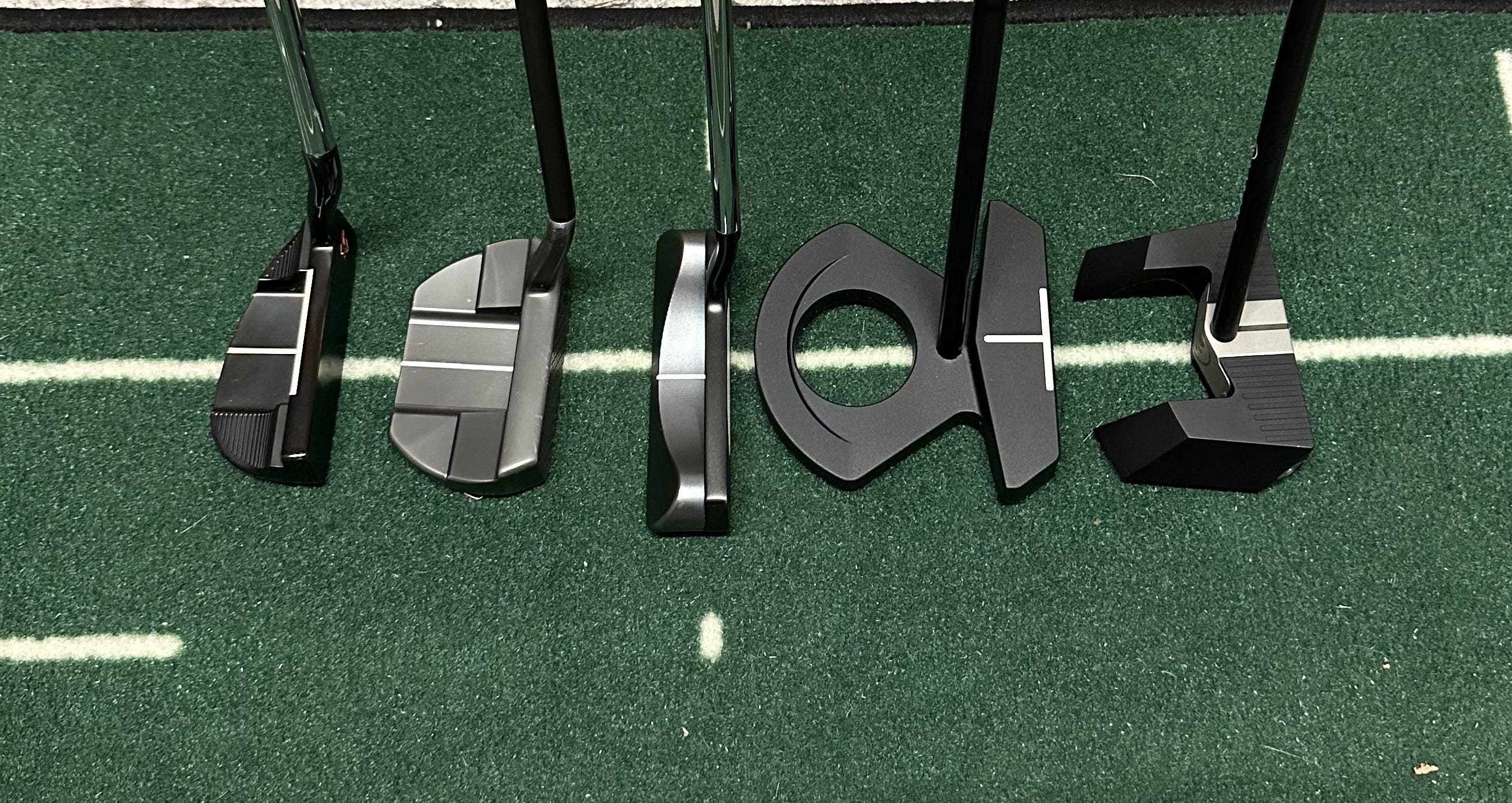
I have this conversation with myself more often than I’d like to admit.
Me: “You know loads of the best players in the world are using mallets now, right?”
Also me: “Yep.”
Me: “So… why aren’t you?”
Also me: “Good question. Let’s talk about it.”
This isn’t me trying to explain what Tour pros are doing or why the market has moved the way it has. I’m not a putting coach. I’m not an expert. I’m just someone who’s tested a lot of putters and noticed something consistent about my own putting: when a putter makes aiming feel obvious, my pace gets better, and my stroke gets quieter. When it doesn’t, I start negotiating with it, and that’s usually the beginning of the end.
First, a confession: I’m not anti-mallet
Me: “Be honest. Have mallets worked for you?”
Also me: “Some have.”
My original benchmark gamer was a Toulon Atlanta. In 2025, I nearly put a Scotty Cameron Monoblok 6.5 in the bag. I also tested the 2025 Scotty Cameron Fastback 1.5 with the new vertical alignment system and found it genuinely interesting.
So no, this isn’t “mallets are bad” or “mallets are for someone else.” Mid-mallets have been perfectly workable for me.
Where I’ve struggled more consistently is with bigger, full-mallet shapes. I’ve tried a handful over time, including an Odyssey 7S (slant neck), Ping Craz-E, an all-black Odyssey #11, a Scotty Cameron 9.5 (short slant neck), and a TaylorMade Spider slant neck that I tried in a fitting studio (indoors rather than on a putting green, so I’m careful not to overstate that one).
And just to head off the obvious follow-up: I have explored zero-torque options too. I even summarised my 2025 testing in a separate post and listed my top three zero-torque putters from the year. So this isn’t me dismissing the concept. It’s me trying to explain why, despite trying several different approaches, full mallets still tend not to be my answer.
So the question isn’t “do mallets work?” They clearly do. The question is: why do some mallet-ish shapes work for me (mid-mallets), while full mallets so often don’t?
The main thing: I’m a face-aligner, not a rear-aligner
Me: “Mallets are supposed to help you aim.”
Also me: “Right. But what am I aiming with?”
Some golfers aim primarily with what’s happening behind the face: long lines, tracks, rails, high-contrast shapes. They stand over it and think, that looks online. For those golfers, full mallets can be a cheat code.
I tend to aim with the face: the leading edge and topline, the way the face sits relative to the target, and whether it looks square the moment I set it down.
If the face looks square, my stroke tends to just happen.
If it looks even slightly open or slightly closed, the stroke becomes a negotiation.
And here’s where it gets awkward: sometimes a big rear “alignment story” can make me feel aimed while the face is doing something subtly different. When my attention gets pulled away from the face, I’m not really aiming anymore. I’m hoping.
Why mid-mallets have often worked better than full mallets (for me)
Me: “So why did the Atlanta work?”
Also me: “Because it still lets the face lead the conversation.”
With the Toulon Atlanta, the head gives me stability and a clear reference without drowning out what I care about most: where the face is pointing. It became my benchmark for a reason. It didn’t ask me to think much.
Same story with the Monoblok 6.5. It’s mallet-ish, but I didn’t feel like it was trying to “aim for me” from ten different places. The front of the club still felt like the reference, not the back.
And the Fastback 1.5 was interesting because the vertical alignment felt closer to how my brain wants to aim. More “square the face” than “follow the runway”. That’s likely why it performed so well on the SAM Puttlab.
So mid-mallets can be a workable middle ground: some help, without overwhelming my primary reference.
Why full mallets tend to break down for me
Now compare that to the full mallets I’ve tried recently.
Scotty Cameron 9.5 (short slant neck): The double alignment line on top drove me to distraction. It was almost like blurred vision, and I never felt settled.
Odyssey #11 (all black): Visually, this was an improvement. I liked the cleaner, blank back, but the overall rear shape still pulled my attention away from the face. Better, but still not my answer.
Spider (slant neck, studio only): Cautious caveat, indoor session only. It didn’t perform well for me there. More importantly, it didn’t give me that instant “this is square” feeling that stops the fiddling.
Me: “So what’s the verdict?”
Also me: “Not ‘bad putters’. Just not a visual match for me.”
The stroke piece: arc, timing, and the feel of closure
There’s also a stroke component I can’t ignore.
I have a strong arc, and I tend to putt best when the head can release naturally. Higher MOI can be brilliant, but for me, it can also change the feel and timing of how the face wants to rotate. If the head feels like it resists rotation, one of two things can happen:
I hold it off and start it right because I don’t quite let it go.
Or I try to “help” it release, and the strike/timing gets messy.
That’s not a universal truth. It’s just how it shows up for me when the head shape and my aim preferences aren’t aligned.
What I’m learning (and the questions I’m asking)
The primary lesson:
I don’t need more alignment information. I need the right alignment information.
When a putter should suit me on paper but doesn’t, I try not to overthink mechanics. I just ask myself, quickly:
Am I aiming with the face/topline, or am I being drawn to the shape behind it?
Do I feel settled straight away, or do I start fiddling?
Does it look square immediately?
When I miss, is it usually the start line or the pace that breaks first?
I’m not writing mallets off. I’m just being more specific about what I’m actually looking for:
options that keep the face/topline as the primary reference,
alignment systems that feel face-relevant (vertical cues, simple flange lines),
neck/CG setups that let the head release naturally with my arc.
If you’re someone who naturally aims with the back of the head, a full mallet could be a great fit. If you’re like me and need face clarity, too much rear “story” can become conflicting noise.
Closing thought
Me: “So why don’t you use a mallet?”
Also me: “Because the best putter for me is the one that makes aiming effortless.”
Mallets are popular for very good reasons. But “popular” doesn’t automatically mean “better for me”. My putting improves most when the putter helps me do two things: aim the face with confidence, and release the head naturally with my arc.
If you’ve ever stood over a putt thinking, this putter should work… why doesn’t it? It might not be your stroke. It might be your eyes.
Do you aim with the face or the shape behind it? Have you tried mallets and returned to a blade? Reply in the comments, because I’d love to hear your thoughts.
Next post teaser:
Next up is my Yes! Tracy II review. After that, I’ll examine the question this post hints at: why some blades look square to me instantly, while others look open.
Subscribe if you want the next one direct to your inbox.
Links:
All my thoughts about putters and putting can be found here: On the Green
My 2025 review roundup is here: The 2025 Putter Review Roundup
How I test putters is here: Putter Testing Framework
Keith good post!! Aiming is definitely huge. I overall hate lines. My Goodwood Square Back putter has one dot on it, no lines. I can aim it well. Tiger and others have a dot or no dots or lines on putters. There is a good reason for this, it is what they aim well. Mallets work well for some, but not everyone. You have to test like you have.