

I’ve had various 3 hybrids in the bag for many years, but I’ve never been completely convinced that they are the perfect solution for me. They have always made sense on paper. They replace a long iron, fit the gap between fairway wood and 4 hybrid, and should offer a useful blend of distance, control and forgiveness. The problem is that sense on paper does not always translate into trust on the course.
My current 3 hybrid is a Callaway Paradym Ai-Smoke, which has been in the bag since mid 2024. It is set at 19 degrees and fitted with a Graphite Design Tour AD-DI 85s hybrid shaft. It sits around the 200-yard spot, gaps nicely between my Qi35 3HL and 4 hybrid, and has been useful as a long iron replacement. I would not describe it as a bad club. It has just never become one of the clubs I automatically want to pull from the bag.


Off the tee, the hybrid has generally been good. From the fairway, it has been less consistent, and from the semi-rough I often prefer my 4 hybrid because it seems to get through the grass better. It can also climb a little too much into the wind, which is not ideal when most of my golf is played on links courses. I’ve always wondered whether there might be a better option in that part of the bag.
Last season I tried some utility irons, and while I quite liked them as an alternative for windy days, they didn’t inspire real confidence. They had a use, but they didn’t feel like the everyday answer. The obvious alternative was a 7 wood, although for a long time I didn’t think they were for a “better player”. That probably says more about my own prejudice than the club itself. It felt like an old man’s club: sensible, practical, probably effective, but not exactly the kind of club I expected to put in my own bag.
The perception of higher lofted fairway woods has changed. Considerably. More professional golfers are using them, there are now more adjustable options available, and the practical case against hybrids is becoming harder to ignore. A 7 wood should generally be easier to launch, more forgiving, and for some golfers more visually appealing behind the ball. It can also produce a strong flight without the same ballooning tendency I have sometimes seen from hybrids.
This test was really about trust. My 3 hybrid already filled the right yardage gap, but I wanted to know whether a 7 wood could do the same job while giving me more confidence from the fairway, the tee, and light rough.
The fitting studio
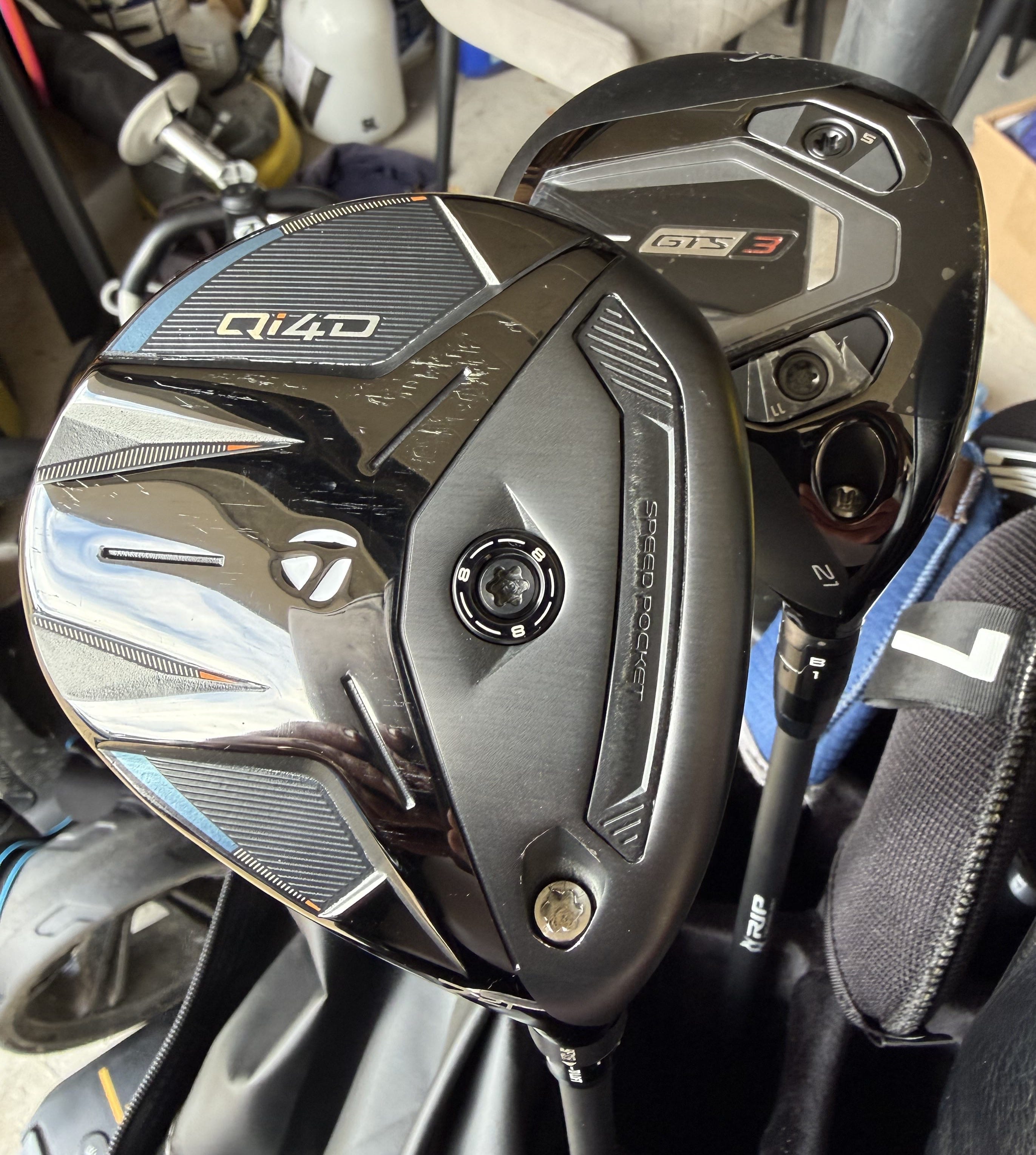
The test started with Adam Legg in the Auchterlonies fitting studio. Adam suggested I try two new options: the Titleist GTS3 and the TaylorMade Qi4D. Unfortunately, I do not have the TrackMan data from the session, so this is more of a practical test than a numbers-led review.


The first thing that impressed me was how nicely both clubs sat behind the ball. My immediate preference was for the Titleist GTS3. To my eye, it looked shallower and a little more inviting than the TaylorMade Qi4D, which had a deeper profile. I had the same concern initially with my Qi35 3HL, but quickly got over it once I used it on the course, so I tried to stay neutral.
Both clubs were very easy to launch. They were carrying around 190 to 195 yards and running out another 10 yards or so, which put them exactly where I needed them to be. More importantly, they inspired much more confidence than my hybrid ever has. The flight was strong and penetrating, without ballooning.
I also found it easy to move the ball around in my stance to alter the flight. That made both 7 woods feel more flexible than my hybrid. After the studio session, there was very little between them. The GTS3 probably won the beauty contest, but performance-wise it was a draw. Adam generously suggested I take both clubs away for a few days, try them on the course from different lies, and test them properly.
On the course
I had a game arranged at Craigtoun, so I took both clubs with me. Before the round, I warmed up with each of them and had the same confidence-inspiring experience I’d had in the studio. Both launched easily, both produced a strong, useful flight, and both immediately felt more comfortable than my 3 hybrid.
On the course, the balance started to tip towards the Qi4D. From standard fairway lies, there was very little to separate them. Both were easy to launch, and both gave me the carry distance I wanted. Off the tee, though, I started to prefer the deeper face of the Qi4D, and from fluffier semi-rough lies it also gave me more confidence that I could make a normal swing. With the GTS3, I had the feeling that I might slide under the ball and sky it. That might not be a fair criticism of the club, but it was there in my head, and that is part of testing too.
With a second round booked later in the weekend, a club outing to Kingsbarns, I decided to make the test simpler. The GTS3 had done nothing wrong, but the Qi4D had started to edge ahead, so, after a final session on the range there, rather than keep switching between both, I put the GTS3 in the car and only took the Qi4D on the course.
That turned out to be the right call. The Qi4D was excellent at Kingsbarns and quickly became my go-to club for long fairway shots, which is not something I would ever really have said about my 3 hybrid. It was easier to hit from the fairway than my 3HL, and it almost went as far. I suspect some of that is just confidence. When a club sits well, launches easily, and gives you the sense that you don’t need to manufacture anything, you swing more freely.
Round one in the fitting studio was a draw. Round two at Craigtoun was a narrow win for the Qi4D. Round three at Kingsbarns confirmed it.
Into the bag
After the test, the Auchterlonies second-hand shop happened to get a Qi4D in as a trade-in, so I bought it immediately. The club has the standard REAX shaft (white profile). Adam and I may look at trying a Ventus option to match my Qi35 3HL at some point, but there’s no rush as the standard shaft is working well enough for now.
Having now had the Qi4D in the bag for several rounds, I’m delighted with the change and don’t miss the 3 hybrid at all. That has probably been the most telling part of the whole test. I expected the 7 wood to be easier to launch, and I expected it to be good from clean fairway lies. What I didn’t expect was that I would trust it more on windy links days too.
So far, it hasn’t ballooned in the wind the way my hybrid sometimes could. I also find it easier to work the flight down when I need to. A 7 wood has a reputation for launching high, which is useful, but on a windy course high can quickly become too high. The Qi4D has given me height without taking away control.
Final thoughts
I went into this test wondering whether a modern adjustable 7 wood could replace my 3 hybrid, and for me the answer is yes. The Titleist GTS3 impressed me, especially in the fitting studio and from clean lies, but once I took both clubs onto the course, the TaylorMade Qi4D became the more convincing option.
Not because it was any longer, and not because the numbers told an obvious story. It won because it gave me more confidence from more lies, and that confidence translated into better golf shots.
So, the 3 hybrid is out of the bag, and I don’t see it coming back.
Now, can I convince myself not to buy the 9 wood that was also available?
Thanks for reading
If you enjoyed this review, please consider liking the post, leaving a comment, or subscribing to The Club House. I’ll keep testing the clubs, putters and golf ideas that interest me, and sharing what I find in the same honest way.
I’m especially interested to hear from any reader who has moved from a hybrid to a 7 wood. Did it solve the same problem for you, or did you end up going back?
Extra:
For anyone wondering about the No Laying Up towel featured in the photos. This was a special commission with all profits going to the My Name’5 Doddie Foundation to raise funds for Motor Neuron Disease.
A 7 wood just seems to exude confidence and I certainly would change….
I just bought a 7-Wood. Cobra Ds-Adapt with Denali Red shaft (Regular) (21.5°). My other clubs have a stiff shaft. Love it, reliable, probably for now the best club in my bag.