

Introduction
For a long time, I thought remote-controlled golf trolleys were just an expensive fad. My PowaKaddy CT6 did everything I needed and, despite some reliability issues, I liked the design and how easy it was to manoeuvre. A remote trolley seemed like an expensive answer to a question I wasn’t really asking.
That gradually changed. Injuries and subsequent conversations with friends and other golfers who already used remote trolleys swayed my opinion. Several people talked about the physical benefits of being able to walk more naturally, with both arms free, rather than constantly reaching for a trolley and twisting to steer it. With recent back injuries, reducing strain and twisting on my back started to sound much more significant than I had previously thought.
Eventually, I decided to try one, but what followed wasn’t quite what I expected. As always before a large purchase, I did a lot of research and spoke to as many users as I could find. I then bought a Stewart Q Follow, really liked some aspects of it, became increasingly concerned about others and eventually returned it after only a few weeks. Then I bought a Motocaddy M7 GPS Remote, which I’ve now been using for around six weeks (and haven’t returned!).
This isn't really two conventional product reviews; it’s the story of moving from one trolley to another and why I’ve done that. So, while Robot Wars might suggest a straightforward battle with one trolley emerging victorious, that isn't quite what happened.


Why a remote trolley?
The main attraction wasn’t laziness, or the novelty of controlling my trolley from a distance (which isn’t actually as easy as it sounds). As mentioned above, the more I spoke to people who used remote trolleys, the more I believed there could be a genuine physical benefit. With a conventional electric trolley, you still need to reach for the handle to steer it and adjust the speed. Although it’s powered, you remain physically connected to it for much of the round. Which is helpful for pulling me up some of the hills at the Craigtoun Course.
A remote trolley allows you to send it ahead and simply walk. Both arms are free; I can stretch my shoulders as I go and, most importantly for me at the moment, there is less reaching and twisting to control it. Having used remote trolleys now for a couple of months, I definitely notice less fatigue at the end of the round, and I like being able to walk more naturally between shots.
Ironically, I still sometimes forget I have the remote and revert to old trolley habits. After years of walking and holding my trolley, it is taking me a while to remember that I can just let it go.
Why the Stewart Q Follow?
The Stewart appealed for several reasons, not least because its four-wheel chassis looked exceptionally stable. The Follow function was also intriguing. Rather than simply controlling the trolley remotely, you can have it follow you around the course, which sounded like the ultimate version of the hands-free experience I was looking for.
Before buying it, I spoke to several existing owners. I was aware of some concerns regarding the robustness of the handle and chassis, but most feedback was generally very positive. While I found that reassuring, perhaps there was also a little buyer justification going. After an expensive purchase, most of us want to believe we’ve made the right decision. Either way, I went into the purchase aware that it wasn’t necessarily flawless, but sufficiently reassured by people who actually owned one.
I bought mine online from Bargain Golf Equipment at Seaham Golf Club and, initially at least, I was delighted with it.
First impressions of the Stewart
The Q Follow is a substantial piece of equipment. It’s heavy, but it feels solid, and once unfolded, the four-wheel design gives it a reassuringly planted stance. More impressively, it folds into a remarkably compact package considering its size and weight. The folding mechanism is clever; there’s a practical carry handle, and it fits very easily into my car boot.
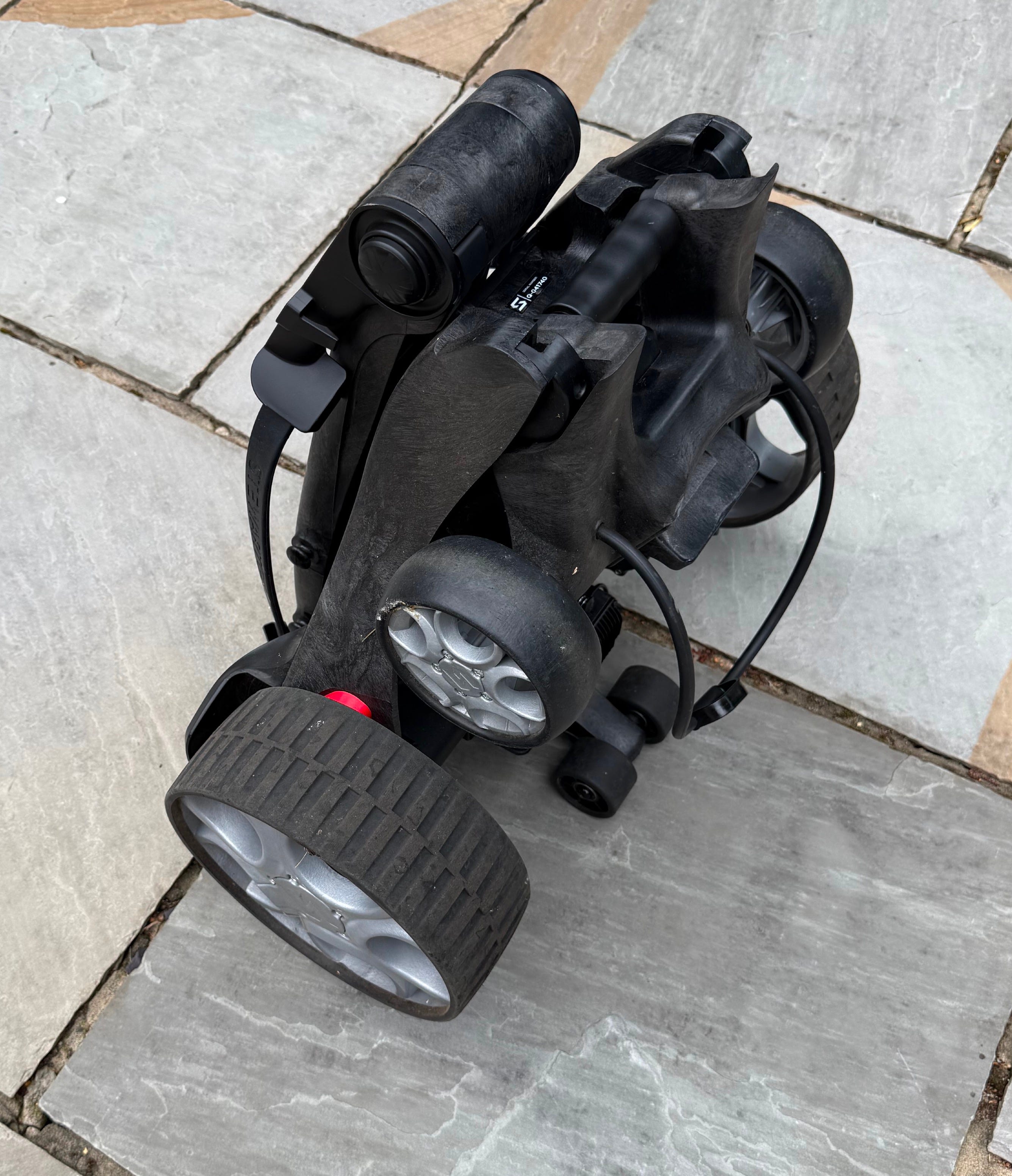
On the course, the chassis is probably the best part of the trolley. It is quiet, extremely stable and very secure on side slopes where it tracks well without needing constant little corrections. Once moving at normal walking pace, it feels very natural to control, and I quickly became comfortable sending it ahead of me.
Slow speed manoeuvring is less impressive. This is a big, heavy trolley and moving it around confined spaces isn’t particularly easy. It was particularly tricky to get over car park kerbs! That’s not unique to the Stewart, though, and is something I’ve subsequently found with the Motocaddy too. My old CT6 was much easier to shuffle around manually, whereas with both of these I often find myself using the powered wheels and remote to help manoeuvre them. The M7 wheels can be adjusted to freewheel, which I may start doing more often when walking from the car.
Following the golfer
The Follow function is the feature that separates the Stewart from most remote trolleys and, technically, it works remarkably well. There is something undeniably clever about walking away and having your golf bag obediently trundling along behind you. But it is a very expensive option too, at around £400 extra.
In practice, I used it much less than I expected. It was most useful on relatively flat, open parts of the course, but those were also the places where simply sending the trolley ahead with the remote was also easiest. On more complicated terrain, I preferred having the trolley where I could see exactly what it was doing, as I didn’t particularly like having my clubs behind me. Headcovers, towels and other bits and pieces occasionally work loose from a golf bag, and I found myself wondering whether something had fallen off without me noticing.
However, it is an impressive feature, and I’m glad I tried it, but for me it turned out not to be the reason to own the trolley. The greater benefit was simply having remote control and the freedom that gave me while walking.
The little things started to bother me
My concerns with the Stewart weren’t really about how it drove. Quite the opposite. Out on the course, I thought it was excellent. It was the small details around the overall product build quality that gradually started to bother me.
The battery has excellent capacity, but it is large and heavy, and removing it is slightly awkward. More strangely for a premium product, there is no simple charge indicator on the battery itself, and you have to use a phone app. The remote is similar, so something as basic as checking whether your trolley and remote are ready for tomorrow’s round (or two rounds in the same day) becomes more complicated than I think it needs to be.
Charging the remote also requires its own cable rather than a conventional USB cable. Stewart specifies the power output required and warns that your warranty will be invalidated if you use the wrong charger, but doesn’t supply a compatible charging plug!
None of these things is disastrous in isolation, but on an expensive trolley I kept finding myself wondering why straightforward things hadn’t been made more straightforward.


I had similar reservations about the handle. I knew before buying the trolley that other owners had expressed concerns about its robustness, and while mine didn’t fail, it never felt like the strongest part of an otherwise substantial machine. When you have to put force through the handle to lift wheels over kerbs etc, you want something more robust than plastic. The fundamental chassis feels hugely robust, yet some of the smaller components attached to it don’t inspire the same confidence.
And then one of those small components failed.
A very small part with a very big consequence
The battery is retained by a small plastic clip. Mine stopped operating properly after only a few weeks, leaving me unable to release the battery normally.
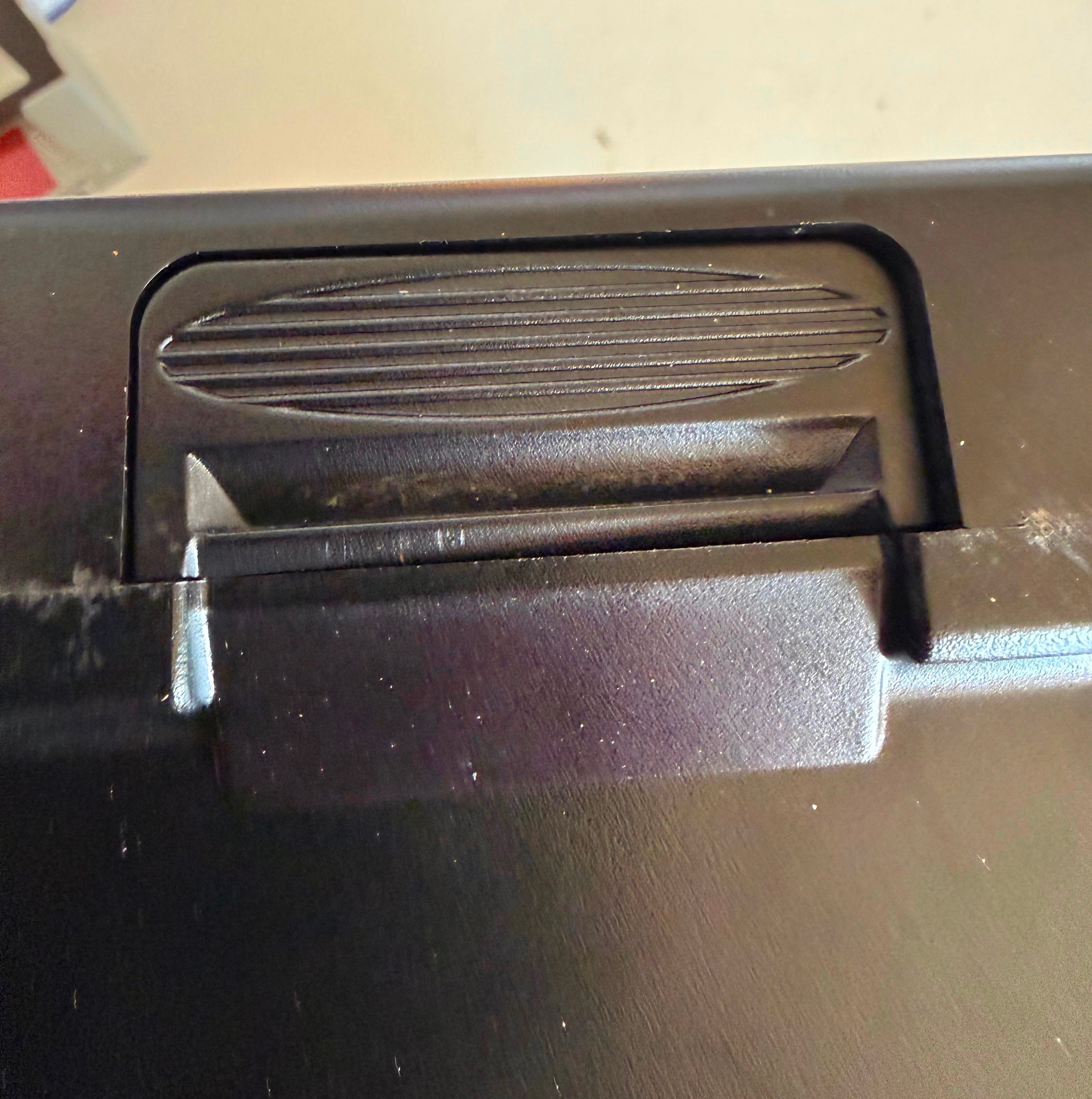
I can’t say definitively what caused it. My suspicion is that sand or grit may have found its way into the mechanism, but that’s only my theory. Golf trolleys inevitably encounter sand, grass, mud and water, so it did make me wonder how well this particular part of the design has been tested in the environment in which it actually has to operate. I subsequently heard of other owners experiencing a similar problem.
What struck me most was the absurdity of it. Here was a sophisticated, premium electric trolley with remote control, Bluetooth connectivity and the ability to follow its owner around a golf course, compromised by what appeared to be a tiny plastic component that probably costs pennies.
Perhaps that’s unfair. Any component on any product can fail. But because I’d already started questioning some of the smaller details, the clip failure increased my concerns.
When a small fault becomes a bigger problem
This is where the story changed.
I had bought the trolley from Bargain Golf Equipment, but the warranty issue needed to be coordinated through Stewart. For a product less than 30 days old, I expected a replacement would be sent and the faulty one collected. Their initial proposal was that I return just the battery to them. That would obviously have left me with a virtually new trolley that I couldn’t use, which didn’t seem reasonable when I’d owned it for only a few weeks.
I asked instead for a replacement battery to be sent out, after which I would return the faulty one. Stewart weren’t initially keen on doing that, and communication took longer than I would have expected. Eventually I decided that I no longer wanted to continue with the trolley and exercised my right to return it.
Stewart subsequently offered to send a replacement battery and also offered compensation, but by then my mind was made up. The failed clip itself wasn’t really the deciding factor. Components fail, and I’ve subsequently had a minor component fail on the Motocaddy too. It was the combination of that failure, my existing concerns about some of the other components and an aftersales experience that dented confidence about what would happen if something else went wrong in future.
Bargain Golf Equipment, by contrast, were excellent. They arranged collection of the trolley and refunded me promptly. I couldn’t fault their service.
The whole experience also changed what I wanted from the replacement. I still wanted a remote trolley, because I’d already been convinced of the benefits, but I now placed considerably more value on being able to buy locally and knowing exactly where I would go if something went wrong.
Trying something different
My local retailer is Auchterlonies of St Andrews, where I physically compared the current PowaKaddy and Motocaddy ranges. My previous reliability problems with the CT6 had dented my confidence in PowaKaddy, and I also had some reservations about the larger GPS displays too. A big screen looks impressive in the shop, but it is also something else that can potentially get knocked or broken when the trolley is being lifted in and out of the car.
The Motocaddy M7 appealed for different reasons. I liked its folding mechanism, and the GPS screen was compact while still offering plenty of information. Having golfed with other Motocaddy owners, I’d also been impressed by how quiet their trolleys were, particularly compared with my old CT6. I compared the features of the GPS and non-GPS versions before deciding on the M7 GPS Remote.
I had also discussed exchanging the Stewart with Bargain Golf Equipment, but they didn’t have one in stock at the time. After what had happened, buying the replacement locally from Auchterlonies felt like the best choice anyway.
First impressions of the M7
The first thing to say is that the Motocaddy isn’t a lightweight alternative. It is another substantial trolley and feels every bit as heavy and robust as the Stewart. The folding mechanism is excellent in its simplicity, and setting it up and packing it away is remarkably quick and easy. Six weeks in, that has become one of the things I like most about it.
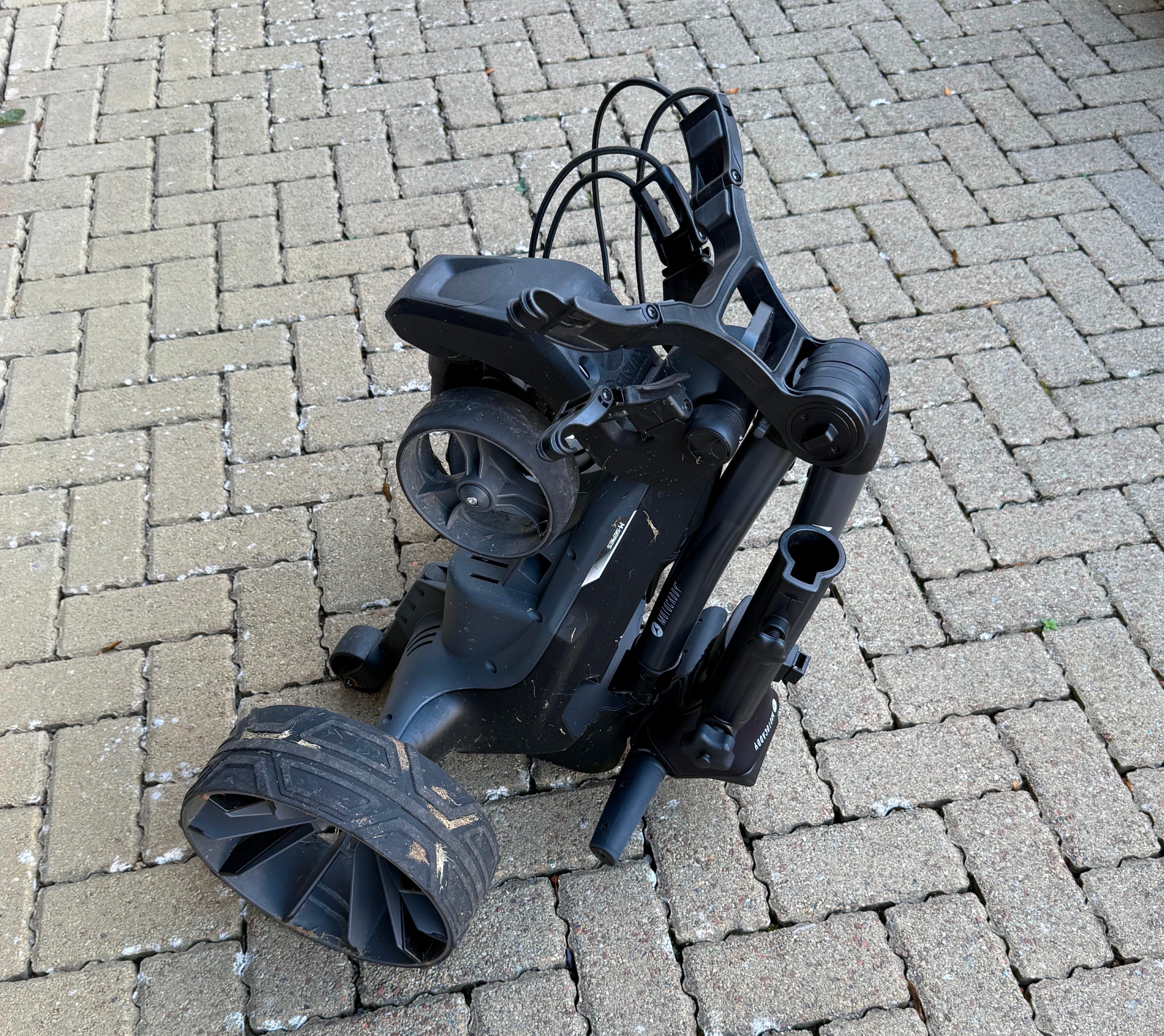
It is still fairly bulky when folded, even with the wheels inverted. The Stewart wins this particular comparison quite comfortably and was much more boot-friendly. The M7 takes up roughly the same amount of space as my old CT6, so it isn’t a major problem for me, but the Stewart’s packaging is undeniably more clever.
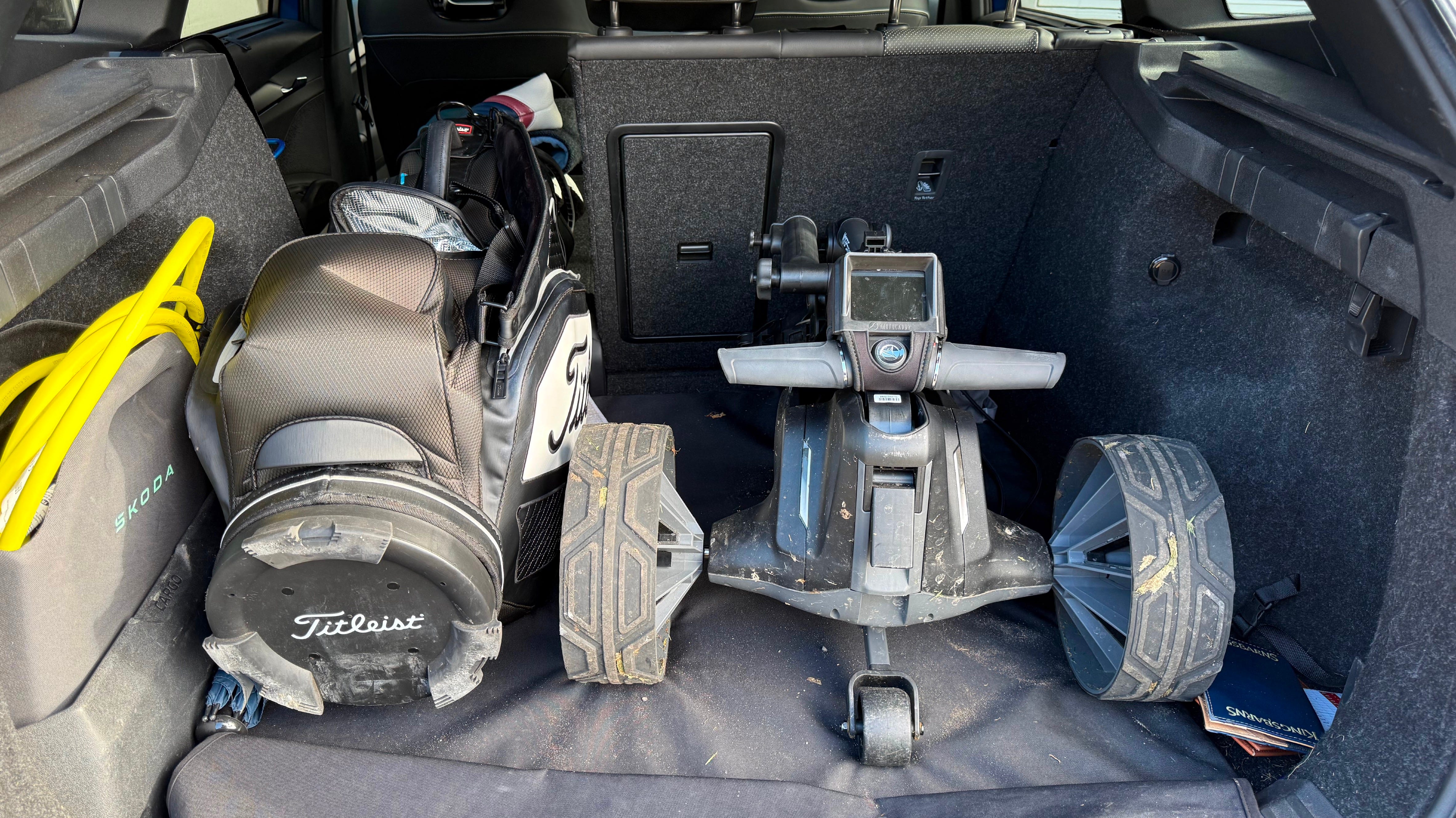
The battery arrangement is much better. Removal is simple, but importantly I don’t have to remove it at all because it can be charged while still fitted to the trolley. The remote is smaller, lighter and easier to hold than the Stewart’s, and it charges using a conventional USB connection. There are also two places on the trolley where I can clip it when I’m not using it.


These aren’t exciting features, but after my experience with the Stewart, I found myself appreciating boring, simple solutions.
On the course
The M7 is extremely smooth and quiet in operation. If anything, it feels slightly more refined when setting off than the Stewart, with less of a jerk as the motors initially engage. The wide rear wheelbase makes it feel planted and secure, and my Titleist bag fits particularly well. I much prefer Motocaddy’s elasticated bungee style attachments over the rubber straps on the Stewart, which never seemed quite as happy with my bag.
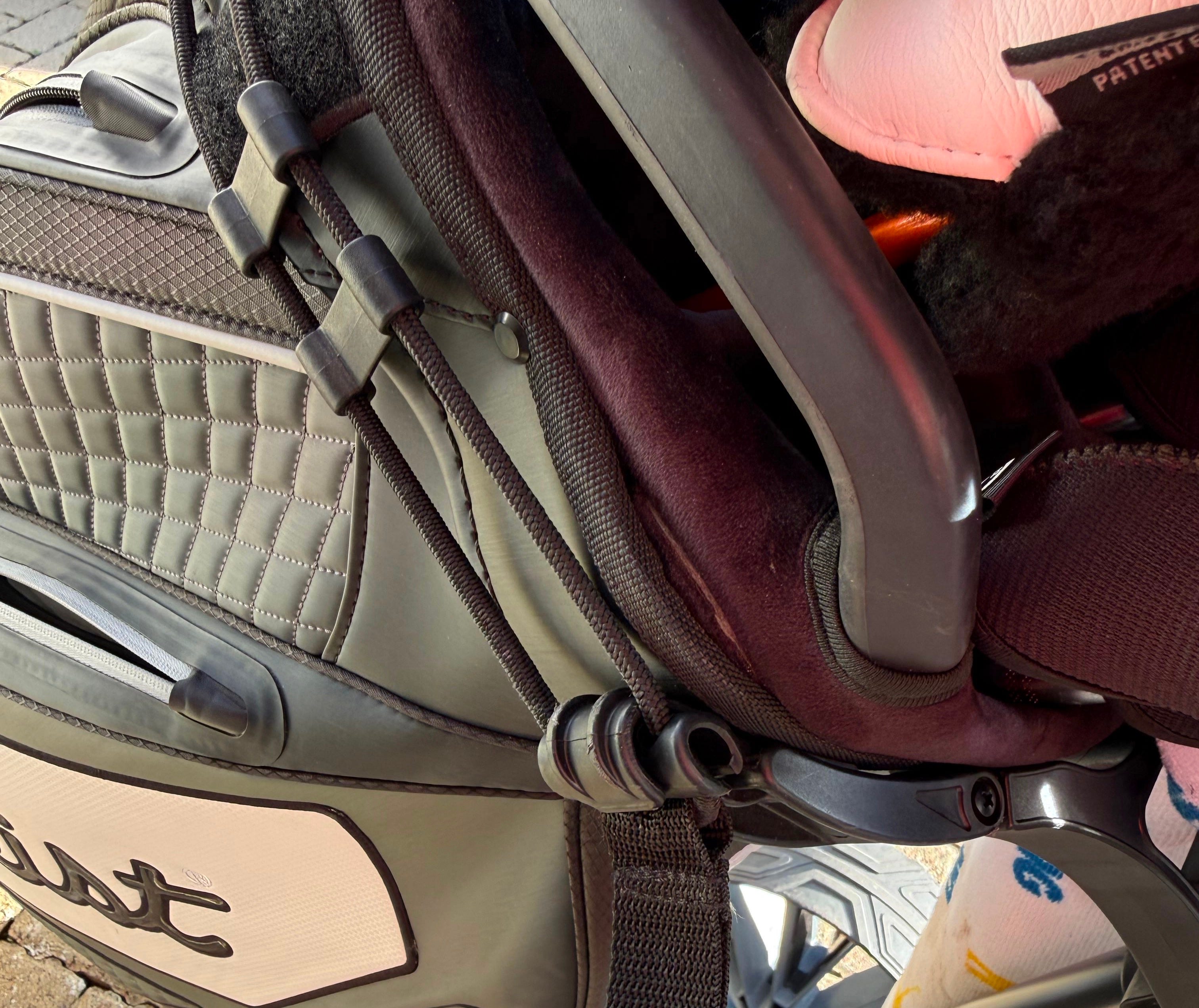
There is, however, one area where I definitely preferred the Stewart: steering and side-slope stability. The M7 has a freely swivelling front wheel, which makes it very manoeuvrable but also means it requires more small corrections to keep it travelling straight. When you make those corrections, it slows down quite noticeably. If the trolley is well ahead of you that isn’t a problem, but there have been plenty of occasions when I’ve found myself catching up to it more quickly than expected while making a series of adjustments.
The difference is even more noticeable on side slopes. The Stewart’s four-wheel chassis was superb here and would track confidently across a side slope. The swivelling front wheel on the M7 naturally wants to turn downhill, so on hillier courses I find myself holding the handle considerably more often than I expected to or having to constantly adjust path with the remote. Given that reducing the amount of reaching and twisting was one of the reasons I went remote in the first place, that’s more than a minor irritation. The fixed wheel of the CT6 was better in this regard.
If I could transplant one major element from the Stewart onto the Motocaddy, it would be the four-wheel chassis.
The GPS I didn’t think I needed
One of the surprises has been how much I like having GPS built in. When I had the Stewart, I used Tangent on my phone and Apple Watch and initially assumed that would be perfectly adequate. In fact, I missed having information permanently visible on the handle more than I expected and ended up buying a phone holder for the Stewart so I could quickly glance at the Tangent information.
The M7’s screen isn’t huge, but it gives me the information I want without dominating the handle or creating another large, vulnerable component. The screen protector is particularly robust, but was an optional extra that I think should be standard. I particularly like the hole flyover and distance bands, which provide useful context rather than simply giving front, middle and back yardages.
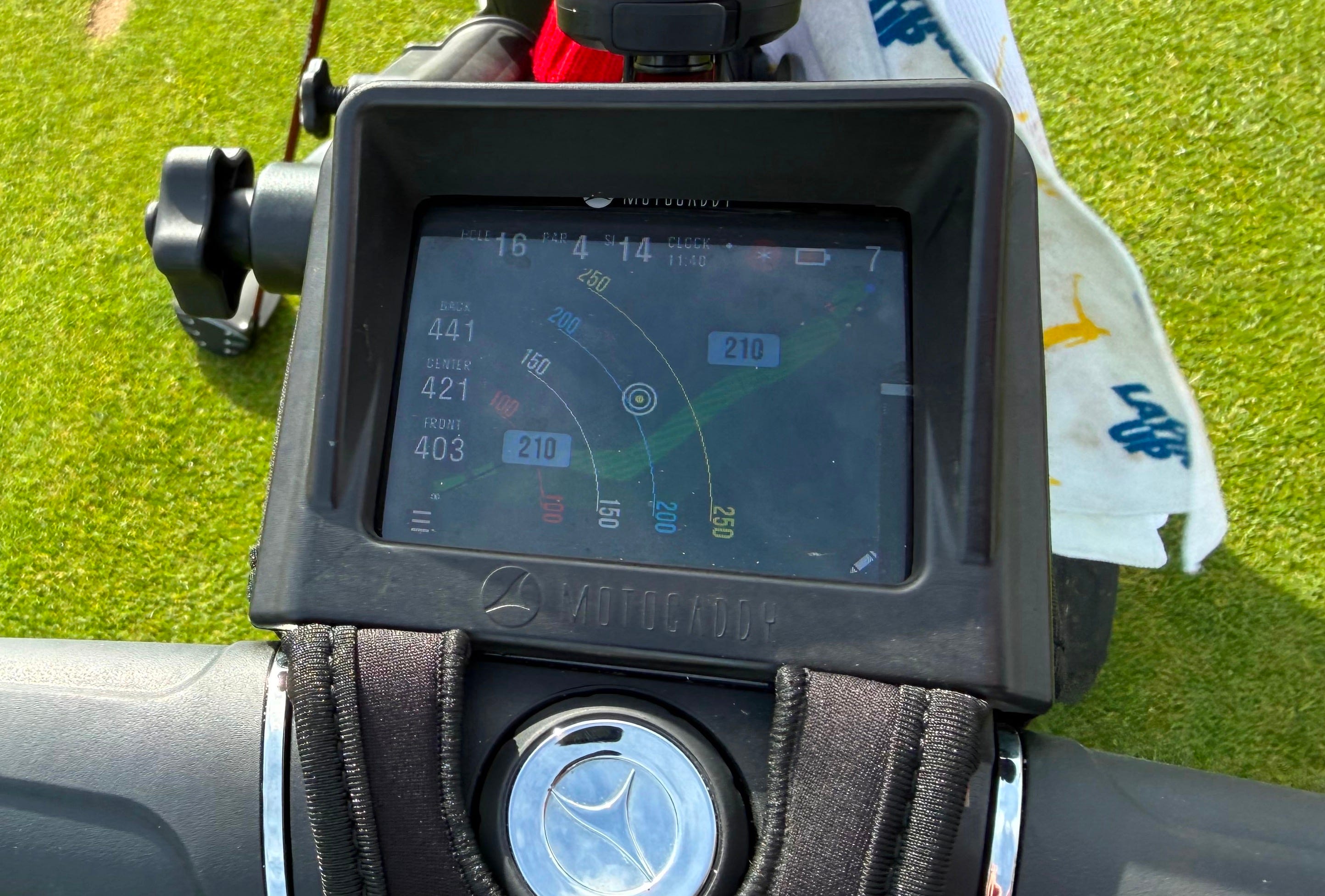
I still use Tangent on my phone and Apple Watch most of the time because I like its wider functionality, but there are occasions when a trolley GPS is simply quicker and more convenient. That’s especially true in winter, when finding an Apple Watch underneath several layers of clothing can be irritating.
A feature on the new model is that it has instructions for administering CPR in an emergency. Hopefully that’s one feature I’ll never have to review properly.
Six weeks with the M7
The M7 hasn’t been with me long enough to draw any long-term reliability conclusions, but after around six weeks it has largely settled into the background, which is what I wanted from a trolley in the first place. The battery has been straightforward to charge, the remote is unobtrusive, and the trolley is extremely easy to erect and fold. I’m noticeably quicker getting ready before a round and packing everything away afterwards.
However, I've had one minor reliability issue. The button that secures the rear stabiliser wheel fell off, leaving the stabiliser bar stuck in position. It didn’t stop me using the trolley, and Motocaddy quickly sent me a replacement part that simply screws into place. It just shouldn’t have happened.


It is interesting to compare my reaction to that with the Stewart battery failure. Both involved relatively small components on expensive products, and neither is something I particularly want to experience. The difference was in the consequence and the resolution. The M7 remained perfectly usable, and getting the replacement part was straightforward. I popped into Auchterlonies, they called Motocaddy and the part arrived within a couple of days. With the Stewart, a similarly small failure affected something fundamental to using the trolley, and resolving it became much more complicated than it should have been.
At slow speeds, the Motocaddy shares one of the Stewart’s weaknesses. It’s heavy and can be awkward to manoeuvre manually, so I often use the remote to help steer it with the powered wheels. Neither is as easy to move around manually as my old CT6 was.
You also need to be slightly careful with the remote. It is small enough to slip easily into a pocket, which is convenient until you accidentally press one of the buttons. I’ve learned to use the clips on the trolley when leaving the trolley at the greenside.
Has going remote actually helped?
I definitely feel less fatigued after golfing, and I like being able to send it ahead while I walk with both arms free. I can stretch my shoulders, change my posture and generally walk naturally. So yes, it has helped.
That doesn’t mean either trolley completely removes the physical interaction. Both are heavy and need some assistance at very low speeds, while the M7’s behaviour on side slopes means I probably reach for its handle more often than I did with the Stewart. Nevertheless, the overall experience is noticeably different from using a conventional electric trolley, and the physical benefit has been significant enough that I wouldn’t willingly go back.
Perhaps the strongest evidence is that when the Stewart went back, I never seriously considered abandoning the idea of a remote trolley. I immediately started looking for another one.
The trolley I’d really like
Having owned both, the frustrating conclusion is that I can see exactly what my ideal remote trolley would look like. I’d take the Stewart’s chassis, its four-wheel stability, excellent performance on slopes and compact folded dimensions. Then I’d add the Motocaddy’s more substantial handle, bag attachment system, battery arrangement, compact remote, conventional charging and GPS display.
That would be a very good trolley indeed.
Unfortunately, I had to choose between the two that actually exist.
Verdict
If the battery clip on my Stewart hadn’t failed, I might still own it. There was a lot I liked about the Q Follow and, purely in terms of how the trolley moved around a golf course, there are things I still think it does better than the M7.
But the clip did fail, and it happened after I’d already started questioning some of the other components, like the handle. The subsequent customer service experience then turned a relatively minor problem into a much bigger ownership concern. Once I’d started wondering what the next failure might be and how difficult it would be to resolve, my confidence in the trolley, and Stewart, had gone.
The Motocaddy isn’t perfect either. I’ve already had a minor component fall off, and it isn’t as good as the Stewart on slopes. It is also still a big, heavy piece of equipment. But I enjoy using it. More importantly, the remote trolley concept itself has delivered what I hoped it would, and the GPS, which I initially regarded as something of an optional extra, has also become a feature I’m very pleased I chose. It adds more value to me than the Follow feature I’ve lost.
Perhaps the biggest lesson from owning these two trolleys isn’t really just about product features. Premium products don’t just have to impress when everything is working. They also have to be easy to live with when something isn’t. While the Stewart impressed me more than I expected, it ultimately made me nervous about owning it longer term. The Motocaddy has its own compromises, but so far I’ve found them easier to live with, and aftercare has been better too.
For something that’s going to accompany me for hundreds of miles around golf courses, that may ultimately matter more than which one has the cleverest technology.
Have you made the move to a remote trolley? I’d be particularly interested to hear from Stewart and Motocaddy owners about how yours has performed over the longer term. Leave a comment below.
And if you enjoy independent golf equipment reviews based on actually living with the gear, rather than simply trying it for a few holes, you can subscribe to The Club House below.