

I have started hitting golf balls again.
Not many. Not violently. Not with anything that looks remotely like abandon.
But still: golf balls.
The first session was deliberately cautious. My ankle was well strapped, and I hit around thirty short-game shots. Mostly short swings and half swings, with no full loading into my lead leg. I was hyper-aware of everything. The ankle. The ground. The movement. The possibility of a twinge.
There were a few.
But it was okay.
That sounds like a small sentence, but it felt like quite a big one.
The second session was a little more ambitious. I spent half the time on short game, then hit fifteen or twenty fuller shots. Again, the ankle held up well. It didn’t feel normal, exactly, but it didn’t feel alarming either.
The problem was that my attention shifted elsewhere.
To my elbow.
That has been grumbling away for more than eighteen months now. I’ve called it tendonitis, because that’s the working assumption, but I’m not completely sure. Is it tendonitis? Is it arthritis? Is it something else? I don’t know.
What I do know is that it is there.
And when I started swinging again, I felt it.
There was a clicking sensation, which I presume is the tendon, and suddenly the ankle wasn’t the only thing I was thinking about. That’s the odd thing about returning from injury. You imagine you are working your way back from one problem, but the body has a habit of reminding you that it works as a whole.
Nothing exists in isolation.
I’ve been doing a lot of gym work during this spell away from the course. Upper body strengthening. Flexibility. Stability. Ankle rehab. Elbow rehab. The usual mixture of sensible exercises that look very minor but are somehow quite tiring when done properly.
I’ve tried to use the time well.
I’ve also finally read both of Fred Shoemaker’s books. That feels relevant, because the biggest idea I took from them was awareness. Not swing theory. Not a new move. Not a secret.
Awareness.
What am I actually doing? What am I feeling? What is my body telling me before I rush past the answer?
That has already been useful. Using a fan swing trainer and doing some slow-motion swings, I started to feel that my elbow discomfort may be made worse by early extension in the downswing. When I slowed everything down and got my wrists into a better position, the discomfort reduced.
That doesn’t mean I’ve solved it.
But it does mean I noticed something.
And maybe that’s the point.
The ankle is more obvious. It swells, it stiffens, it complains. It can be strapped, strengthened and measured. It is easier to understand, even when it is frustrating.
The elbow feels more elusive.
It’s one thing to worry about walking, turning and loading properly on the ankle. It’s another to worry that the basic act of swinging a golf club might keep irritating something that has already been hanging around for far too long.
That’s the bit that concerns me most.
I can see a route back for the ankle. It may be slow, but the path is fairly clear: rehab, strength, stability, orthotics, patience. The elbow feels less certain. And that raises a more uncomfortable question.
What if I can’t play freely?
Not perfectly. I gave up on that idea a long time ago.
But freely.
What if I’m always aware of the next twinge? What if every round becomes a negotiation with pain? What if I get back to the course, but not back to the feeling I actually miss?
Perhaps not quite as much as I expected, which has surprised me. The weather has helped. When it’s cold, wet and miserable, being injured feels slightly less offensive. I’ve also kept myself busy. Reading has helped. Writing has helped. Thinking about golf has helped.
But I do miss it.
I miss being outside. I miss the rhythm of a round. I miss the nonsense talked between shots. I miss the easy adult conversation that comes from walking beside someone for four hours with no particular agenda other than getting a small white ball around a field.
That sounds flippant, but it isn’t.
Golf is one of my main social spaces. It is where I see friends, meet people and have conversations that sit outside the immediate orbit of family life. Losing that, even temporarily, has reminded me that golf is not just a game I play.
It is part of how I live.
Next Monday, I’m due to play my first round back. It won’t be a normal round. It’s part of Caddie School for Service Veterans, a charity helping veterans move into caddying, and I’ll be playing while taking one of the caddies on a training round.
In some ways, that feels like a very fitting return.
It won’t be about score. It can’t be. I’ll need to be careful, measured and sensible. I’ll need to listen to the ankle, listen to the elbow, and resist the temptation to turn one encouraging session into evidence that everything is fixed.
But I’ll also be there for someone else.
That matters. The point of the round isn’t just to test my ankle or ease myself back into golf. It is to help give the caddy a useful training experience, to listen properly, and to be part of their day rather than making the whole thing about mine.
I’ll need to listen to the caddy.
That may be the most important part of the day. Whatever frustrations I’ve had over the last few weeks, and whatever worries I have about an ankle or an elbow, I’ll be walking beside someone whose life experience will almost certainly put my own problems into perspective.
That doesn’t make my concerns disappear.
But it should help put them in their proper place.
There has also been another, more serious, layer to all of this. My physiotherapist has suggested that, in the longer term, I may need to consider stabilisation surgery on the ankle. InternalBrace augmentation of the lateral ligament was the phrase used. In plain English, it was described to me as a kind of seatbelt for the ankle: extra support to help stabilise the joint and reduce the risk of repeated sprains.
I was shocked.
The video of the physio manipulating the ankle makes the issue very clear. Compared with the good ankle, there is far too much movement. Seeing that was quite disturbing. It is one thing to know you have a problem. It is another thing to watch it move around on a screen.
The surgery suggestion makes sense in context. I’ve had repeated sprains over the years. That frequency is one of the reasons I went to the podiatrist in the first place, and why I’ve now been fitted for orthotics.
But I’m not ready to jump to surgery.
Not yet.
My instinct is to explore and exhaust the non-surgical route first. Strengthen the ankle. Use the orthotics. Improve stability. Build better movement patterns. Give the rehab process a proper chance before deciding that the only answer is an operation.
That may change.
But for now, that feels like the right approach.
The strange thing is that this injury has not just interrupted golf. It has deepened thoughts and questions that were already there.
It is tied up with bigger decisions I’ve made about work, time and what I want life to feel like, but this probably isn’t the place to unpack all of that.
In golf terms, I’ve been circling these ideas on The Club House for a while now. I’ve written before about golf, gratitude, awareness and the danger of reducing everything to score.
So the ankle hasn’t created the question.
It has just made it harder to ignore.
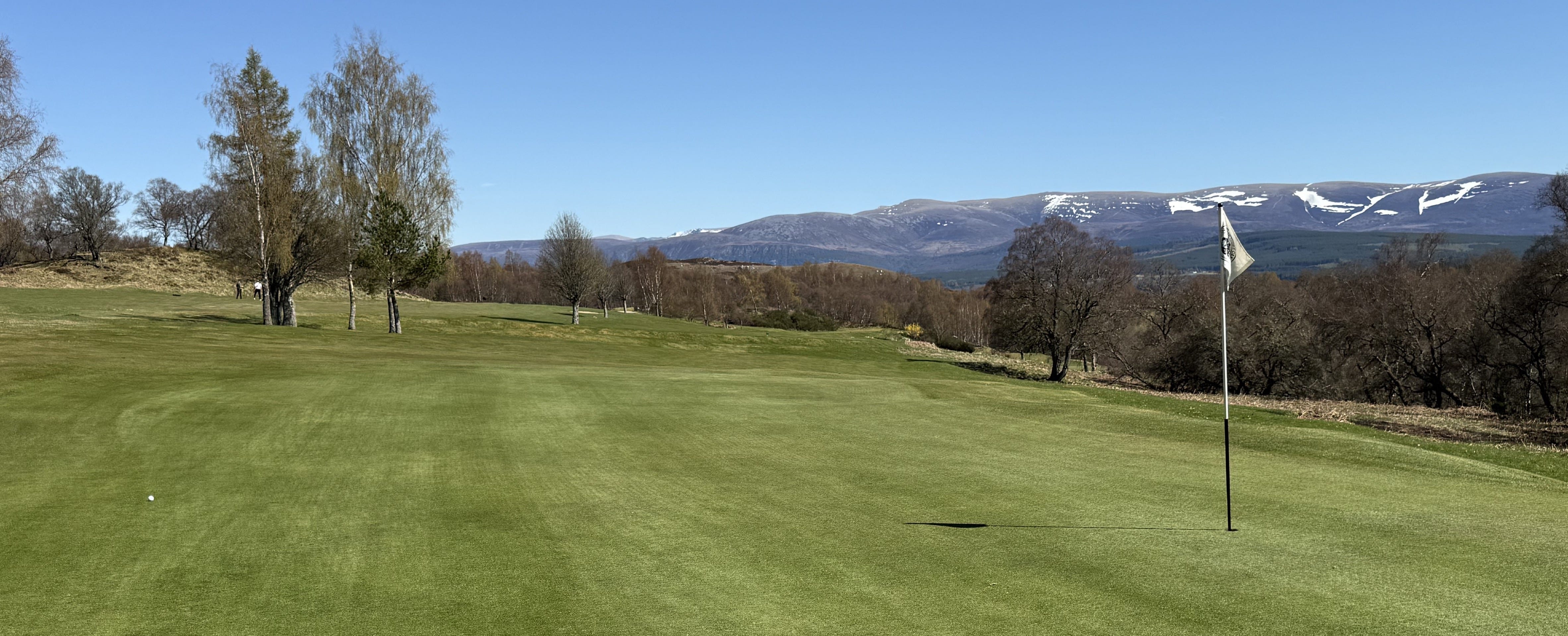
My round at Kingussie was another example. I was in the Highlands to visit a friend and fitted the golf around that, rather than the other way round. For once, the score felt secondary. The peace mattered more. The air mattered more. The views mattered more.
I remember thinking that I couldn’t hit the sky or the mountains.
So why was I in such a rush to reduce everything to yardages, clubs and outcomes?
It wasn’t an epiphany. It was another nudge in the same direction.
That is the version of golf I’m trying to move towards.
Not careless golf. Not passive golf. Not pretending that scores and shots don’t matter at all, because of course they do.
But a version of golf where I’m more aware.
Aware of the body. Aware of the place. Aware of the people I’m with. Aware of the difference between trying properly and forcing things.
That’s easy to write and harder to live.
Especially when the first tee comes back into view.
But maybe that’s the opportunity in all of this. The ankle has forced me to slow down. The elbow has forced me to pay attention. Shoemaker has given me a better language for awareness. And the time away has reminded me that golf is not only something I do when my body is behaving perfectly.
It is something I need to learn how to return to properly.
So next week is not a comeback.
Not really.
It is a measured reintroduction. A careful first step. A chance to see what the body says when theory becomes walking, swinging and playing again.
I want to play.
I want to enjoy it.
But more than that, I want to listen.
Because getting back matters.
Getting back properly matters more.
Final Thoughts
Have you ever had a spell away from golf that changed how you thought about the game when you came back?
I’d genuinely be interested to hear your experiences in the comments.
And if you enjoy these more reflective pieces alongside the equipment reviews, please consider subscribing to The Club House and hitting the like button. It really does help the blog grow.
Further Reading
If you want to follow some of the threads behind this post, these are good places to start:
Thought for post Keith no fun having physical issues especially I think with your elbow you need to someone really credible who can help you get past that there are people like that out there