

There’s a certain kind of comfort to indoor putting, and it’s not emotional. It’s physical.
Sometimes it’s not a preference. It’s the only option. In St Andrews, it’s been such a wet start to the year that even a quick practice session has felt almost impossible. And in my case, I’ve also been recovering from hernia surgery, which puts a fairly obvious limit on what counts as training.
The good news is that all is not lost. If you’ve got space for a putting mat, you can still make real progress. Indoor practice strips putting back to what matters most: a repeatable setup, a face that behaves at impact, and a start line you can trust.
This is my little indoor lab: a PuttOut mat, a mirror, a ruler, and a couple of gates that don’t let you pretend.
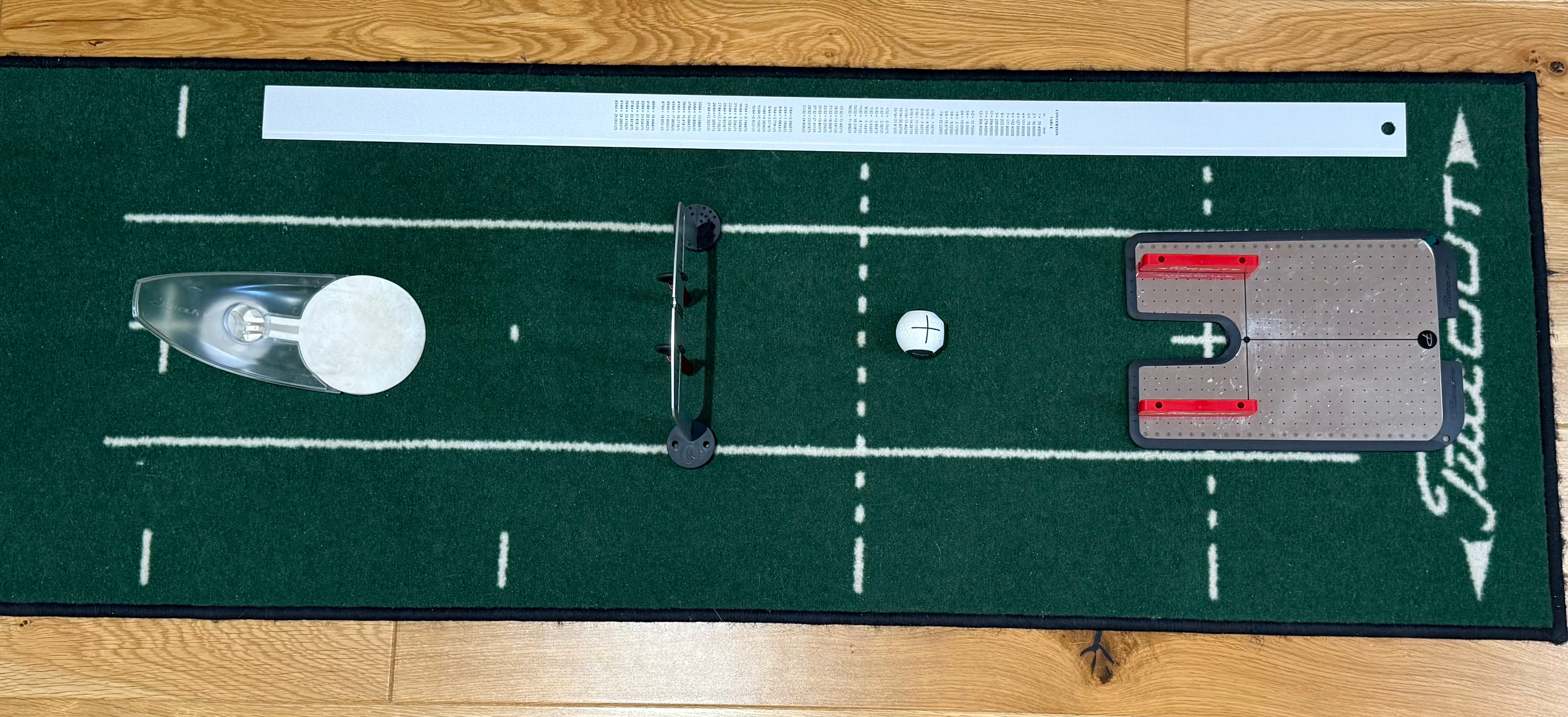
The objective: test vision, path and impact
Putting isn’t one thing. Indoors, I’m mostly testing three: what I see, where the putter travels, and what the face is doing at impact.
If you don’t see the line correctly, your brain does clever things to compensate. You aim somewhere, then subconsciously steer the face. Or you set up square but feel like you’re aimed left, so you “fix” it with your hands.
My indoor practice is mostly about removing that confusion.
Test 1: The ruler and mirror setup check
It’s easy to see a straight line when you’re standing behind the ball. Side on, in your putting posture, it can be much harder. This is where the ruler test is really effective. It’s also a very good test to check if your putter fits you correctly.
I place the ruler on the ground between the ball and the target, but it shouldn’t run all the way. It’s simply a straight reference that my eyes can line up against.
Using a putting mirror for reference, I get into position without a club and adjust my head and body until I see the ruler pointing directly at the target. When it does, I know I’m seeing the line properly. Then I use the mirror to check where the ball sits relative to my eyes. For me, the ball is slightly above my lead eye. That becomes the reference point I try to return to in every practice session.
Once I’m happy, I add the putter into the equation. If you have to adjust position and posture to suit the club, there is a high likelihood that it’s not a good fit. Having done this test in fittings, I know my putter needs to be 33 inches long (or grip down with a 34-inch club) with a lie angle of 72 degrees. I mention gripping down here as the majority of putters I get to test are 34 inches long.
This is a test used by Bruce Rearick, and it’s a variation on one I did at an Odyssey fitting where they laid out several balls in a line towards the target. When I first used the line of balls, it actually looked curved! Different props, same point: your eyes need to agree with the line before you can trust what your stroke is doing.
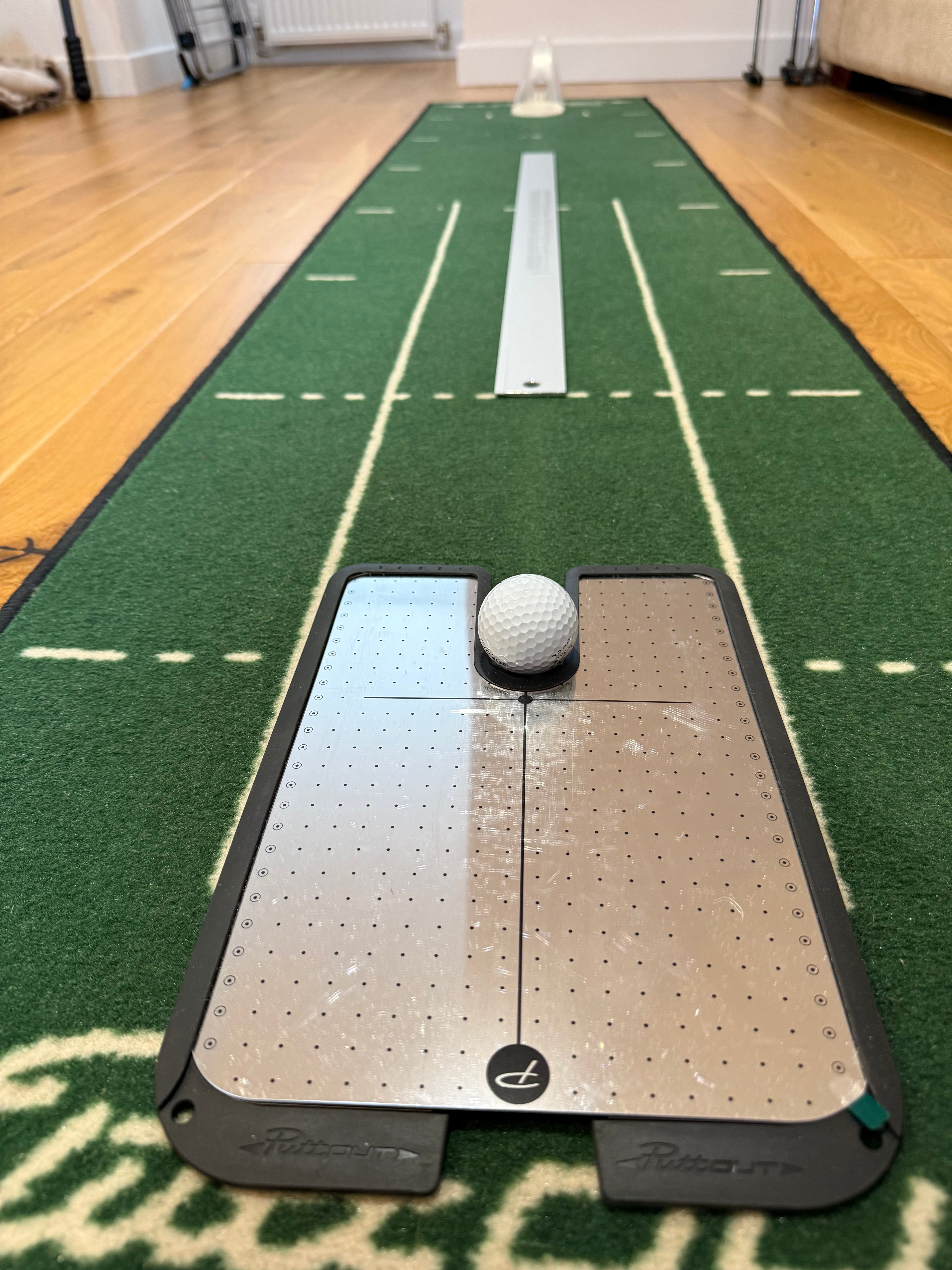
Test 2: The head gate path check
My PuttOut mirror has gates for the putter head, and I set them just wide enough to fit the putter.
This is one of my favourite bits of kit because it’s immediate feedback.
If my path is too far inside or too far outside, I’ll hit the gates. And I don’t need an app, a camera, or a 20-minute debate with myself about whether it was “a good one”.


If I had one issue with the design of the PuttOut gates, it would be that they don’t work quite as well with a heel-shafted putter like a Wilson 8802, as the hosel can catch despite the head being fine. You have to move the gate slightly wider on the hosel side. I’d make the gates slightly less tall, as I’m sure they’d still work just as well.
Test 3: The ball gate face check
The ball gate is the face test. For indoor practice, I’ll start with the gate at 18 inches, then move it out to 3 feet, 4 feet and 5 feet, which makes any face issues show up even more quickly. This 18 inch test is also part of my putter-review protocol.
Again, immediate feedback. If the face is open, I’ll clip the right side of the gate. If it’s closed, I’ll clip the left. If it’s really bad, I might miss the gate (especially when further away).
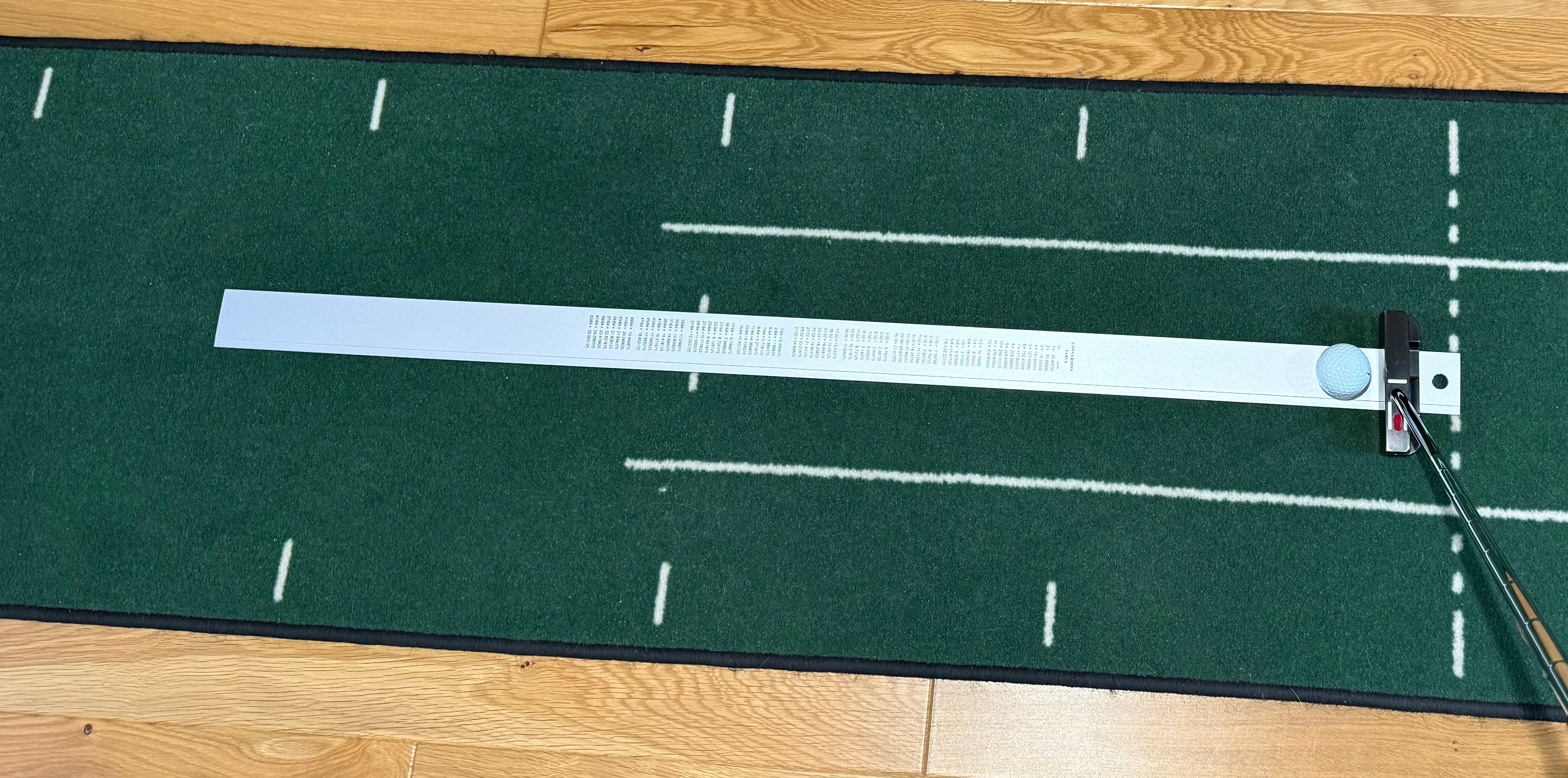
Test 4: The ruler roll start-line check
Putting along a ruler is a simple but revealing test that quickly exposes both path and face angle.
If the face isn’t square at impact, the ball will fall off. If the path isn’t stable, it won’t stay on for long either.
It’s not subtle. It’s either on the ruler or it isn’t.
This drill has a nice side effect too: it pulls your focus away from “making a stroke” and towards “starting the ball on line”. That’s the job.
Test 5: Strike and face check with the Devil Ball
The PuttOut Devil Ball is another tool for assessing face at impact, but with a twist.
You can see it in the first image above. It has a round/easy side and a flat/difficult side. The flat side exaggerates any face issues and makes mishits obvious.
Truth be told, I don’t use this much, or for long sessions, because the difficult side feels overly harsh. I use it more like a spot check. A reminder that when I get lazy with setup or face control, the ball will tell on me instantly.
Test 6: Pace control with the PuttOut Pressure Putt Trainer
Once I’ve done enough start line work, I move to speed.
The PuttOut Pressure Putt Trainer is a great tool because it gives you a clear goal: get the ball to stop in the small hole.
It’s a useful proxy for real putting because pace changes the hole’s “capture” size. Too firm and you’ve made the hole smaller. Too gentle, and the ball never arrives.
What indoor practice is good for, and what it isn’t
Indoor putting practice is good for:
Building a repeatable setup
Training your eyes to see the line consistently
Start line control
Face awareness
Basic pace control
Experimenting without expectations
It’s not great for:
Green reading
Breaking putts (although PuttOut now have their “AirBreak” product that offers this)
Variable pace across different green speeds
The pressure of a four-footer that actually matters (games can never truly replicate the on-course pressure)
But that’s fine. This isn’t meant to replace putting on real greens.
It’s meant to drill a better baseline, so you’re not turning up outdoors with a setup that changes depending on mood, confidence, or how your back feels that day.
What I like most about my indoor lab
When I’m putting badly, I can stop and rebuild quickly. Ruler. Mirror. Ball position. Eye line. Back to square one, but in a good way.
And when I’m putting well, I’m not tempted to “tweak” anything. I just keep returning to the same picture.
Final thoughts
If you’re stuck indoors because the weather is relentless, or because life has temporarily taken proper practice off the table, this is one of the simplest ways I know to keep moving forward. A mat, a few alignment tools, and a bit of patience will get you a lot further than you’d think.
If you do any indoor putting practice, I’d love to hear what your go-to drill is, and what tools (if any) actually made a difference for you. Comments are open.
And if you’re new here, consider subscribing. Most of my writing sits at the intersection of putting, equipment testing, and the mental game, from the perspective of a normal golfer who likes trying new ideas and keeping what works.
Probably my most used putting aid is a steel meter rule - looks like yours in the picture although mine may be a little narrower at 28mm wide. Like you say it's great for working on your face angle / start line, it sits leaning on the wall next to me in the office and I often spend 5 mins at a time between meetings (honestly I wouldn't do it while on a conference call) rolling balls down it at different speeds.
I also use a Visio Mi Putting Template to check my putter path and face rotation / alignment that I use with a set of gates for start line. Little and often seems to be the key with these.
For practice putting at home I have an ExPutt simulator which is surprisingly good for working on your pace (5-50') when you can't get to an actual green. It also shows you putter path and face angle, although I try not to get too obsessed about them.
Thanks Colin, I've been thinking about getting a Visio template and notice that WellPutt do a version too. I agree that little and often is the way to go and with an indoor setup it's easy to do 5 mins now when you can.