

I am writing this on Friday afternoon with my left foot in a medical boot. Not exactly where I expected to be!
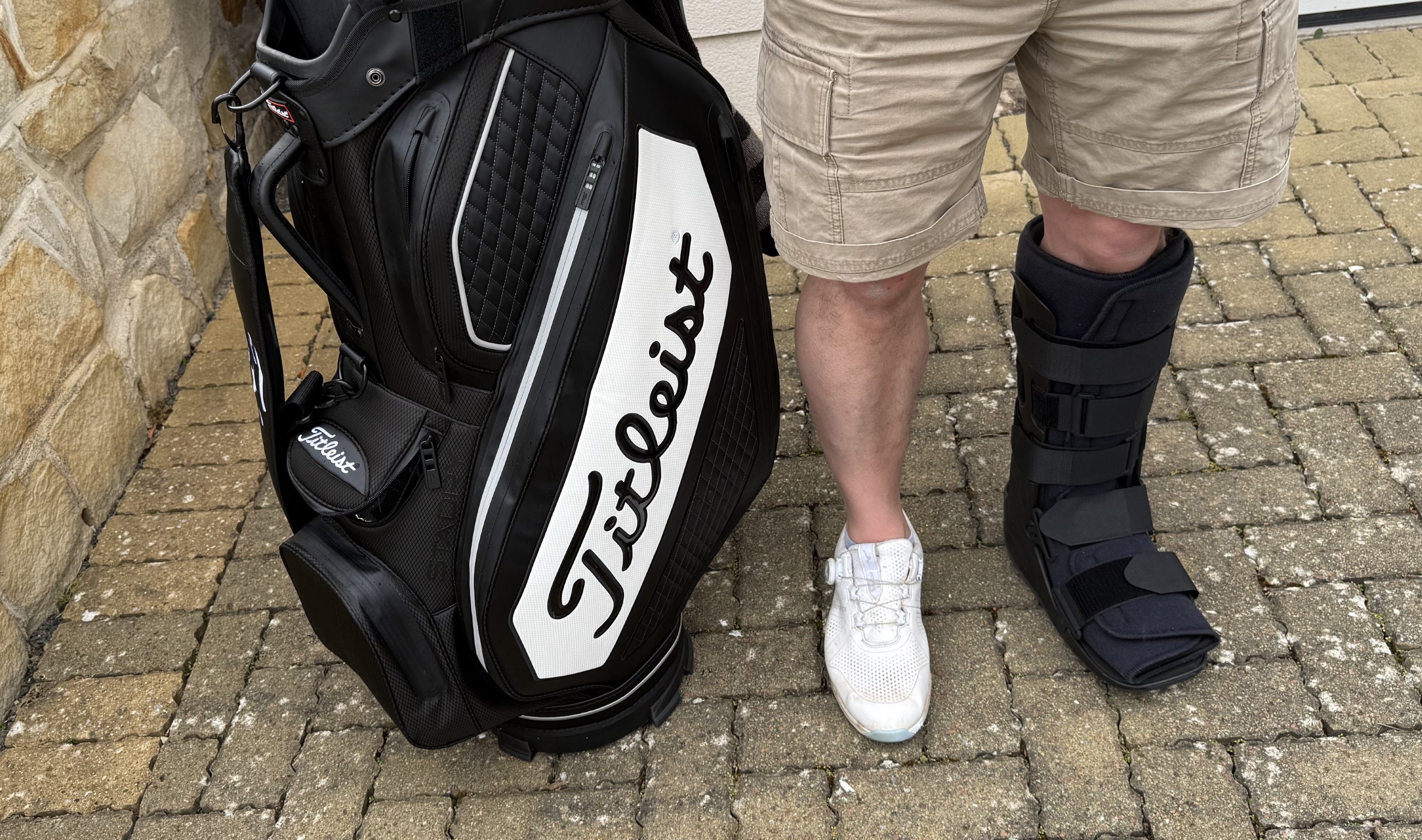
It has been exactly a week since I tripped on a tree root and rolled my ankle. The nurse thinks the X-ray shows a break, but we’re waiting to hear back from radiology.
So I am in that slightly ridiculous holding pattern where I don’t quite know what I am dealing with, but I am already trying to plan around it.
I am also trying to be a good Stoic about the whole thing. Accept what has happened. Notice the frustration without feeding it too much.
Some moments are better than others.
When can I train? When can I play golf? How much of the season will I miss? What happens to the driver fitting follow-up blog pieces I’d planned?
Sensible questions, perhaps.
But underneath them are the less useful ones.
How stupid was that? Why did I not watch where I was going? Is this just part of getting older? Why does one small accident suddenly make me feel so helpless?
The boot itself doesn’t help.
It creates a height difference that makes me walk like a pirate. Stairs are awkward, but sleeping with it on is worse. The same boot that is outside on pavements and grass is then meant to come into bed with me.
My wife is, understandably, not thrilled by this arrangement.
There is probably a philosophical point in there somewhere.
I’m not sure I’ve found it yet.
Mostly, though, it is just irritating.
It is also a constant reminder of my own stupidity. The roll happened last Friday night, after playing golf at Kingussie Golf Club. I was out at The Dell in Nethy Bridge; it had been a great day, and I had enjoyed a few beers.
That detail feels relevant.
At first, I assumed it was just a sprain. I followed the RICE protocol on Saturday, and by Sunday, it felt much better. Over the next few days, it continued to improve. Not completely, but enough to make me think I had probably got away with it.
By Wednesday, I even did a gym session with it strapped up. Nothing heroic. Nothing stupid, or at least nothing that felt stupid at the time. Recovery seemed to be on track, and light exercise should have been fine.
However, there was still some tenderness and swelling around the bone and an odd tingle in my small toe.
That is the sort of detail you can either take seriously or explain away in your head. I did a bit of both. Eventually, on Thursday, I went to the minor injuries clinic. They were concerned there might be a break, so I was sent for an X-ray.
That was the moment the story changed.
Until then, I thought I had just sprained my ankle. Annoying, yes. Poor timing, definitely. But still minor.
After the X-ray, it became something else.
Likely a small fracture, but radiology will confirm.
Not dramatic. Not catastrophic. Just enough to stop me in my tracks.
And that is what made it more frustrating. This didn’t happen because I had been pushing too hard in the gym, ignoring advice, or trying to prove something. In fact, the opposite is true. I had recently started back at the gym after hernia surgery, working under the supervision of a trainer. I was also working with my physio and had only recently returned to playing golf unrestricted.
Typical sensible me.
Not rushing. Following the protocol. Trying to build things properly.
The whole point was to understand my physical limitations and put a plan in place to address them. Rotation. Hips. Glutes. Strength. All of it was golf-specific, but not in a superficial way. This wasn’t about trying to hit the ball ten yards further by next Tuesday. It was about building a better foundation.
Not just to play better now, but to keep playing for the next twenty years or more.
That was the real motivation.
The injury and rehab journey actually started with elbow tendinosis. Working with my physio and gym instructor, I wanted to investigate my general biomechanics. Was the elbow the real problem, or was it simply where the problem had shown up?
That led to an assessment with a podiatrist and gait specialist, which highlighted issues with my feet and ankle stability. The suggestion was that my body had been compensating for that instability for years. Is it a cause of, or result of, also having mild scoliosis? One of the more interesting findings was that I have developed very large and strong calf muscles, almost as if they had been doing work that other parts of the system should have been sharing.
The recommendation was that I should get orthotic insoles.
That made sense when I thought about it.
Historically, when I walk, I almost fall forward. I am heavy on my heels. I often catch the ground early (like hitting the ball fat) and almost stumble. I have frequently tripped over my own feet, fallen off kerbs, or rolled my ankles.
None of that felt especially connected at the time.
It was just how I moved.
But that is the thing about long-standing habits. They stop feeling like habits. They just become “me”.
The theory is that the instability in my feet has knock-on implications for my golf swing. If the base is unstable, everything above it has to respond. For me, that may mean a less stable follow-through and poorer rotation. If the upper legs and glutes are weaker than they should be, the arms start doing too much. That, in turn, may have contributed to the tendinosis.
I am careful with the word “may”, because bodies are complicated and I don’t want to pretend this is neater than it is. It’s a working theory.
But the pattern is hard to ignore.
Feet and ankles. Calves. Glutes. Hips. Rotation. Back. Arms. Elbow.
Last year, protecting my elbow may have contributed to back problems. This winter, I had a second inguinal hernia. Now my ankle.
It would be too easy to draw one clean line through all of that and say: this caused that, which caused that, which caused that.
Life is rarely that tidy.
Still, I do think there is something here. Not a diagnosis. Not a theory for anyone else. Just a personal observation.
This isn’t one injury.
It is a pattern of adaptation.
That is what I find interesting. The body is extremely good at finding a way. If one part is weak, another part helps. If something is unstable, something else tightens. If movement is uncomfortable, the body alters the route. At first, that is useful. It keeps you going.
But what if the workaround becomes the problem?
For years, I have probably been moving in ways that allowed me to function reasonably well. I could play golf. I could walk. I could train. I could get through normal life without thinking too much about how my feet hit the ground or whether my glutes were doing their fair share.
Then, after the gait assessment, I started wearing my new orthotics.
Suddenly, the assumptions changed.
It feels as though my body is being asked to stand and move differently, and it’s taking time to recalibrate. My posture is better. My stability and balance in the gym are better. I don’t feel like I want to fall forward in my golf swing. My walking has improved, and I don’t have the old heavy heel pattern.
But the first time I used them for golf, I could barely make contact with the ball.
That was not ideal.
It was also quite revealing. Change the feet, and the swing changes. Change the foundation, and the old compensations no longer work in quite the same way. The body has to renegotiate. I almost have to learn to swing again.
In theory, that is exactly what I wanted.
In practice, it is uncomfortable.
Not just physically, although there is plenty of that. It is uncomfortable because it challenges the story I had about myself. I thought I was just a fairly normal middle-aged golfer trying to get a bit fitter, move a bit better, and protect his body for the years ahead.
Which is true.
But I am also someone who has spent years working around weaknesses without really knowing it. Someone who can be careful and still get it wrong. Someone who can follow the plan and still trip over a tree root after a few beers.
That last bit is annoying.
There is a temptation to see this ankle injury as a setback. In some ways, it is. The timing is poor. The boot is irritating. The stairs are awkward. The gym work will need to be adjusted. Golf will have to wait.
But I have to look at this differently.
It has made the whole body compensation thing harder to ignore.
The X-ray hasn’t yet given me a clear answer about the ankle, but it has forced a wider question: what else have I been walking around with, thinking it was just normal?
We often think change starts with effort. Train harder. Stretch more. Get stronger. Be more disciplined. There is truth in that, but maybe sometimes change starts with noticing. Noticing how you stand. How you walk. How your body compensates. How one small weakness can quietly become a whole way of moving.
For me, this began as an attempt to understand and improve my golf biomechanics.
It has become a little more than that.
I was trying to fix how I move so I could swing better, train better, and hopefully keep playing for another few decades. Instead, I have ended up in a boot, moving worse for a while, and being forced to pay attention to things I should probably have noticed years ago.
That feels about right.
Progress rarely announces itself as progress at the time. Sometimes it looks like a sensible plan. Sometimes it looks like frustration. Sometimes it looks like a dirty medical boot that you somehow have to sleep in.
For now, I am trying not to overstate the lesson.
I rolled my ankle. I may have fractured it. I had been drinking. I was unlucky, but not entirely innocent.
I also feel frustrated, stupid, old and oddly helpless, which is probably a fairly normal response to being stopped by something so small.
Still, beneath the obvious story, there is another one.
The body remembers the compromises we ask it to make. Eventually, it asks us to account for them.
If you’ve been through something similar, I’d be interested to hear how you approached it.
I’ll write more as I work out what this actually means in practice. If you’d like to follow the rehab, the golf, and the lessons learned along the way, please consider subscribing below.
Darn!! Get well soon Keith!!!!!