

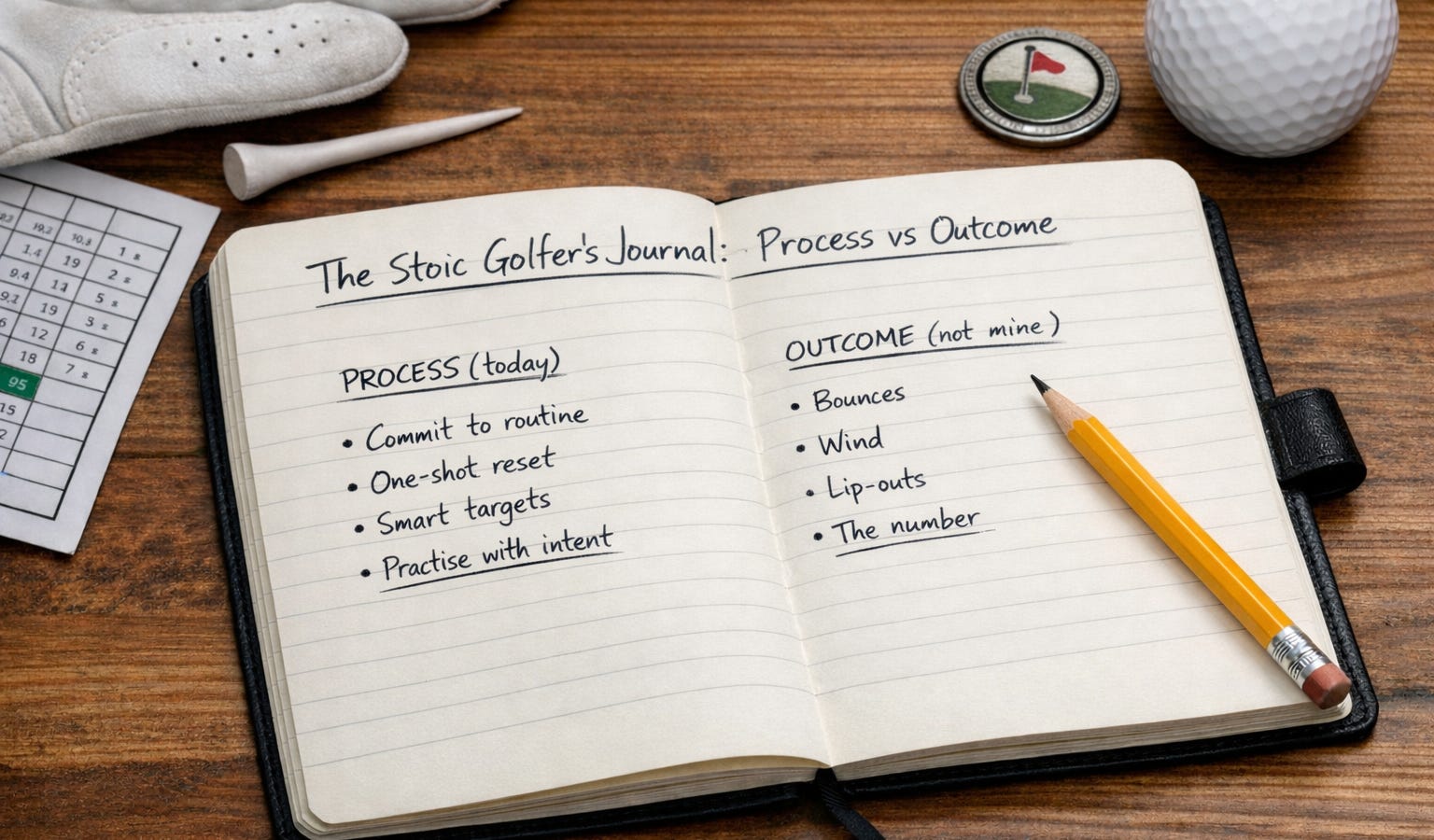
Having re-written The Golfing Stoic, it got me thinking about an older post I wrote about my golfing goals. Whether those goals actually fit together or whether they quietly fight each other. So I decided to revisit it through a Stoic lens.
In the original version of this post (back on my old site), I set a seriously ambitious target: qualify for a Senior Open by the time I’m 60. Why so ambitious? It came down to two things. Reading Vision 54, by Pia Nilsson and Lynn Marriot and an interesting comment Bob Rotella made in Make Your Next Shot Your Best Shot.
Vision54 is the idea that if the golf course has a par of 72, then 54 is the score you would make if you birdied every hole. Many of us have birdied every hole on our home course, so why can’t we do it in the same round? Big on ambition. Dr Bob argued that Tiger Woods wasn’t ambitious enough when he said he wanted to beat Jack Nicklaus’s record of 18 major wins and that he “should” have said he wanted to beat it by 10 or 20. Not because anyone expects that outcome, but because the size of the target changes the way you think, how you commit, and the standard you hold yourself to. Jack still holds the record.
Those ideas stuck with me. The Senior Open isn’t a prediction; it’s a deliberate stretch target. One that forces me to get serious about the things I can control: practice, fitness, better decisions, and getting comfortable under pressure… without turning every round into a progress report.
But when I re-read that original note, I spotted something telling. There were a few “even if I don’t…” clauses. A few consolation prizes. It was as if I were preparing my excuses before I’d even started.
So let’s ask the question properly:
Do goals help… or do they quietly hurt?
Where goals can go wrong
The problem isn’t ambition. The problem is attachment.
This is where the Stoic angle stops being philosophical and starts being practical. Golf is a live demonstration of what you control and what you don’t. I can control preparation, intention, decisions, effort, and response. I cannot control the bounce, the wind, the lie I get in a bunker, or whether a ball decides it’s scared of the dark and lips out at the last moment.
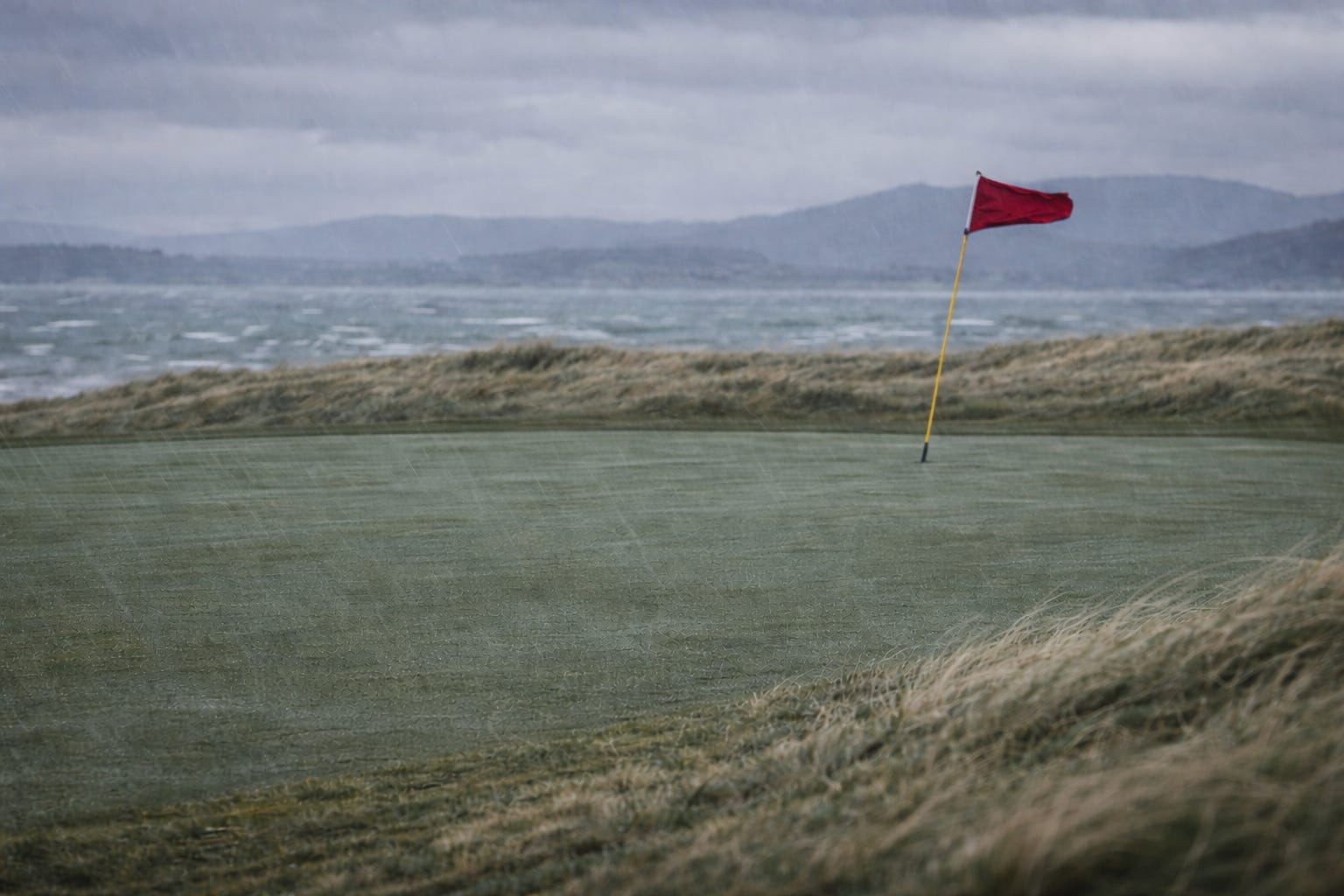
When a goal drags me into the uncontrollables, it can actually become demotivating and turn into emotional quicksand.
The score is information.
The story I attach to it is optional.
That’s the subtle way goals can start hurting: the ego turns every round into a verdict.
Results goals vs process goals
I still find the classic split useful:
Results goals
Specific, measurable, time-bound
Outcome-based
Binary (you either do, or you don’t)
Process goals
Action-based and repeatable
The inputs that create the results
Mostly controllable
The work you can actually do on a Tuesday in February
Results goals can be an excellent compass. But day-to-day, golf rewards loyalty to the process, because the process lives almost entirely on the controllable side of the line.
Outcome as direction.
Process as daily practice.
The intermediate goals
Here’s the structure I’m using. Not to turn golf into a spreadsheet, but to stop a big target from becoming a vague, stressful idea floating above my head.
Results goal 1: cut my WHS index meaningfully (low single digits → lower)
Easy on paper, but in practice, it’s where patience and ego go to fight in the car park.
Controllable today: preparation and decisions.
Uncontrollable today: the number I walk off with.
Process goals
Daily mobility + strength work (flexibility, stamina, resilience)
Putting practice (always)
Regular distance calibration (carry numbers I can trust)
Proximity work with approach shots (where Tangent data shows the most upside)
Short game reps to improve scrambling
Chase speed carefully — without letting accuracy (or my body) collapse
Course management: fewer disasters
Self-management: better decisions under stress (remember, I’m a Stoic!)
Love the process (because if I don’t, what’s the point?)
The handicap is the scoreboard.
The process is the actual game.
Results goal 2: get comfortable with competitive golf
I’ve learned this the slow way: being “good at golf” and being “good at competitive golf” aren’t quite the same thing.
This also links to something else I’ve been thinking about lately: why do I actually play golf? The more I think about it, the more I believe it’s about (self)mastery rather than winning. Winning is the clean, measurable outcome. The indicator that something has improved. But it isn’t the point. And crucially, it isn’t fully in my control.
Competition matters because it’s the most honest environment I can put myself in. It strips away the comfortable narratives (good swing on the range, decent score on a quiet Tuesday) and tests what holds up when there’s something on the line. Looking at my scoring record, competition play is definitely an area that needs improvement.
Controllable today: reps under pressure, preparation, decision making.
Uncontrollable today: the leaderboard.
Process goals
Play more competitions (there’s no shortcut here)
Be more organised about entry deadlines (it’s not rocket science, Keith!)
Add pressure to casual rounds by submitting general play scores (and adding in friendly competitions with partners)
Treat results as feedback, not identity (as any good Stoic should)
Competition is where theory becomes practice — and in practice, theory doesn’t always work.
Results goal 3: reach scratch (or better)
This is the first “gate” I can’t really dodge. Without getting to scratch, or better, I’m unlikely to get into a qualifying competition in the first place. There are a huge number of excellent senior golfers out there, and whatever romantic story I tell myself about the Senior Open, the admin reality is simple: you need the number.
It’s also the point where improvement stops being vague and starts being brutally specific.
Scratch isn’t a feeling or an ego badge. It’s evidence.
Controllable today: the inputs; practice quality, physical work, smart decisions, and competing regularly.
Uncontrollable today: how quickly the number moves.
Process goals
Repeat (and refine) everything above
Play as many age-category Opens as possible to build competitive experience across different courses and conditions
Keep the focus on controllables when the handicap plateaus (because it will, and maybe it already has!)
Scratch isn’t the destination. It’s the entry requirement.
Results goal 4: play in a Senior Open qualifier
This is the “put up or shut up” stage. It’s not about qualifying for the Senior Open (yet), but earning the right to tee it up in a qualifier and see what that environment actually feels like. It’s one thing to have a tidy plan on paper; it’s another to stand on the 1st tee where the standard is obvious, the margins are thin, and nobody cares about your backstory.
It’s also where the whole structure gets tested. If the earlier goals are the training, this is the exam.
Controllable today: preparation, logistics, routines, and my response when it gets uncomfortable.
Uncontrollable today: the draw, conditions, course setup, and whether the golf gods decide to smile on me.
Process goals
Treat the build-up like a project: practice plan, fitness, recovery, schedule
Keep competing beforehand so “nerves” aren’t a surprise guest
Play the round in front of me, not the round I hope to have (should be the basis of how I play all my rounds)
The goal isn’t to feel ready. It’s to show up anyway.
Results goal 5: keep playing well into old age
This one sounds sentimental, but it might actually be the most serious goal of the lot.
If I’m brutally honest, the thing I’m really trying to avoid isn’t a missed cut, it’s the slow drift into “I used to…” golf. The gradual narrowing of what my body can do, what my mind tolerates, and what my game can sustain… until one day I’m basically out for a walk with occasional interruptions. My recent struggles with tendonitis have really brought this home.
I want the next two decades (at least) to be purposeful: staying strong, staying mobile, staying curious, staying competitive (in whatever form that takes). Age will take what it takes, but I don’t have to make it easy.
And here’s the slightly counter-intuitive part: if I get this one right, it buys me freedom elsewhere. If I’m still strong, still mobile, still improving, then “qualify by 60” stops being a cliff edge. It becomes a direction of travel, and I can extend the timeline without letting my ego rebrand it as “giving up”.
That doesn’t mean I’m about to go full tour-pro recovery mode either. I’m not rushing out to buy a hyperbaric chamber for the garage. But I am taking the unglamorous stuff seriously, because it’s the foundation for everything else.
I take inspiration from a former club champion at The New Golf Club. He won the scratch championship at 65 and is still playing off +2 at age 67. That’s the sort of example that really matters to me because it proves what’s possible if you keep the right habits in place.
Controllable today: strength, mobility, recovery, practice habits, and how I choose to engage with the game.
Uncontrollable today: time and biology (annoyingly consistent performers).
Process goals
Keep the mobility and strength work as non-negotiable
Prioritise recovery as much as practice (because I’m not 25)
Keep competing in some form to maintain sharpness and perspective
Protect enjoyment — if it becomes joyless, the whole thing collapses
The real win is still being able to play, and still caring enough to try.
Monitoring progress without becoming a hostage to it
Handicap is the obvious benchmark, and also a dangerous one, because it encourages the illusion that the number is fully “mine”.
It isn’t.
I can influence outcomes, but I can’t control them. And this is where the Stoic lens helps me use data properly and keeps the ego from hijacking the whole project.
Because if I’m not careful, the tracking turns into a different game entirely: not “how do I get better?”, but “am I good yet?” The ego loves that question. It turns every update into a verdict, every bad round into a crisis, and every good round into a brief hit of validation.
And that’s where you can quietly stop playing golf.
It’s still golf in the literal sense, with clubs, a ball and a scorecard, but the fun drains out of it. It becomes a self-assessment exercise disguised as a game. I’m not playing for money, but I am playing with a target in mind, and that’s where it risks becoming a negative cycle: the target drives the focus, the focus drives the pressure, and the pressure starts to squeeze out the very thing that makes you want to play this game in the first place.
So I try to keep it simple:
Used well, stats are feedback: what should I practise next?
Used badly, stats become ammunition for self-flagellation.
I’ve been using Tangent Golf for the last couple of years. It tracks my rounds in the background, keeps me honest and ties my performance back to specific practice recommendations. For me, that’s the point of tracking: support the process, keep me focused on controllables, and stop the ego from turning golf into an identity check.
The mental side (because it always shows up anyway)
Improvement from “decent” to “really good” isn’t linear. Early gains can come quickly, then you hit the phase where every fraction costs more. Progress slows, expectations don’t, and that’s where frustration sneaks in.
A reader picked up on this when I wrote my 2025 golf year-in-review and asked how I reconcile plateaus with progress. It’s a good question! On a plateau, it can feel like nothing is happening, even when the work is being done. The swing might be better, the decisions might be better, the preparation might be better… and the scores still refuse to cooperate for a while.
And that’s before the head gets involved.
The most useful thing I’ve learned from leaning into Stoic ideas is this: most rounds don’t unravel because of one bad swing; they unravel because I keep replaying it while I’m standing over the next ball. Golf punishes rumination and rewards attention.
The mistake isn’t the mistake. It’s the reaction.
The shot is in the past.
The response is still mine.
This is also where big goals can quietly do damage. They shrink the “space” between what happens and how I respond. Suddenly, every shot feels connected to something larger: the handicap, the plan, the identity. That’s when you stop playing the shot in front of you and start playing the story in your head.
One thing I’ve noticed recently is how much more open professional golfers have become about their own struggles with the mental game. That’s reassuring. Not because it offers a magic fix, but because it normalises it. If players at the highest level still wrestle with confidence, attention, expectation, and emotional control, then it’s clearly not a “me problem”. It’s golf. Actually, it’s life!
Voltaire unintentionally summed up golf well when he said:
“Madness is to think of too many things in succession too fast, or of one thing too exclusively.” — Voltaire
The practical answer (for me) isn’t mystical. It’s noticing when the mind has left the present, and bringing it back, again and again. One swing. One decision. One reset.
Could these goals still be unhelpful?
Absolutely.
There’s a version of this where I get obsessed with outcomes, lose enjoyment, and turn golf into a joyless project. I’ve been on that road a couple of times. You can chase improvement so hard you stop noticing you’re meant to be enjoying the chase.
So the difference-maker isn’t the size of the goal. It’s the relationship I have with it.
If the Senior Open becomes an identity thing, a way to prove something, or a way to keep score of my own worth, then it’s already missed the point. And ironically, that mindset is usually the quickest route to playing worse, not better.
But if it stays what it’s meant to be, a stretch target that points me towards better habits, then it remains useful. Aim for Mars and be happy to hit the Moon. That’s the Rotella idea from the introduction in a nutshell: the lofty goal isn’t about predicting the future; it’s about organising the present.
It keeps me honest about the work: practise with intent, look after my body, play more competitive golf, make smarter decisions, and (hardest of all) respond better when things don’t go my way.
In that sense, it’s less “I must do this by 60” and more “this is the standard I’m trying to live up to”.
The goal is the direction.
The process is the point.
And I take a bit of inspiration from how elite players approach it. Not the outcomes, the mindset. They reassess, commit, do the work, accept the cost, and repeat. No drama, no mythology. Just process. As Hogan said, “the secret is in the dirt”.
Final thought
I’m naturally conservative, and I’m not especially drawn to declaring ambitions on the internet. But a goal only stays alive if you treat it like it matters, and if you’re honest about the ways it can quietly go wrong.
I recently read a line in a Substack post by Charlie Garcia that struck a chord:
“Even people who understand the madness, who can describe it in meticulous detail, who warn against it, are not immune.”
That’s basically the warning label for this entire post. I can talk about process goals, Stoicism, controlling the controllables, and not letting ego take the wheel… and still find myself getting tense over a number on a card. Knowing the trap doesn’t mean you never step in it.
So here it is: I’m aiming high, but trying to hold the ambition lightly. If the Senior Open target helps me practise better, move better, compete more, and enjoy the game for longer, it’s doing its job. If it starts squeezing the fun out of golf, I’ve drifted from “playing” to “proving”.
If you’ve ever wrestled with that tension, goals as fuel vs goals as pressure, I’d genuinely like to hear what’s worked for you.
If you enjoyed this post, then please subscribe to The Club House for more posts on golf, gear, practice, and the mental side of the game.
And if you know someone who lives in the tension between “chasing better” and “actually enjoying golf”, feel free to share it. If that describes you, then please leave a comment below!
On the eve of the Winter Olympics, this post actually reminds me of Eddie the Eagle and his ambition to be the first Brit to compete in the ski jump. Big goals! https://en.wikipedia.org/wiki/Eddie_the_Eagle
I struggle with tracking statistics that become a way to beat myself up for not playing well. One goal this year is to use statistics as a way to focus practice, not as a way to think about the game on the course. Think about the game as simply hitting shots and staying focused mentally.